
AC-gekoppelter Hybridwechselrichter für den Heimgebrauch: Generator + Solarenergie für echte Energiesicherheit
Nach Hauptquartier
2026.04.15Verwandte Beiträge

Niederspannungsbatterie Schnellreaktion: Anpassung der Dynamik des Solarinverters in Echtzeit
April 24, 2026

220V Solarwechselrichter mit WLAN – Jenseits der Überwachung: Prädiktive Erhaltung in 2026
April 23, 2026

110V Solarwechselrichter ohne Batterie – Der Smarte 2026 Kostensparende Lösung
April 22, 2026
For decades, homeowners and procurement professionals faced a frustrating trade-off: install a standard grid-tied solar system that shuts down during blackouts, or build a costly off-grid setup that still struggles during multi-day cloudy weather. Heute, a modern Hybrid Inverter for Home Use eliminates this compromise entirely.
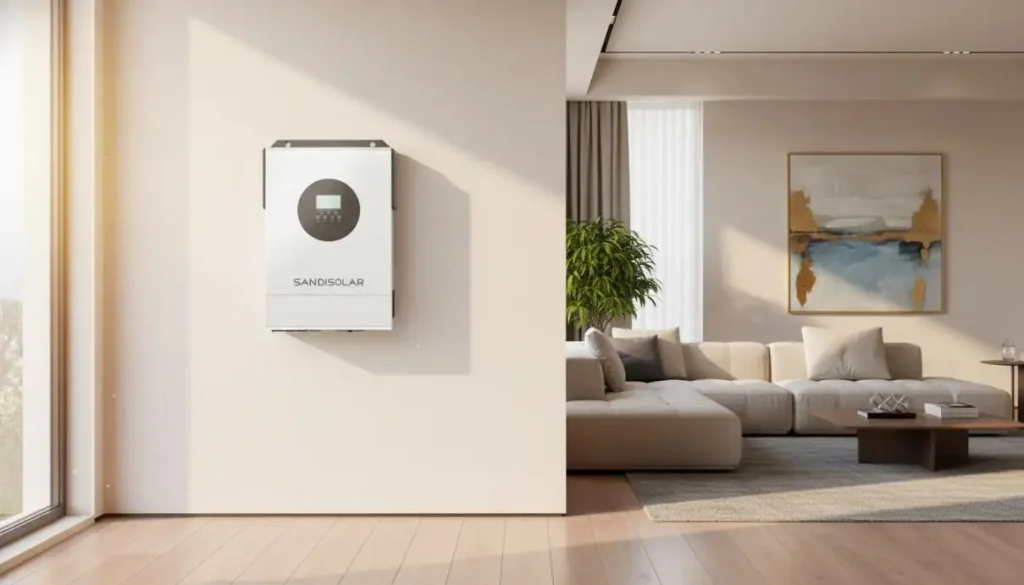
By seamlessly AC-coupling a backup generator with solar and battery storage, SANDISOLAR delivers true energy security – without over-sizing your battery bank or worrying about prolonged bad weather. This article explains how AC coupling works, why generator integration is the missing piece for resilient residential power, and how SANDISOLAR's off-grid inverter platform turns that vision into a reliable, cost-effective reality.
The Hidden Weakness of Solar-Only Backup Systems
A standard off-grid or hybrid system relies on solar panels to charge batteries during the day and then discharges the battery at night or during outages. This works well for short interruptions but fails under two common scenarios:
• Extended cloudy or rainy periods (typical in monsoon regions or northern winters) where PV generation drops to 10–20% of rated output.
• High-consumption events (heating, well pumps, EV-Laden) that drain a battery faster than solar can replenish it.
• The conventional solution is to oversize the battery bank – often doubling or tripling capacity to cover 3–5 days of autonomy. But with lithium battery prices still representing 40–50% of total system cost, this approach is financially prohibitive for many homeowners and small businesses. That is where generator AC coupling changes the equation.
What Is AC Coupling in a Hybrid Inverter for Home Use?
AC coupling means your Hybrid Inverter for Home Use accepts an AC input from a generator (diesel, petrol, or propane) and intelligently manages it alongside DC solar and battery power. Unlike old-fashioned transfer switches that simply cut over to the generator as the sole power source, a modern AC-coupled hybrid inverter coordinates all three energy flows:
• Solar first: During daylight, PV powers the home and charges the battery.
• Battery second: When solar is insufficient, the battery discharges.
• Generator last: Only when the battery state of charge falls below a configurable threshold (Zum Beispiel.., 20%) does the inverter automatically start the generator.
But SANDISOLAR goes further. Instead of using the generator as a “dumb” backup, our off-grid inverters treat it as a controllable AC source. The inverter can:
• Use the generator to simultaneously power home loads AND charge the battery at an optimal rate (adjustable charge current).
• Stop the generator automatically once the battery reaches a safe level (Zum Beispiel.., 80%).
• Protect the generator from low-load inefficiency or frequent short cycling.
The result: You can spec a smaller, affordable battery (1–2 days of autonomy) and rely on a generator for the rare 3-day storm or winter week. Total system capital cost drops by 25–35% while availability climbs to near-utility levels.
SANDISOLAR's Generator-Ready Architecture: Hauptmerkmale
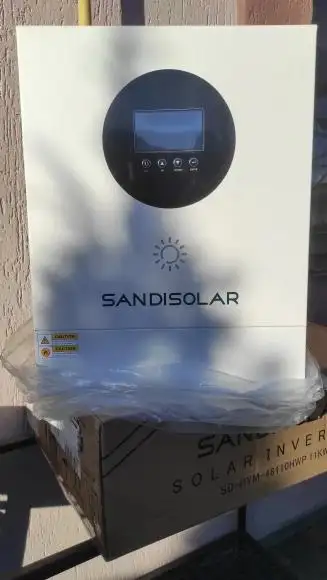
SANDISOLAR has engineered AC coupling as a core capability across our off-grid inverter series (SD-HYM line, 3kW to 11kW). Here is what procurement buyers and system integrators need to know:
• Adjustable charge/discharge parameters: Fine-tune the battery voltage setpoints at which the generator starts, stops, and ramps its charge current. This prolongs both battery cycle life and generator engine life.
• Fast switch time for load start/stop: When the generator is called, the inverter transfers the connected loads in under 15 milliseconds – so sensitive electronics like home servers or medical CPAP devices don't reset or reboot.
• Pure sine wave output from both solar AND generator pass-through: Even when running on generator AC input, the inverter conditions that power to a clean pure sine wave, filtering spikes or frequency drift common from low-cost portable generators.
• Supports low or high voltage lithium batteries: Our inverters work seamlessly with standard 48V LiFePO₄ banks (Zum Beispiel.., Pylontech, BYD) or emerging high-voltage rack systems.
The RS485, CAN, and Wi-Fi communication ports provide options for generator system integration and long-distance monitoring to automate emails when a generator starts, and to provide fuel level estimates and track generator run hours.
Real-World Application: Where AC Coupling Pays Off
The combination of generator + solar is not just for remote cabins anymore. These are the purchasing segments where SANDISOLAR sees the strongest demand in 2026:
• Rural homes and farms: Unreliable grid, long winter nights, and essential water pumps or milk cooling equipment.
• Mobile homes & Wohnmobile: Limited roof space for panels, so a small generator provides occasional top-ups without spending $5,000+ on extra batteries.
• Telecommunication towers: Critical DC backup with generator fallback – our inverter's adjustable charging protects expensive VRLA or lithium batteries from deep discharge.
• Emergency backup power for home offices: Homeowners who work remotely cannot afford a 2-day outage; a generator integrated with a 5kWh battery gives them 24/7 readiness.
For an authoritative external resource on AC coupling principles, refer to this technical overview from SolarReviews – but note that SANDISOLAR's implementation goes further with generator-specific smart logic.
Why Choose SANDISOLAR for Your Generator-Ready Hybrid System?
As a manufacturer with over a decade of field experience and certifications (EC, RoHS, UL listed to IEC 62109), SANDISOLAR does not simply “add a generator input” as an afterthought. Our AC coupling is built on three engineering principles that procurement buyers value:
• No single point of failure: If the generator fails, solar+battery continue seamlessly. If the inverter's charge controller fails, the generator's AC pass-through still powers critical loads.
• Fuel efficiency logic: The inverter can run the generator at 70–80% of its rated load (its most fuel-efficient range) by blending battery charging with direct load supply – avoiding inefficient light-load running.
• Future-proofed for VPP and grid services: While you use a generator today for security, the same communication ports allow future participation in virtual power plant programs when grid conditions improve.
Schlussfolgerung: True Energy Security Is No Longer a Trade-Off
A Hybrid Inverter for Home Use should not force you to choose between expensive battery autonomy and noisy, inefficient generator reliance. SANDISOLAR's AC-coupled off-grid inverters give you the best of both: solar-powered daily savings, battery-backed outage coverage for 1–2 days, and a generator that only runs when truly needed – at optimal efficiency. Für Hausbesitzer, it means lower upfront costs. For procurement professionals, it means a system that meets both budget constraints and reliability KPIs.
Ready to design your generator-ready solar system? Contact SANDISOLAR for a technical datasheet and project quote. Our engineering team supports tailored solutions from 3kW residential units to 11kW parallel-capable commercial configurations.
Häufige Fragen
Q: Can SANDISOLAR's Hybrid Inverter for Home Use work with my portable generator?
Ein: Ja. If your generator has a stable output of 230VAC (or close) for the inverter, it is compatible. If you have a pure sine wave generator, it is ideal.
Q: Is the inverter capable of starting my generator?
Ein: Ja. The inverter is capable of remote starting. Nothing is required beyond a generator that has an electric starter and an all start control module.
Q: Can all three (Solarenergie, Batterie, und Generator) operate simultaneously?
Ein: Ja. The inverter is able to blend all three of them as follows: the solar is used to power the loads first, the battery is used next, and then lastly the generator is used.
Q: What is the time taken by the inverter to switch to the generator power during an outage?
Ein: SANDISOLAR's off-grid inverters have a transfer time of under 15 milliseconds. Which is the duration required to power sensitive electronics such as computers (to switch) and even medical devices.
Q: Does the generator have to have the capacity to power my entire home?
Ein: Nein. The hybrid inverter has the capability of using the generator to recharge the battery, while the battery is used to power the loads of the generator. So smaller capacity generators have the ability to work perfectly too.
Teilen Sie auf Social Social:


Kontaktieren Sie uns
In diesem Artikel
Verwandte Beiträge
Niederspannungsbatterie Schnellreaktion: Anpassung der Dynamik des Solarinverters in Echtzeit
April 24, 2026
220V Solarwechselrichter mit WLAN – Jenseits der Überwachung: Prädiktive Erhaltung in 2026
April 23, 2026
110V Solarwechselrichter ohne Batterie – Der Smarte 2026 Kostensparende Lösung
April 22, 2026