
Split Phase Off Grid Inverter: Complete Guide to 120/240V Off-Grid Solar Power
By hqt
2026.06.16Related Posts
48V 6kW Off Grid Inverter: Why 48V Battery Systems Are Common for Higher-Power Solar Systems
August 31, 2026

Residential Solar System Installation: Technical Sizing, System Matching and Installation Guide
August 31, 2026

48 Volt Inverter for Solar Battery Storage: Key Specifications Buyers Should Compare
August 27, 2026
Off-grid solar is no longer just for remote cabins. In 2024, more homeowners, small businesses and farms are investing in energy independence, resilience and long-term savings. For many of these users, a split phase off grid inverter is the critical component that makes a 120/240V power system possible without a utility connection.
This page explains what split phase off grid inverters are, how they work, how to design a system around them, and what to look for when selecting the right model for your application. It's written for users considering or already planning an off-grid solar system in markets like North America and other regions where 120/240V split-phase standards are common.
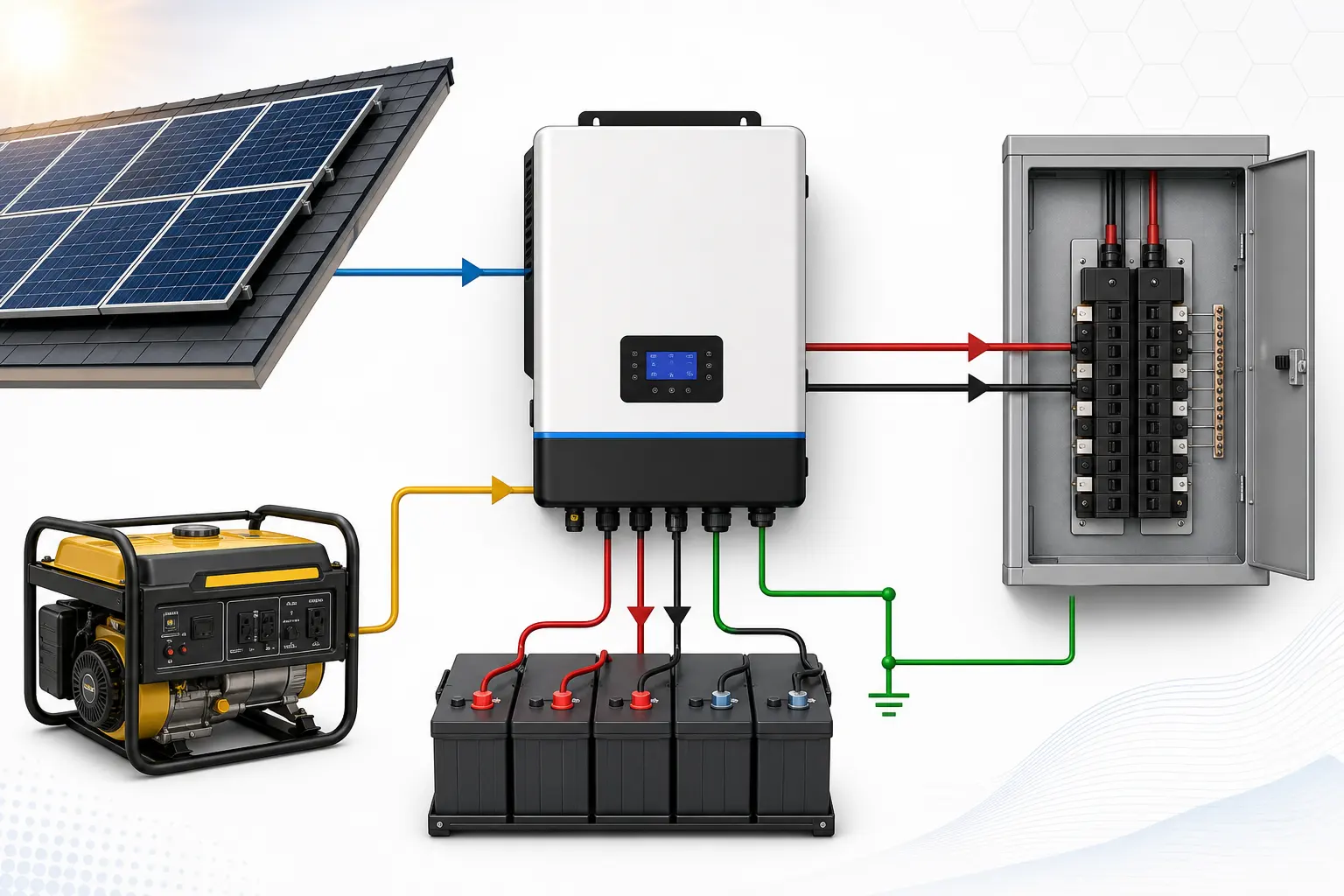
What Is a Split Phase Off Grid Inverter?
A split phase off grid inverter is a power conversion device that:
- Converts DC power from a battery bank (typically 24V, 48V or higher) into AC power
- Provides dual 120V legs that are 180° out of phase
- Delivers both 120V single-phase and 240V split-phase outputs for typical North American residential loads
- Operates independently from the utility grid (fully off-grid), often with optional generator support
Split Phase vs Single Phase vs Three Phase
To understand why split phase inverters are popular for off-grid homes, it helps to distinguish between common AC systems:
- Single phase 120V: One hot and one neutral; suitable for small loads (lighting, small appliances).
- Split phase 120/240V: Two 120V legs (L1 and L2) plus neutral.
- 120V between either leg and neutral
- 240V between L1 and L2
- Used widely in North American homes for mixed small and large loads.
- Three phase: Three or four conductors with 120° phase shift; used mainly for industrial or commercial systems, and sometimes for larger off-grid microgrids.
A split phase off grid inverter effectively simulates the 120/240V service you would normally receive from a utility transformer, enabling you to power:
- Standard 120V circuits (lighting, outlets, electronics)
- 240V loads (well pumps, electric ranges, some HVAC units, air compressors, tools)
Why Choose a Split Phase Off Grid Inverter?
Off-grid projects are diverse. Some systems can run entirely on 120V single-phase, but many real-world homes and farms need 240V loads. That is where a split phase inverter becomes essential.
Key Benefits
- Support for 240V loads
- Deep well pumps
- Electric water heaters
- Some air conditioners and heat pumps
- EV chargers designed for 240V
Without a split phase output, these loads require an additional transformer or a second inverter stack.
- Native compatibility with North American wiring standards
In countries such as the United States and Canada, residential panels are typically 120/240V split phase. A split phase off grid inverter can be wired directly to a standard load center, simplifying installation and inspection.
- Balanced load distribution
- Splitting circuits across L1 and L2 can reduce neutral currents
- Properly balanced loads can improve inverter efficiency and reduce stress on components
- Flexible system scaling
Many split phase off grid inverters support:
- Parallel operation for higher total capacity
- Stacking to form larger split-phase or even three-phase systems, depending on the product
- Resilience and energy independence
Paired with adequate battery storage and solar capacity, a split phase off grid inverter can:
- Maintain household or farm operations during grid outages
- Enable fully off-grid living where grid extension is impossible or uneconomical
2024 Market Trends for Split Phase Off Grid Inverters
The split phase off grid inverter market is evolving quickly. Several trends are shaping product design and user expectations in 2024.
1. Higher Power Ratings and Surge Capacity
Typical off-grid homes now use:
- 5–10 kW continuous power for everyday loads
- 10–20 kW surge capacity for starting motors or air conditioners
Manufacturers are responding with:
- 8–15 kW split phase off grid inverters designed as single units
- Stacking capabilities to 30 kW or more in parallel
This aligns with the growth of electric appliances (induction cooktops, heat pumps, EV chargers) even in off-grid environments.
2. Integrated Hybrid Functionality
Even though this page focuses on off-grid use, many "off-grid" products now include hybrid features:
- Generator input support (auto-start and priority logic)
- Optional grid-connect modes where available
- Integrated MPPT solar charge controllers in some all-in-one units
For users, this reduces the number of separate devices and simplifies system design.
3. Growing Adoption of Lithium Batteries
Lithium iron phosphate (LiFePO₄) batteries are rapidly becoming the default for new off-grid systems because of:
- Longer cycle life
- Higher usable depth of discharge
- Better energy density and smaller footprint
As a result, modern split phase off grid inverter models often include:
- Advanced BMS (Battery Management System) communication
- Preconfigured charge profiles for common LiFePO₄ brands
- Firmware updates to support new battery models
4. Smarter Monitoring and Remote Management
In 2024, users expect robust visibility and control:
- Wi-Fi or Ethernet connectivity
- Mobile apps with real-time power flow and historical data
- Cloud-based alerts for overloads, faults or low battery conditions
These features are particularly valuable for remote sites (cabins, telecom applications, irrigation systems) where onsite maintenance is costly.
5. Policy and Incentive Landscape
In many markets, off-grid systems may not qualify for the same incentives as grid-tied systems, but there are still relevant policy dynamics:
- Rural electrification programs: In some regions, subsidies encourage off-grid solar solutions for remote communities.
- Resilience incentives: Certain jurisdictions promote backup power and microgrids in wildfire-prone or disaster-prone areas, which often employ split-phase inverters.
- Building and electrical codes: Increasingly emphasize safety, disconnect requirements and standards compliance (e.g., UL 1741 in North America).
Designing a compliant system with a certified split phase off grid inverter helps ensure long-term reliability and acceptance.
How a Split Phase Off Grid Inverter Works
Internal Architecture Overview
A typical split phase off grid inverter performs several tasks:
- DC-DC Conversion
Steps battery voltage (e.g., 48V DC) up to an intermediate DC bus (e.g., 380–400V DC).
- DC-AC Inversion
Converts high-voltage DC into AC using high-frequency switching (IGBTs or MOSFETs).
- Split Phase Output Generation
Creates two 120V AC outputs that are 180° apart in phase. Provides 120V between each leg and neutral, and 240V between the legs.
- Control and Protection
Monitors output voltage, current and frequency. Manages overloads, short-circuits, over-temperature and other faults. Interacts with batteries, solar chargers and generators.
Battery and Solar Integration
While some split phase inverters include built-in MPPT solar controllers, many systems use separate charge controllers. In a typical off-grid solar system:
PV array → MPPT charge controller → Battery bank → Split phase off grid inverter → AC loads
Key points:
- The inverter draws from batteries; it does not usually regulate panel output directly unless it has integrated MPPT.
- Battery sizing affects inverter run time and surge capability.
- Charge current limits and voltage setpoints must match battery chemistry and manufacturer recommendations.
Key Specifications to Consider
When selecting a split phase off grid inverter, pay attention to more than just the power rating. The following parameters strongly influence system performance and longevity.
1. Power Rating (kW / kVA)
- Continuous power: The maximum sustained power the inverter can deliver.
- Surge power: Short-term peak capacity for motor startup or sudden load changes.
Match these to your load profile:
- Small cabins: 3–5 kW
- Standard off-grid homes: 5–10 kW
- Larger homes or small businesses: 10–20 kW (often via parallel inverters)
2. Battery Voltage
Common options:
- 24V DC: Smaller systems; higher current for the same power, thicker cables needed
- 48V DC: Standard for most medium to large systems; better efficiency and manageable currents
- Higher voltages (e.g., 96V or 120V DC): Used in some large or specialized systems
Choosing a 48V-based split phase off grid inverter typically balances performance, cabling cost and safety.
3. Efficiency and Idle Consumption
- Peak efficiency: 92–96% for modern units is typical.
- Idle or standby consumption: Important for small systems; look for lower no-load draw to preserve battery life.
4. Output Waveform
Pure sine wave output is essential for:
- Sensitive electronics
- Motor loads
- Audio equipment
Avoid modified sine wave inverters for modern off-grid homes; they can cause overheating, noise and reduced equipment life.
5. Transfer and Generator Support
For off-grid users who also employ a generator:
- Check transfer time between inverter and generator.
- Look for built-in transfer switches and auto-generator-start (AGS) capability.
- Ensure the inverter can handle the generator's voltage and frequency tolerances.
6. Environmental Ratings
Off-grid inverters may be installed in sheds, garages or equipment rooms:
- Check operating temperature range.
- Look for IP rating suitable for dust or moisture conditions.
- Confirm cooling method (fan-cooled vs. convection) and required clearances.
Typical Applications for Split Phase Off Grid Inverters
1. Off-Grid Homes
Homes in rural or remote areas commonly use split phase off grid inverters to:
- Power mixed 120/240V loads
- Maintain reliable power independent of the grid
- Integrate with solar, wind or hybrid systems
Typical load mix:
- 120V: Lighting, electronics, kitchen outlets, refrigerators
- 240V: Well pumps, dryers (where electric), mini-split heat pumps
2. Agricultural and Farm Operations
Farms often have:
- Deep well pumps
- Irrigation systems
- Workshop tools and compressors
- Refrigeration or cold storage
A split phase off grid inverter enables them to run these loads without or in addition to grid service, especially in regions where extending power lines is expensive.
3. Remote Commercial Sites
Small businesses, telecom sites or remote offices may use split phase off grid inverters to:
- Power communication equipment
- Provide AC power for office equipment, tools or small machinery
- Maintain operations during prolonged grid failures
4. Backup and Resilience Systems
Even in areas with grid access, some users prefer a robust off-grid-capable system:
- Inverters designed for split phase off grid use can form the backbone of a standalone power system that remains operational during extended outages.
- When combined with battery storage and solar, they provide a level of autonomy impossible with a simple generator.
Designing a Split Phase Off Grid Inverter System
A successful system design aligns load requirements, solar resource, battery capacity and inverter capability.
Step 1: Assess Your Loads
- List all 120V and 240V loads.
- Note:
- Running power (W)
- Starting surge (especially motors)
- Daily energy use (kWh/day)
- Identify critical vs non-critical loads:
- Critical: Refrigeration, water pumping, basic lighting, communications
- Non-critical: Electric ovens, large workshop tools, entertainment loads
This helps right-size the split phase off grid inverter and battery bank.
Step 2: Choose Battery Capacity and Type
Battery capacity (kWh) should match:
- Daily energy consumption
- Desired autonomy (number of days without sun)
Example guideline:
If your off-grid home uses 15 kWh/day and you want 2 days of autonomy, you may target 30–40 kWh of usable storage, depending on battery chemistry.
Typical choices:
- Lead-acid (AGM, GEL): Lower upfront cost, shorter lifespan, heavier
- LiFePO₄: Higher upfront cost, longer lifespan, deeper usable capacity, smaller footprint
Ensure your split phase off grid inverter supports the chosen battery type.
Step 3: Size Your Solar Array
Solar array size should:
- Generate enough energy to cover daily use plus losses
- Account for seasonal variation and local insolation
Rough estimation:
For 15 kWh/day consumption and average 4 sun-hours/day, a system might require approximately 4–5 kW of PV, adjusted for location and tilt.
Step 4: Match Inverter and Balance-of-System Components
- Select a split phase off grid inverter with continuous and surge ratings above your calculated peaks.
- Ensure:
- Adequate DC cabling and protection
- Proper AC panel configuration (L1/L2 balancing)
- Compatible charge controllers and batteries
Step 5: Consider Future Expansion
Off-grid loads tend to grow over time. Choose equipment that allows:
- Parallel inverter operation
- Additional PV strings
- Battery capacity upgrades
Practical Selection Tips for 2024
When comparing split phase off grid inverters, keep these practical considerations in mind.
1. Certification and Compliance
For North America, look for:
- UL 1741 or CSA certification
- Compliance with NEC provisions where applicable
This can be critical for insurance and inspection.
2. Integrated vs Modular Design
All-in-one units (inverter + MPPT + charger):
- Simplify wiring and installation
- Can be more compact and neat
- May limit flexibility if you want to mix PV, generator and battery technologies
Modular systems (separate inverter, charge controllers):
- Higher flexibility and easier component upgrades
- Potentially more complex design and installation
Choose based on your technical comfort level and long-term plans.
3. Support and After-Sales Service
Because a split phase off grid inverter is central to your power system, consider:
- Warranty length and terms
- Availability of local or regional support
- Access to firmware updates and technical documentation
4. Monitoring and Integration
- Ensure the inverter supports monitoring solutions aligned with your needs:
- Local display or touchscreen
- Remote web portal or app
- Data export for advanced users
Monitoring is invaluable for diagnosing issues and optimizing performance.
Common Mistakes to Avoid
Even with the right split phase off grid inverter, certain design or installation mistakes can limit system effectiveness:
- Underestimating peak loads
Not accounting for starting currents of pumps or compressors can cause nuisance shutdowns.
- Poor load balancing
Overloading one leg (L1 or L2) while the other is lightly loaded stresses the inverter and can trip breakers.
- Inadequate ventilation
Inverters generate heat; installing them in small, unventilated spaces can trigger thermal derating or shutdown.
- Insufficient battery capacity
Oversizing the inverter relative to the battery bank can cause deep discharges and reduced battery life.
- Neglecting maintenance
Ignoring alerts, failing to inspect connections or clean filters (where applicable) can shorten equipment life.
Who Should Consider a Split Phase Off Grid Inverter?
A split phase off grid inverter is especially suitable for:
- Homeowners in rural or remote areas with 120/240V loads
- Farmers running deep well pumps, irrigation and workshop equipment
- Small businesses needing resilient power for mixed 120/240V loads
- Users seeking long-term energy independence with full household functionality, not just minimal backup
If you only have low-power 120V loads, a single-phase inverter might be enough. But if you need a household-like power experience off-grid, split phase is usually the appropriate choice.
Actionable Checklist Before You Buy
- Confirm your required continuous and surge power (kW)
- List all 120V and 240V loads and identify critical ones
- Select battery chemistry and capacity based on energy needs and autonomy goals
- Estimate your PV array size and check local solar conditions
- Verify inverter certifications and compatibility with your region's standards
- Plan for monitoring and expansion to future-proof your system
Conclusion: Building a Reliable 120/240V Off-Grid System
A well-chosen split phase off grid inverter allows you to run a full range of residential and light commercial loads off-grid, with the same 120/240V capability that grid-connected homes enjoy. In 2024, advances in inverter technology, lithium batteries and smart monitoring make off-grid systems more capable and user-friendly than ever.
By carefully sizing your inverter, battery bank and solar array, and by paying attention to standards, monitoring and future expansion, you can build an off-grid power system that is:
- Reliable for everyday use
- Flexible enough for seasonal or load changes
- Scalable and maintainable over many years
Whether you are powering a remote home, a farm or a small business, a modern split phase off grid inverter is at the heart of a resilient and efficient standalone energy system.


Contact Us
In This Article
Related Posts
48V 6kW Off Grid Inverter: Why 48V Battery Systems Are Common for Higher-Power Solar Systems
August 31, 2026
Residential Solar System Installation: Technical Sizing, System Matching and Installation Guide
August 31, 2026
48 Volt Inverter for Solar Battery Storage: Key Specifications Buyers Should Compare
August 27, 2026