
15.36 kWh LiFePO₄ Battery for Home Energy Storage: Capacity, Runtime and Application Guide
By hqt
2026.08.17Related Posts
48V 6kW Off Grid Inverter: Why 48V Battery Systems Are Common for Higher-Power Solar Systems
August 31, 2026

Residential Solar System Installation: Technical Sizing, System Matching and Installation Guide
August 31, 2026

48 Volt Inverter for Solar Battery Storage: Key Specifications Buyers Should Compare
August 27, 2026
A 15.36 kWh LiFePO₄ Battery provides energy shifting, solar power at night, and backup power for residential uses. There are other factors that affect system performance aside from capacity. These include the battery energy, usable depth of discharge, inverter power, current limits, PV generation, and the household load.
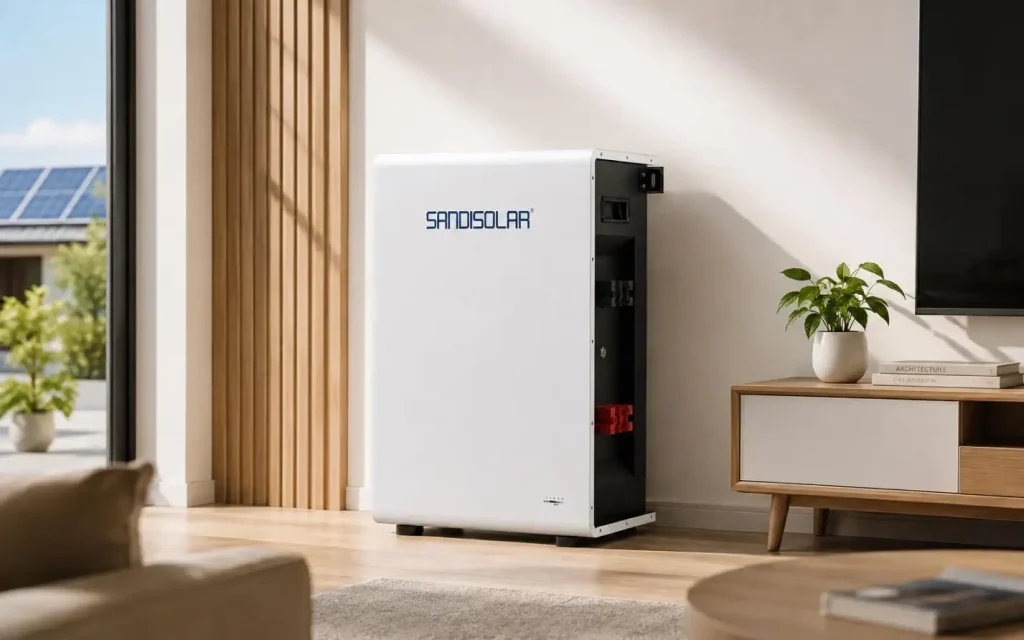
SANDISOLAR's SD-51.2V300AH uses LiFePO₄ chemistry with a 51.2V nominal voltage, 300Ah rated capacity and 15.36kWh rated energy. It operates within a specified 44.8–57.6V range and supports CAN, RS485 and RS232 communication.
The battery also incorporates 5A Active Balancing and CCS technology, helping improve cell consistency, electrical connection reliability and long-term pack performance.
How Much of 15.36kWh Is Actually Available?
Rated battery energy is calculated as:
51.2V × 300Ah = 15,360Wh = 15.36kWh
SANDISOLAR specifies support for 80% depth of discharge. Based on this value:
15.36kWh × 80% = 12.29kWh
This is a theoretical battery-side figure. Actual AC energy available to appliances will be lower because of:
•Inverter conversion losses
•BMS operating limits
•Cable and connection losses
•Battery temperature
•Standby consumption
•Actual charge and discharge conditions
For practical system sizing, runtime should therefore be calculated from usable energy rather than nameplate capacity.
How Long Can a 15.36kWh LiFePO₄ Battery Power a Home?
A simplified runtime formula is:
Runtime ≈ Usable Battery Energy ÷ Average Load
Using 12.29kWh as the battery-side reference:
| Average Load | Typical Application | Theoretical Runtime* |
| 0.5kW | Refrigerator, lights, router and electronics | 24.6 hours |
| 1kW | Essential residential loads | 12.3 hours |
| 2kW | Moderate household operation | 6.1 hours |
| 3kW | Several appliances operating together | 4.1 hours |
| 5kW | Heavy continuous load | 2.5 hours** |
*Before inverter and system losses.
**Subject to battery discharge-current and inverter-power limits.
This demonstrates the difference between three important ratings:
•kWh: stored energy
•kW: instantaneous power
•A: current flowing through the battery system
A battery may contain enough energy for several hours of operation but still be unable to supply a high-power load if the inverter or battery current limit is exceeded.
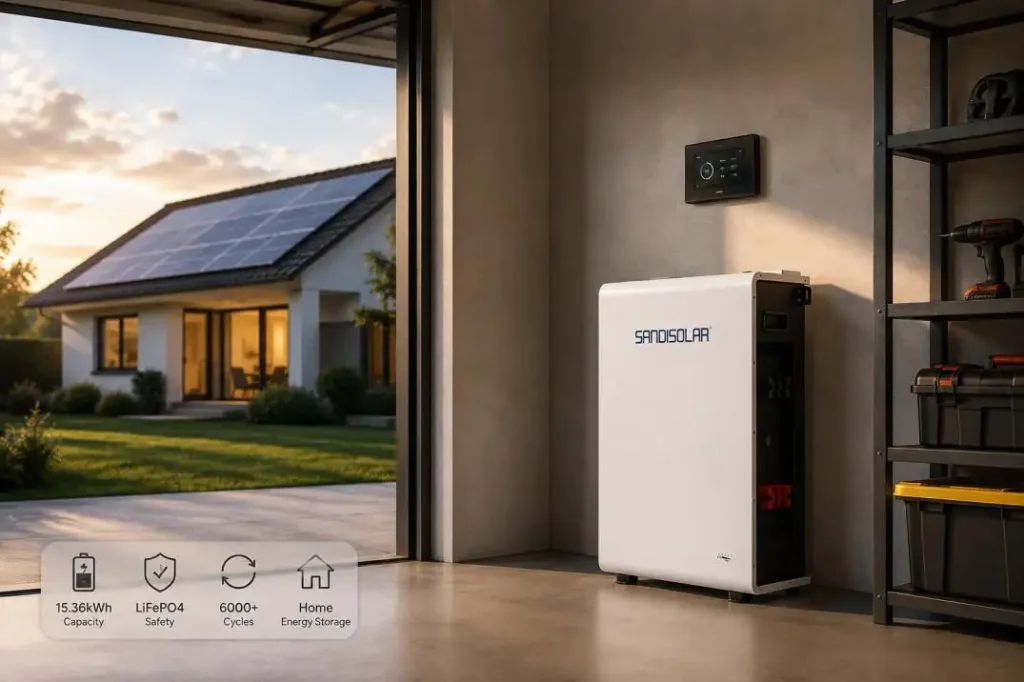
10kWh vs. 15.36kWh vs. 20kWh
| Capacity | Suitable Scenario | Main Consideration |
| Around 10kWh | Essential backup and lower evening consumption | Limited reserve during extended outages |
| 15.36kWh | Medium residential loads, overnight solar use and backup | Balanced storage and recharge requirements |
| Around 20kWh | Higher consumption or longer autonomy | More PV energy and a larger investment required |
A 15.36 kWh LiFePO₄ Battery is especially applicable where daytime PV production exceeds household consumption and the excess energy needs to be stored for nighttime use.
Additional modules may be used for larger systems, but battery parallel capability, inverter rating, total current, protection settings and BMS communication must be confirmed before expansion.
Why 5A Active Balancing Matters
Cells within a battery pack can develop minor differences in voltage and state of charge. If the imbalance grows large, one cell can reach its protection threshold before the others, resulting in the BMS limiting the charging or discharging of the pack, even if there is energy stored in the other cells in the pack.
The SD-51.2V300AH uses Active Balancing with a balancing current of 5A. Active balancing makes up for the voltage difference by moving energy between cells, as opposed to relying on the energy loss through resistors like in other methods of balancing.
Potential system-level benefits include:
•Faster correction of cell-voltage differences
•Better cell consistency across the pack
•Reduced risk of imbalance-related early cutoffs
•More stable usable capacity over long-term operation
•Improved support for large-capacity residential storage
The 5A rating refers specifically to balancing current. It should not be confused with the battery's maximum charge or discharge current.
How CCS Technology Supports Pack Reliability
SANDISOLAR also applies CCS—Cell Contact System—technology within the battery pack. CCS integrates cell electrical connections and signal collection into an organized assembly rather than depending on numerous independently routed wires.
For a residential energy-storage battery, this can provide:
•More consistent cell-to-cell electrical connections
•Reliable voltage and temperature signal transmission
•Fewer loose wiring points inside the battery pack
•A cleaner and more compact internal structure
•technology works together with the BMS and 5A Active Balancing system: CCS supplies reliable cell data and connections, while the BMS monitors, protects and balances the cells.
Inverter Compatibility Starts With Voltage and Current
An inverter should not be selected merely because its datasheet states "48V battery compatible." The following parameters must be checked together:
•Inverter battery-input voltage range
•Recommended charging voltage
•Maximum charging current
•Battery continuous discharge current
•Inverter DC current requirement
•Low-voltage cutoff settings
•CAN or RS485 communication protocol
Although the SD-51.2V300AH provides CAN, RS485 and RS232 interfaces, physical interface availability does not automatically guarantee compatibility. The communication protocol, inverter firmware and supported battery profile must also match.
How Much Solar Should Be Paired With the Battery?
PV capacity should be based on daily energy balance:
Daytime Loads + Battery Recharge + Conversion Losses
Important variables include household consumption, nighttime battery discharge, local peak sun hours, seasonal irradiation, shading and system efficiency.
A 15.36kWh battery does not require a 15.36kW PV array. If the household uses only 8kWh from the battery overnight, the solar system generally needs to replenish that 8kWh plus conversion losses.
Backup Power and High-Demand Loads
Essential loads commonly include refrigeration, lighting, internet equipment, security systems and selected sockets. Air conditioners, water heaters, induction cooktops, pumps and EV chargers require much higher power.
Whole-home backup therefore depends on both stored kWh and available kW. Motor and compressor starting surges must also be considered. Grid-outage switching is primarily controlled by the inverter, EPS circuit or transfer equipment—not by the battery alone.
Cycle Life, Installation and Procurement Checks
SANDISOLAR specifies up to 6000 cycles, but cycle life should be assessed together with test DoD, charge/discharge rate, operating temperature and end-of-life capacity criteria.
Before purchasing or installing the battery, confirm:
•Maximum continuous charge and discharge current
•BMS protection thresholds
•5A Active Balancing specifications
•CCS construction and signal-collection design
•Compatible inverter protocols
•Operating and storage temperatures
•DC cable and overcurrent protection
•Permitted parallel configuration
•Cycle-life documentation and warranty
•Market-specific transport and safety documentation
SANDISOLAR's SD-51.2V300AH combines 15.36kWh storage capacity, 5A Active Balancing, CCS technology and multiple communication interfaces for residential solar-storage applications. For project evaluation, SANDISOLAR can assess household consumption, critical loads, PV capacity and inverter specifications to determine whether the battery is properly matched to the complete energy-storage system.
FAQs
Q1.What is the rated capacity of the 15.36kWh LiFePO₄ Battery by SANDISOLAR?
The SANDISOLAR SD-51.2V300AH is rated at 300Ah and has a nominal voltage of 51.2V. This unit provides 15.36kWh of stored energy.
Q2.What is the usable energy of the 15.36kWh LiFePO₄ Battery?
The battery, with an 80DoD, yields approximately 12.29kWh of battery-side energy. Post inverter and system losses translates to less available AC energy to household loads.
Q3.How long can the SANDISOLAR 15.36kWh LiFePO₄ Battery power a house?
Runtime is dependent on average load. With a 12.29kWh energy capacity at 80DoD, and accounting for system losses, this battery can power a 1kW load for 12.3 hours or a 2kW load for 6.1 hours.
Q4.Can the 15.36kWh LiFePO₄ Battery be coupled with a solar PV system?
Yes, the battery can be used as energy storage for solar PV systems for residential energy storage applications.
Q5.Which inverter is recommended for the 51.2V 300Ah battery?
The chosen inverter should operate in the 44.8-57.6V working voltage range, address battery charging, discharge capability, and support the BMS communication protocol.


Contact Us
In This Article
Related Posts
48V 6kW Off Grid Inverter: Why 48V Battery Systems Are Common for Higher-Power Solar Systems
August 31, 2026
Residential Solar System Installation: Technical Sizing, System Matching and Installation Guide
August 31, 2026
48 Volt Inverter for Solar Battery Storage: Key Specifications Buyers Should Compare
August 27, 2026