
Solar Inverter With Battery Storage for Residential Energy Independence
By hqt
2026.08.18Related Posts
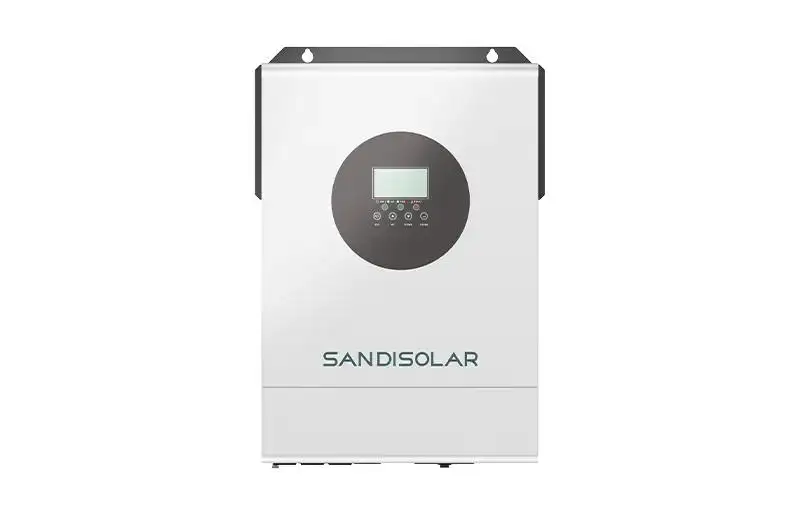
48V 6kW Off Grid Inverter: Why 48V Battery Systems Are Common for Higher-Power Solar Systems
August 31, 2026

Residential Solar System Installation: Technical Sizing, System Matching and Installation Guide
August 31, 2026

48 Volt Inverter for Solar Battery Storage: Key Specifications Buyers Should Compare
August 27, 2026
Residential energy independence depends on how effectively solar generation, battery capacity and household loads are coordinated. Installing a large PV array does not guarantee reliable backup if the inverter cannot start motor loads, the battery BMS cannot supply the required current, or the PV strings fall outside the MPPT operating range.
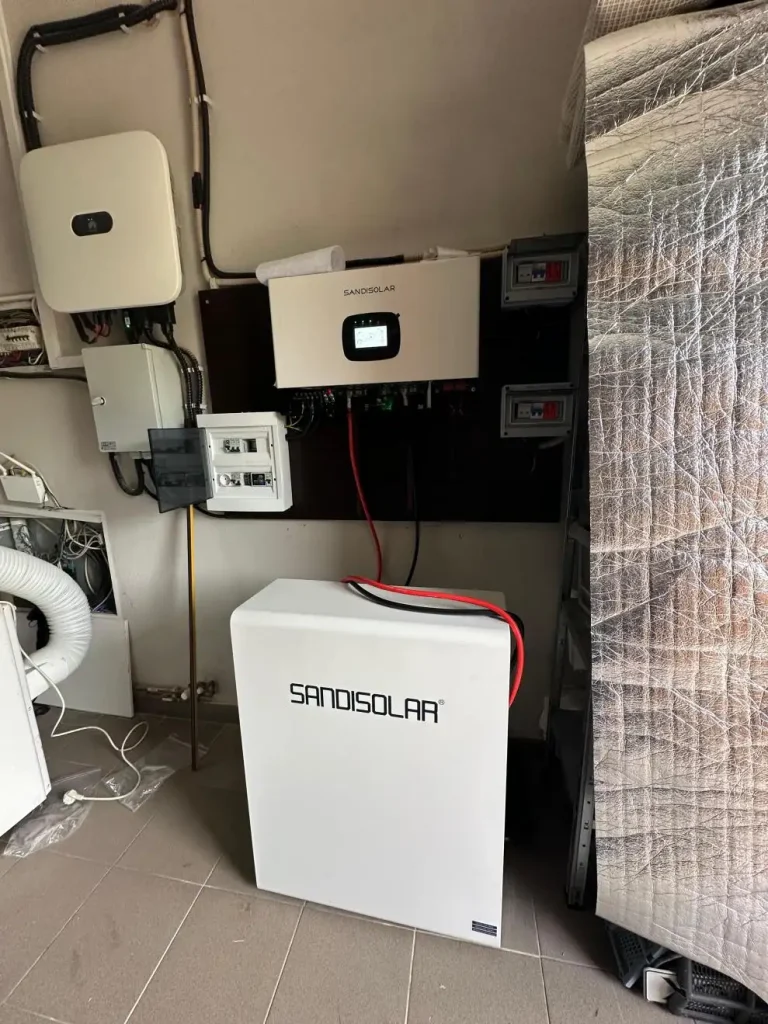
A correctly engineered Solar Inverter With Battery Storage should therefore be selected in this order:
Load Profile → Surge Demand → Backup Duration → Battery Current → PV Configuration → Protection
For high-demand residential and off-grid applications, the SANDISOLAR SD PRO 12kW inverter can be paired with the SD-51.2V300Ah LiFePO₄ battery to create a 48V-class energy storage system with 12kW output and 15.36kWh nominal storage.
How Solar, Battery and Backup Sources Interact
A Solar Inverter With Battery Storage manages energy flow according to PV production, load demand, battery state of charge and the configured operating priority.
| Operating Condition | Typical Energy Flow | Control Objective |
| Strong PV production | PV → Loads → Battery | Increase solar self-consumption |
| Low PV production | PV + Battery → Loads | Reduce dependence on external power |
| Battery reaches reserve SOC | Grid/Generator → Loads or Battery | Preserve backup capacity |
| Power outage | PV + Battery → Critical Loads | Maintain essential household functions |
| Extended low-solar period | Generator → Loads/Battery | Restore energy availability |
Battery reserve should be configured according to outage risk. Using the full battery capacity for daily cycling may reduce the energy available when an unexpected outage occurs.
SD PRO 12kW Inverter for High-Demand Homes
The SANDISOLAR SD PRO 12kW Off-Grid Inverter, model SD-PRO-48120WP-EU, is designed for homes with larger simultaneous loads, motor-driven equipment or substantial backup requirements.
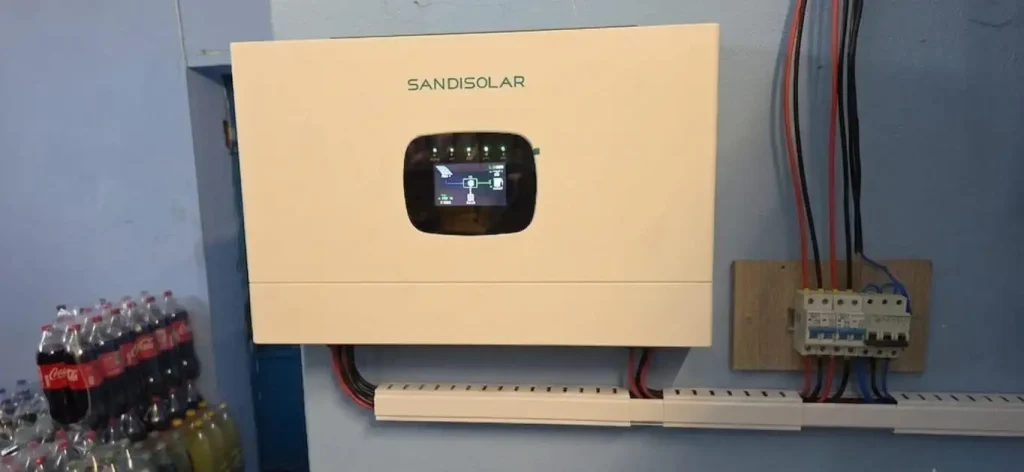
Key specifications include:
• 12kW rated AC output
• Two times rated power for five seconds in off-grid mode
• Maximum 18,000W PV input
• Dual MPPT inputs rated at 30A each
• 90–450V MPPT operating range
• 500V maximum PV input voltage
• Maximum battery discharge capability of 280A
• UPS-level transfer time of no more than 4ms
• Generator input and dual AC outputs
• 4.3-inch interactive touchscreen
• AI-assisted energy management
• Parallel operation of up to nine units
The five-second overload capability helps the Solar Inverter With Battery Storage start compressors, pumps and other inductive loads. It does not mean the inverter can continuously deliver 24kW; continuous loads must remain within the rated 12kW output and applicable temperature limits.
Why Use a 51.2V 300Ah LiFePO₄ Battery?
The SANDISOLAR SD-51.2V300Ah LiFePO₄ battery provides:
• 51.2V nominal voltage
• 300Ah rated capacity
• 15.36kWh nominal energy
• 44.8–57.6V working range
• Up to 6,000 published cycles
• 80% recommended depth of discharge
• CAN, RS232 and RS485 communication
• CCS integration technology
• 5A active balancing
• WiFi remote monitoring
• Overcharge, over-discharge and overheating protection
LiFePO₄ chemistry is widely used in stationary storage because of its cycle life and thermal stability. The battery's 5A active-balancing system transfers energy between cells to reduce voltage differences. This supports pack consistency and usable capacity, but it does not replace correct charge-voltage, temperature or BMS configuration.
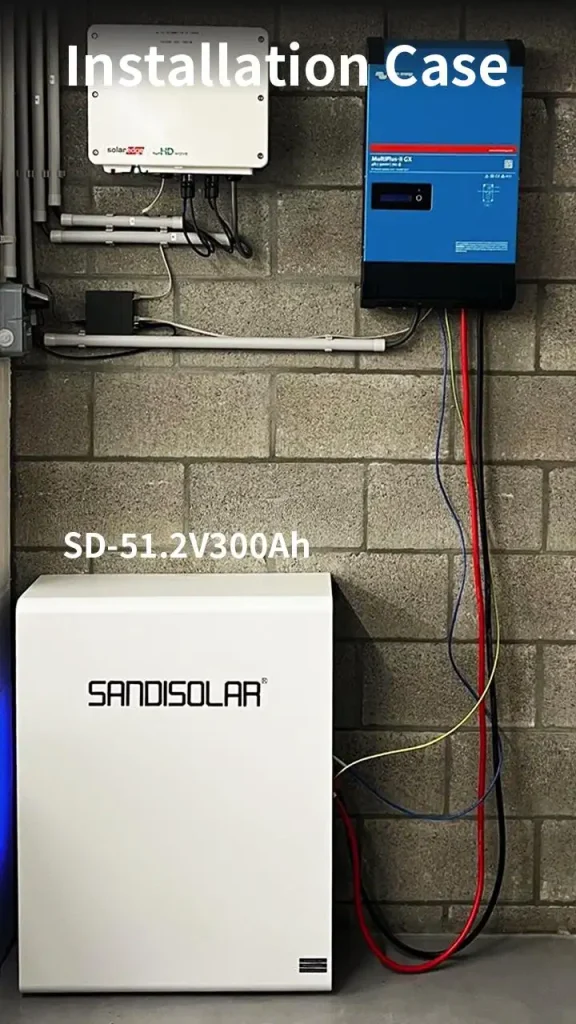
CCS technology integrates voltage and temperature sensing into a structured connection assembly, reducing complex point-to-point wiring and supporting consistent battery-data acquisition.
Verify Battery Current Before Using the Full 12kW
Battery kWh and inverter kW measure different characteristics:
• kWh indicates stored energy.
• kW indicates instantaneous power.
• A determines the DC current the battery, BMS and cables must carry.
At nominal voltage:
12,000W ÷ 51.2V ≈ 234A
At the battery's lower operating voltage:
12,000W ÷ 44.8V ≈ 268A
These figures exclude conversion losses. Consequently, full 12kW output at a low battery state of charge may approach the inverter's 280A discharge limit.
Before commissioning this Solar Inverter With Battery Storage, confirm:
• Battery BMS continuous and peak discharge ratings
• Maximum permitted inverter discharge current
• Battery-to-inverter communication protocol
• DC cable ampacity and temperature derating
• Busbar, breaker and fuse ratings
• Connector torque and terminal temperature rise
If the battery BMS rating is below the calculated demand, output power must be limited or an approved parallel battery configuration used. Adding inverter capacity without increasing battery current capability will not increase usable system output.
Calculating Usable Energy and Backup Runtime
At 80% depth of discharge:
15.36kWh × 0.80 = 12.29kWh usable DC energy
Assuming 92% overall conversion efficiency, approximately 11.3kWh may be delivered to AC loads.
| Average Load | Estimated Runtime |
| 2kW | 5.7 hours |
| 4kW | 2.8 hours |
| 6kW | 1.9 hours |
| 12kW | 0.9 hours |
These are planning estimates. Actual runtime varies with temperature, battery age, inverter consumption, load cycling, cable losses and minimum SOC settings.
A 12kW inverter does not require the home to draw 12kW continuously. It provides the power headroom needed for overlapping loads and short-duration startup demand.
Engineering the PV Array
The SD PRO inverter accepts up to 18,000W of PV input. Each string must still comply with the electrical limits of the two MPPT channels.
Installers should verify:
• Cold-weather open-circuit voltage remains below 500V.
• Operating string voltage remains within the 90–450V MPPT window.
• Current does not exceed 30A per MPPT.
• Short-circuit current remains below 44A per MPPT.
• East/west or differently shaded arrays are assigned appropriately.
• PV power is sufficient for loads and battery recharge.
An oversized array can improve energy harvest during weak irradiance, but exceeding voltage or current limits can cause shutdown or equipment damage. PV oversizing must therefore follow the manufacturer's permitted configuration.
Separate Critical and Non-Critical Loads
The inverter's dual AC outputs allow the Solar Inverter With Battery Storage to prioritize essential circuits such as:
• Refrigeration and lighting
• WiFi and security systems
• Essential sockets
• Water or circulation pumps
• Monitoring and communication equipment
Air conditioning, electric water heating and other high-consumption loads can be assigned lower priority. This prevents non-essential equipment from rapidly depleting the battery during an outage.
The ≤4ms transfer time supports fast backup switching, although equipment requiring guaranteed zero-interruption power may still need a dedicated online UPS.
Commissioning and Expansion
Before operation, installers should check BMS communication, charge and discharge limits, PV polarity, grounding, protection coordination, generator settings and emergency isolation.
Although the inverter supports up to nine units in parallel, expansion requires a complete reassessment of:
• Battery-bank energy and current capacity
• DC busbars and protection devices
• AC distribution and fault current
• PV capacity and charging rate
• Ventilation and thermal management
Parallel capability should be treated as a system-engineering option rather than a standalone product feature.
A Balanced SANDISOLAR Storage Solution
The SD PRO 12kW inverter and SD-51.2V300Ah battery form a capable Solar Inverter With Battery Storage solution for high-demand residential backup and off-grid applications. The system combines 12kW AC output, 15.36kWh nominal storage, up to 18kW PV input, fast transfer, dual-load management, active battery balancing and remote monitoring.
Final sizing should be based on measured household loads, motor-starting current, battery BMS limits, required backup duration, PV string calculations and local electrical regulations. SANDISOLAR can support installers, distributors and project buyers with inverter, battery and system-protection matching.
FAQs
Q1. Can the SANDISOLAR 12kW inverter work with the 51.2V 300Ah battery?
Yes. The SD PRO 12kW inverter uses a 48V-class battery platform, while the SANDISOLAR battery has a 51.2V nominal voltage and a 44.8–57.6V operating range. Installers must still confirm BMS communication, charge voltage and discharge-current settings before commissioning.
Q2. How much energy does the SANDISOLAR 51.2V 300Ah battery store?
The battery stores 15.36kWh of nominal energy, calculated as:
51.2V × 300Ah = 15.36kWh
At an 80% depth of discharge, approximately 12.29kWh of DC energy is available before conversion losses and reserve settings are considered.
Q3. Can one 51.2V 300Ah battery support the inverter's full 12kW output?
This depends on the battery BMS continuous-discharge rating. A 12kW load requires approximately 234A at 51.2V and about 268A at 44.8V before conversion losses. SANDISOLAR should confirm the permitted BMS current before full-power operation.
Q4. How long can the SANDISOLAR battery provide backup power?
Runtime depends on the average load. Assuming 80% depth of discharge and approximately 92% system efficiency, the battery may support a 2kW load for about 5.7 hours or a 6kW load for about 1.9 hours. Actual results vary with temperature, battery age and load cycling.
Q5. What is the maximum PV input of the SANDISOLAR 12kW inverter?
The inverter supports up to 18,000W of PV input. Its dual MPPT channels operate within a 90–450V range, with a 500V maximum PV input voltage and a maximum input current of 30A per MPPT.


Contact Us
In This Article
Related Posts
48V 6kW Off Grid Inverter: Why 48V Battery Systems Are Common for Higher-Power Solar Systems
August 31, 2026
Residential Solar System Installation: Technical Sizing, System Matching and Installation Guide
August 31, 2026
48 Volt Inverter for Solar Battery Storage: Key Specifications Buyers Should Compare
August 27, 2026