
48V 6kW Off Grid Inverter: Why 48V Battery Systems Are Common for Higher-Power Solar Systems
By hqt
2026.08.31Related Posts
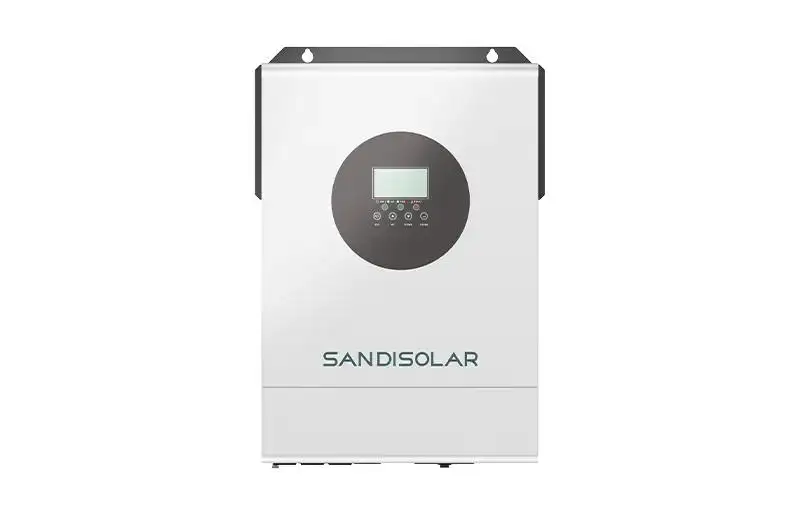
48V 6kW Off Grid Inverter: Why 48V Battery Systems Are Common for Higher-Power Solar Systems
August 31, 2026

Residential Solar System Installation: Technical Sizing, System Matching and Installation Guide
August 31, 2026

48 Volt Inverter for Solar Battery Storage: Key Specifications Buyers Should Compare
August 27, 2026
A 6kW Off Grid Inverter sits at a power level where battery-side design becomes critical. The question is no longer simply whether the inverter can deliver 6kW AC output. The battery bank, BMS, DC cable, protection devices and PV charging system must all support the current required to maintain that output.
This is why 48V battery architecture is widely used for higher-power off-grid systems. SANDISOLAR's current 48V platform includes a 6.2kW pure sine-wave inverter with 120A MPPT charging, up to 500Vdc PV input, LiFePO4 communication through RS485 and parallel operation of up to 12 units.
Why 6kW Changes the Battery-Side Design
For an initial comparison:
DC Current ≈ Power ÷ Battery Voltage
| Battery Voltage | Ideal DC Current at 6kW | Engineering Impact |
| 12V | 500A | Extremely high current |
| 24V | 250A | Heavy cable and protection requirements |
| 48V | 125A | More practical for higher-power systems |
These values exclude inverter losses. If a 6kW Off Grid Inverter is 92% efficient at a particular operating point, for example, 6kW AC output would require about 6.52kW from the DC side. At 48V, that represents about 136A rather than 125A.
Battery voltage also falls and rises with SOC, chemistry and load conditions. Therefore, inverter design should consider maximum expected DC current, not simply calculate 6000 ÷ 48 once.
Current Also Determines Cable Loss
Resistive loss follows:
P Loss = I² × R
If the same conductor resistance is assumed, reducing current from 250A to 125A reduces theoretical I²R loss to one quarter.
This affects more than efficiency. Higher DC current increases:
• Conductor cross-section requirements;
• Terminal and connector heating;
• Voltage drop;
• Fuse and breaker current ratings;
• BMS discharge-current requirements;
• Installation cost and complexity.
For a 6kW Off Grid Inverter, this is the principal engineering advantage of moving from 24V to 48V.
24V vs. 48V: The Difference Goes Beyond Efficiency
A 24V architecture is technically possible at high power, but the current path becomes much more demanding.
| Design Factor | 24V System | 48V System |
| Current for equal power | High | About half |
| Cable requirement | Larger conductor typically required | Easier to manage |
| Voltage-drop sensitivity | Higher | Lower |
| BMS current demand | Higher | Lower |
| DC protection rating | More demanding | More practical |
| Future power expansion | More difficult | Better suited |
The correct conclusion is therefore not that “48V is always better.” Instead, as continuous load power rises, reducing DC current becomes increasingly valuable.
Battery kWh Does Not Tell You Whether It Can Supply 6kW
One of the most common 6kW Off Grid Inverter selection errors is sizing the battery only in amp-hours.
For example:
• 48V × 100Ah = 4.8kWh nominal
• 48V × 200Ah = 9.6kWh nominal
The second battery stores approximately twice as much energy, but neither figure proves that the battery can continuously supply the inverter.
Check Power Capability Separately
A battery for a 6kW Off Grid Inverter should be evaluated for:
• BMS continuous discharge current
• BMS peak discharge current and duration
• Cell discharge C-rate
• Usable SOC/DoD range
• Minimum operating voltage
• Voltage sag under high load
• Battery-inverter communication
A 4.8kWh battery could have adequate energy for a short operating period but still shut down under a 6kW load if its BMS current limit is too low.
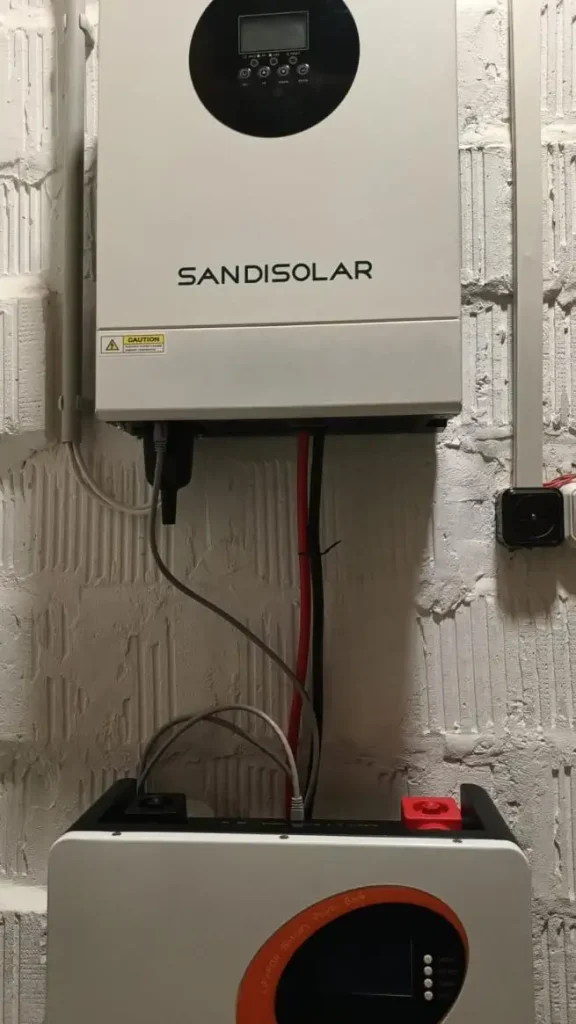
This is why SANDISOLAR's 48V inverter platform supports RS485 communication with compatible LiFePO4 batteries and lithium-battery activation through PV or utility input.
Motor Loads Require More Than a 6kW Nameplate Rating
Load type matters just as much as total wattage.
| Load Type | Operating Characteristic | Main Design Check |
| Lighting | Stable | Energy consumption |
| Electronics | Relatively stable | Output quality |
| Refrigerator | Compressor startup | Surge power |
| Air conditioner | High starting demand | Surge + battery voltage sag |
| Power tools | Rapid load changes | Peak current |
6kW Off Grid Inverter sizing should check:
Continuous Load + Simultaneous Loads + Motor Starting Power + Surge Duration + Battery Peak Current
Rather than adding appliance nameplate wattages alone.
Match the PV Array to MPPT Limits, Not AC Output Power
Another design mistake is assuming that a 6kW inverter automatically requires exactly 6kW of PV modules.
PV design must be checked against several independent limits:
• Maximum PV input power
• MPPT operating-voltage range
• Maximum PV open-circuit voltage
• MPPT input current
• PV string configuration
• Module Voc at low temperature
• Battery charging-current limit
SANDISOLAR's 48V 6.2kW platform offers 120A MPPT charging and 500Vdc maximum PV input, and it can operate without a battery in supported operating conditions.
However, 500Vdc is a limit—not a target string voltage. Installers must calculate string Voc and operating voltage from the selected modules and local temperature conditions.
DC Protection Becomes Critical Above 100A
Even with a 48V battery architecture, a 6kW Off Grid Inverter remains a high-current DC system.
Installation engineering should cover:
Battery-to-Inverter Circuit
• Cable ampacity and voltage drop
• Short and symmetrical battery connections
• DC-rated fuse or breaker
• Correct terminal torque
• Isolation provisions
• Proper conductor protection
Parallel Batteries
• Equal cable resistance where required
• Suitable busbar design
• Compatible BMS architecture
• Controlled current sharing
• Communication compatibility
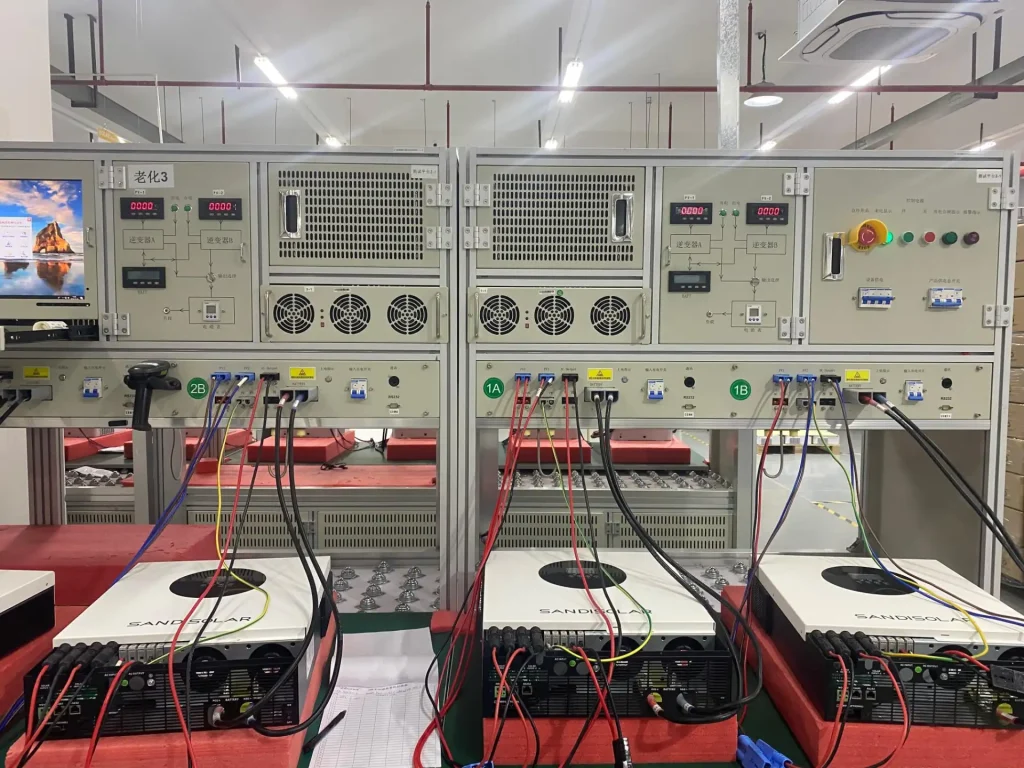
Thermal Management
• Keep ventilation paths clear
• Inspect terminals for heat discoloration
• Avoid loose high-current connections
• Monitor battery and inverter temperature
SANDISOLAR also supports parallel networking of up to 12 units on this platform, including single-phase and three-phase configurations, making parallel architecture relevant where system power needs to expand beyond one 6kW Off Grid Inverter.
Standards and Documentation Should Be Verified Before Purchase
Technical specifications should be supported by applicable documentation. IEC 62109-1 defines general safety requirements for PV power-conversion equipment. IEC 62619:2022 addresses safety requirements and tests for industrial lithium batteries, including stationary applications. IEC 62548-1 covers PV-array wiring, protection, switching and earthing design. Lithium batteries transported internationally also need appropriate evaluation under UN Manual of Tests and Criteria Section 38.3.
Buyers should verify applicable:
• Certificates and test reports
• Battery compatibility documentation
• Technical datasheets
• Installation manuals
• Market-specific declarations
How to Specify a 48V 6kW Off Grid Inverter Correctly
A reliable system should be selected in this order:
Load profile → surge demand → 6kW Off Grid Inverter → battery current → BMS → battery kWh → PV array → MPPT → DC protection
The 48V architecture solves an important current problem, but it does not replace proper system engineering.
At SANDISOLAR, we therefore evaluate a 6kW Off Grid Inverter together with battery discharge capability, LiFePO4 communication, PV configuration and future parallel requirements. For residential, remote or backup projects, defining these electrical conditions before ordering helps create a more stable and scalable off-grid power system.
FAQs
Q1. Does the SANDISOLAR 6kW Off Grid Inverter support MPPT solar charging?
In the context of the current 48V 6.2kW solar inverter system, the referenced configuration will take up to 120A MPPT charging. In this case, the actual PV configuration must fall below the inverter’s maximum voltage and current.
Q2. Does the SANDISOLAR 6kW Off Grid Inverter support LiFePO4 batteries?
Yes. SANDISOLAR has built an integrated 48V DC solar inverter system designed to support lithium batteries and has RS485 communication compatible with a number of battery systems. The battery voltage, BMS and minimum discharge current should be examined prior to the installation.
Q3. Do I need a 48V 100 Ah battery for a SANDISOLAR 6kW Off Grid Inverter?
A 48V 100Ah battery delivers approximately 4.8kWh of energy, but the battery size is not the only factor in system compatibility. The battery BMS must be able to handle the continuous and peak discharge currents for the 6kW Off Grid Inverter.
Q4. How big should the battery bank be for a 6kW Off Grid Inverter?
Adequate battery capacity is defined by the average load, the duration of backup power, usable discharge depth, and the inverter's losses. When evaluating batteries, capacity in kWh is the primary consideration over Ah capacity.
Q5. What aspects should I consider when matching solar panels with a SANDISOLAR 6kW Off Grid Inverter?
• Maximum PV input voltage
• MPPT operating range
• Maximum MPPT input current
• Module Voc
• Low temperature Voc increase
• Series/ parallel string configuration
• Limits of battery charging current
• PV wattage is insufficient in itself to perform a string design.
Share on Social:


Contact Us
In This Article
Related Posts
48V 6kW Off Grid Inverter: Why 48V Battery Systems Are Common for Higher-Power Solar Systems
August 31, 2026
Residential Solar System Installation: Technical Sizing, System Matching and Installation Guide
August 31, 2026
48 Volt Inverter for Solar Battery Storage: Key Specifications Buyers Should Compare
August 27, 2026