
Residential Solar System Installation: Technical Sizing, System Matching and Installation Guide
By hqt
2026.08.31Related Posts
48V 6kW Off Grid Inverter: Why 48V Battery Systems Are Common for Higher-Power Solar Systems
August 31, 2026

Residential Solar System Installation: Technical Sizing, System Matching and Installation Guide
August 31, 2026

48 Volt Inverter for Solar Battery Storage: Key Specifications Buyers Should Compare
August 27, 2026
A reliable Residential Solar System Installation is not simply a matter of placing solar modules on a roof and connecting an inverter. The system must be engineered around household energy demand, peak power, roof conditions, PV string voltage, MPPT limits, battery discharge capability, electrical protection, and local grid requirements.
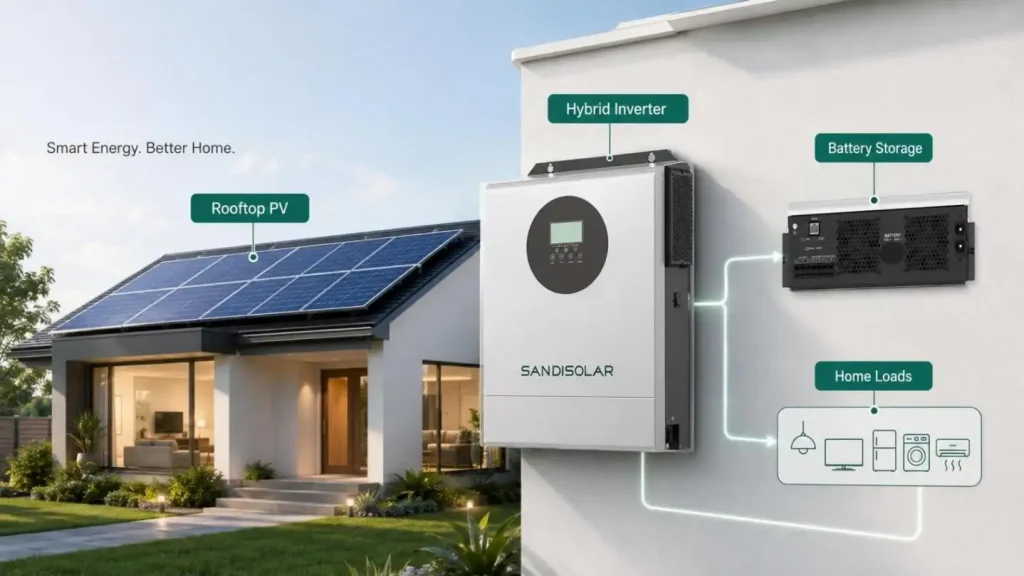
For homeowners, installers, distributors, and system integrators, the key question is therefore not "How many panels do I need?" but:
Can the PV array, inverter, battery, roof structure, and household loads operate correctly as one system?
Start Residential Solar System Installation With a Load Profile
System sizing should begin with electrical consumption rather than floor area.
Before specifying equipment, collect:
• Annual electricity consumption, kWh/year
• Average daily consumption, kWh/day
• Maximum simultaneous load, kW
• Daytime and nighttime load distribution
• Motor and compressor starting loads
• Critical loads required during outages
• Required backup duration
• Future loads such as EV chargers or heat pumps
These figures influence different components.
| Load Data | Design Impact |
| Daily/annual kWh | PV array capacity |
| Peak load, kW | Inverter continuous output |
| Motor starting load | Surge-power requirement |
| Nighttime consumption | Battery capacity |
| Critical loads | Backup distribution |
| Backup hours | Usable battery energy |
A technically correct Residential Solar System Installation must distinguish energy in kWh from power in kW.
Calculate PV Capacity From Energy Demand
A preliminary array can be estimated using:
PV Capacity ≈ Daily Energy Demand ÷ Peak Sun Hours ÷ System Performance Factor
The performance factor accounts for real operating losses, including:
• Module temperature
• Inverter conversion
• DC and AC cable losses
• Module mismatch
• Shading
• Soiling
• Orientation and tilt
For example, a household using 25 kWh/day does not automatically need a 5 kW array simply because the location receives five peak-sun hours. Real output is lower than ideal STC-based calculations.
Annual solar yield modeling is therefore preferable when designing a final system.
Verify PV String and Inverter Compatibility
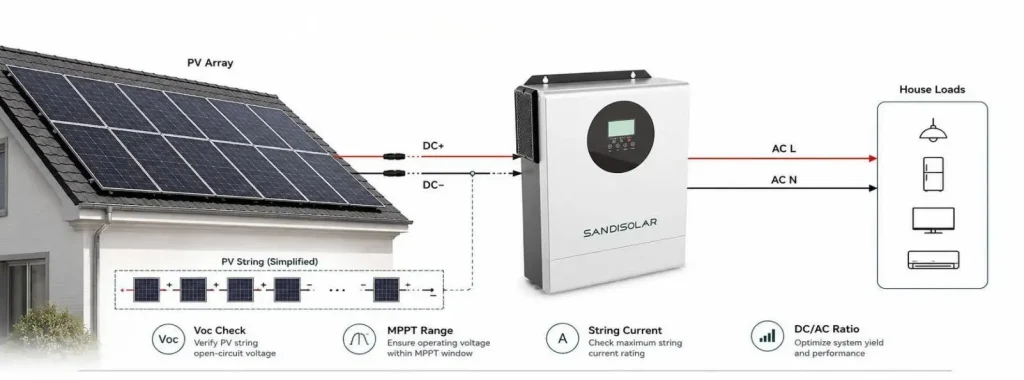
Electrical matching is one of the most important engineering stages in Residential Solar System Installation.
Total PV wattage alone is not enough.
| PV-Side Parameter | Inverter Parameter | Engineering Check |
| String Voc | Maximum DC voltage | Prevent DC overvoltage |
| String Vmp | MPPT operating range | Maintain stable tracking |
| String Imp | MPPT input current | Avoid current clipping |
| String Isc | Maximum input current | Verify electrical limit |
| PV array kWp | Rated AC output | Establish DC/AC ratio |
Check String Voc at Minimum Temperature
PV module open-circuit voltage increases as cell temperature falls.
The designer should verify:
Modules per string × temperature-corrected Voc < inverter maximum DC voltage
Using only the module's STC Voc can underestimate cold-weather string voltage and create an input-overvoltage risk.
Keep Vmp Inside the MPPT Window
String operating voltage should remain inside the inverter's MPPT range under expected operating conditions.
Too few modules can produce insufficient MPPT voltage. Too many modules can push Voc close to the maximum DC limit.
For roofs with east/west orientations or separate shading conditions, independent MPPT inputs can also improve array configuration flexibility.
Select a Practical DC/AC Ratio
An 8 kWp PV array does not always require an 8 kW inverter.
Moderate DC oversizing may increase inverter utilization during mornings, evenings, and lower irradiance. Excessive oversizing, however, can increase clipping and exceed manufacturer input limits.
The suitable DC/AC ratio depends on:
• Local irradiance
• Module orientation
• Inverter maximum PV input
• Export restrictions
• Expected clipping
• System economics
The inverter datasheet, rather than a universal ratio, should define the allowable design envelope.
Grid-Tied, Hybrid or Off-Grid?
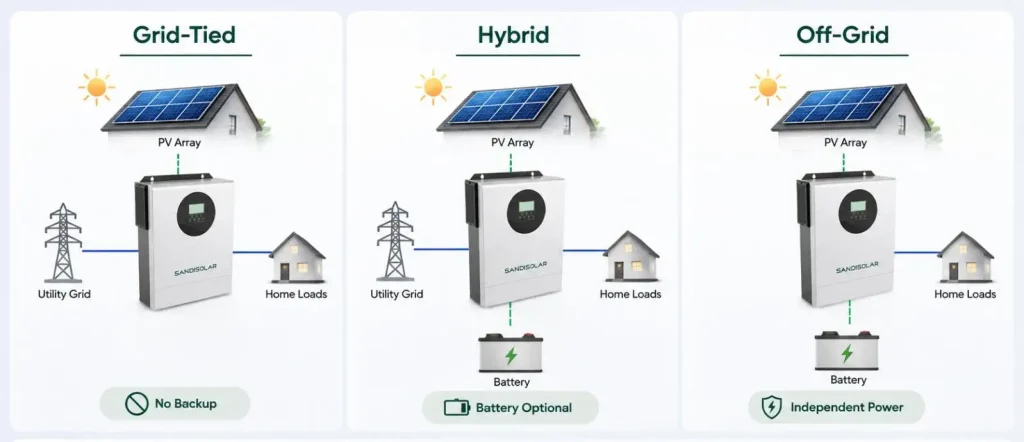
The architecture of a Residential Solar System Installation should match grid conditions and backup expectations.
| System | Battery | Blackout Operation | Typical Application |
| Grid-Tied | Usually no | Normally unavailable | Stable utility grid |
| Hybrid | Optional/Yes | Available when correctly configured | Self-consumption + backup |
| Off-Grid | Required | Yes | Remote or unreliable-grid sites |
A standard grid-tied inverter normally shuts down when utility power disappears because of anti-islanding protection.
A homeowner requiring backup needs compatible equipment such as:
• Hybrid inverter
• Battery storage
• Backup/EPS output
• Transfer equipment
• Dedicated critical-load circuit
Off-grid design requires additional energy reserve because the utility grid cannot compensate during consecutive low-solar days.
String Inverter vs. Microinverter vs Optimizer
The roof determines the preferred topology.
String Inverter
Best suited to:
• Simple roof geometry
• Similar module orientation
• Limited shading
• Centralized system architecture
Microinverter
Useful where:
• Roof sections face different directions
• Shading varies by module
• Module-level monitoring is required
Power Optimizer
Can provide module-level DC control while retaining centralized DC-to-AC conversion.
No architecture is universally superior. Residential Solar System Installation should select the topology according to roof complexity, maintainability, monitoring requirements, and project economics.
Battery Capacity Must Be Matched in Both kWh and kW
Battery sizing is often reduced to storage capacity alone.
That is incomplete.
| Battery Parameter | What It Determines |
| Nominal capacity | Total stored energy |
| Usable capacity | Energy available to loads |
| Continuous discharge power | Simultaneous load capability |
| Peak discharge power | Short-duration high loads |
| DoD | Usable operating range |
| Charge/discharge current | Power limitation |
| Communication | Inverter-BMS compatibility |
A 15 kWh battery can store substantial energy but may still be unable to operate a large heat pump if its discharge-power limit is too low.
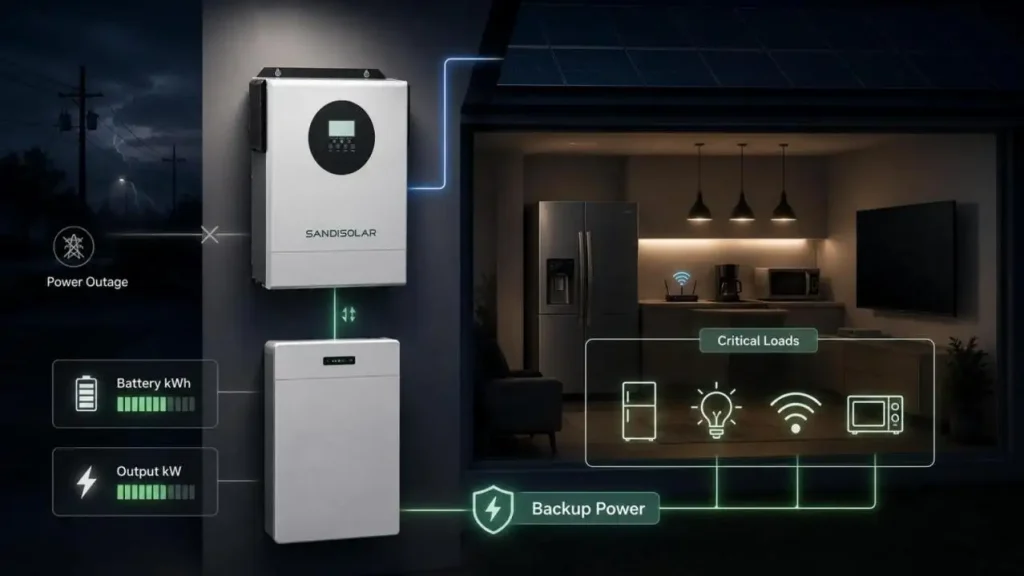
Whole-Home vs. Critical-Load Backup
Critical-load backup typically reduces both inverter and battery requirements.
Typical priority circuits include:
• Refrigerator
• Lighting
• Network equipment
• Security system
• Selected sockets
• Essential pumps
Whole-home backup requires substantially higher continuous and surge power.
Roof and BOS Design Cannot Be Ignored
Before installation, verify:
• Usable roof area
• Roof condition and remaining service life
• Wind and snow load
• Mounting attachment method
• Waterproofing
• Fire and access clearances
• DC cable routing
• Voltage drop
• Grounding/bonding
• DC and AC isolation
• Surge protection
High-wattage modules are not automatically better. Larger modules may reduce module count but can complicate roof layout, handling, mounting loads, and string configuration.
Commissioning a Residential Solar System Installation
Installation is complete only after electrical and functional verification.
Commissioning should include:
• String polarity check
• String Voc measurement
• Insulation verification
• Inverter parameter setup
• Grid setting verification
• Battery-BMS communication test
• Charge/discharge test
• Monitoring connection
• Backup transfer test
• Critical-load operation test
Post-installation monitoring should compare actual production against expected yield rather than waiting for a complete system failure.
Confirm Standards Prior to Procurement
Requirements vary based on installation country and utility.
The following are some areas that commonly require verification:
• PV module safety and performance
• Inverter safety and performance
• Anti-islanding and grid connection
• Battery safety
• Electrical system installation
• Fire protection
• Structural loading
Regarding equipment evaluations, standards such as IEC 61215 and IEC 61730, etc.; all may be applicable. Local grid rules and/or the local authorities may have additional requirements.
The certification of one component of a Residential Solar System Installation does not automatically constitute certification of the entirety of the Residential Solar System Installation.
What Should a Residential Solar System Quotation Include?
A professional quotation should specify more than "10 kW solar system."
Ask for:
• Module model/specification and quantity
• PV string configuration
• MPPT allocation
• Inverter rated and surge power
• Battery usable kWh and discharge kW
• Mounting structure
• Cables and connectors
• DC/AC protection devices
• Monitoring equipment
• Applicable certifications
• Warranty terms
• Wiring diagram and technical documents
A well-designed Residential Solar System Installation is ultimately a system-matching exercise, not a collection of individual products.
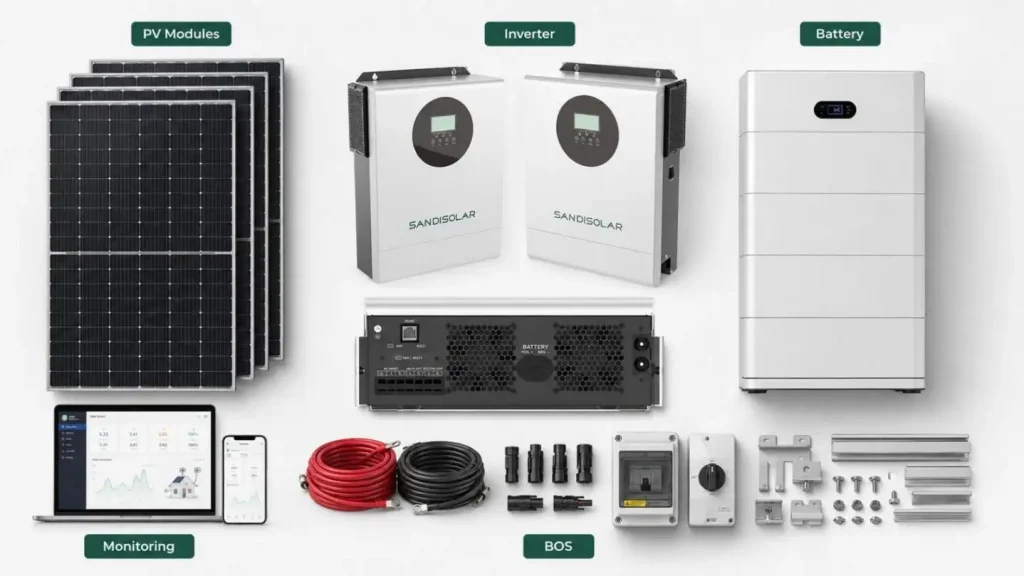
For projects requiring coordinated PV generation, inverter conversion, and battery storage, SANDISOLAR can support residential system configuration based on load demand, grid conditions, roof limitations, and backup requirements. Providing these project parameters before quotation allows the system specification to be built around the application rather than around a generic pre-sized package.
FAQs
Q1. Does SANDISOLAR offer solutions for Residential Solar System Installation?
Yes. SANDISOLAR offers solutions for both the Residential PV System and the Residential Energy Storage System, and offers a line of solar modules, inverters, batteries, and ESS products which can be combined based on the project requirements.
Q2. Can SANDISOLAR pair an inverter and a battery for a residential solar system?
Yes. SANDISOLAR describes a system-matching approach that analyzes household loads, PV arrays, inverter type and configuration, battery voltage, and regional conditions of the supplied AC power.
Q3. What information should buyers provide to SANDISOLAR to request a Residential Solar System Installation solution?
The following information should be used as a baseline to provide SANDISOLAR with project data:
• Daily and annual electricity consumption
• Maximum household load
• Grid voltage and frequency
• Roof conditions
• Required backup hours
• Critical loads
• Preferred battery capacity
Except for the nominal rating of a chosen module, providing the above information will allow the rest of the system configuration to be based on actual conditions rather than just a desired kW rating.
Q4. Does SANDISOLAR manufacture solar inverters and batteries?
Yes. SANDISOLAR has a complete line of off-grid inverters, batteries, and energy storage systems as well as solar modules and other smart-energy solutions, so customers can see the range of products for inverters and storage systems.
Q5. Does SANDISOLAR provide battery storage for home solar systems?
Yes. SANDISOLAR provides lithium batteries and residential energy storage systems that use LiFePO4 batteries and are designed for solar storage, backup power, and off-grid use.


Contact Us
In This Article
Related Posts
48V 6kW Off Grid Inverter: Why 48V Battery Systems Are Common for Higher-Power Solar Systems
August 31, 2026
Residential Solar System Installation: Technical Sizing, System Matching and Installation Guide
August 31, 2026
48 Volt Inverter for Solar Battery Storage: Key Specifications Buyers Should Compare
August 27, 2026