
6.2kW 48V Off-Grid Solar Inverter Explained: Smarter Daily Energy Use
By hqt
2026.02.24Related Posts
48V 6kW Off Grid Inverter: Why 48V Battery Systems Are Common for Higher-Power Solar Systems
August 31, 2026

Residential Solar System Installation: Technical Sizing, System Matching and Installation Guide
August 31, 2026

48 Volt Inverter for Solar Battery Storage: Key Specifications Buyers Should Compare
August 27, 2026
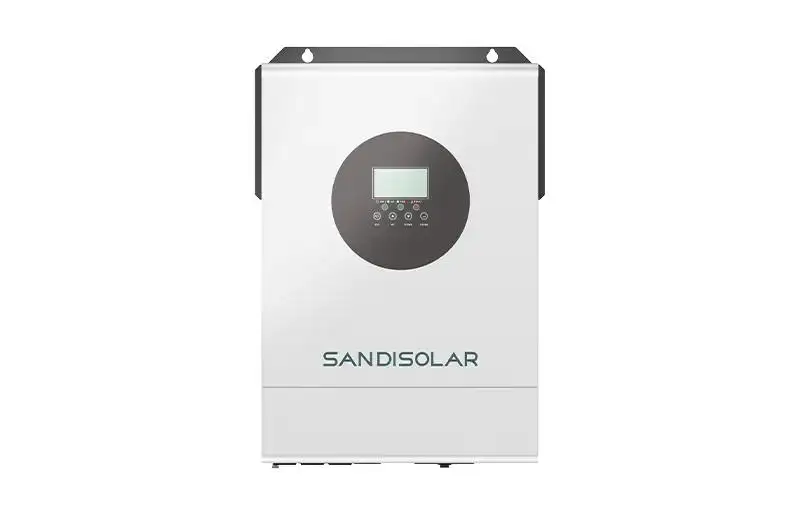
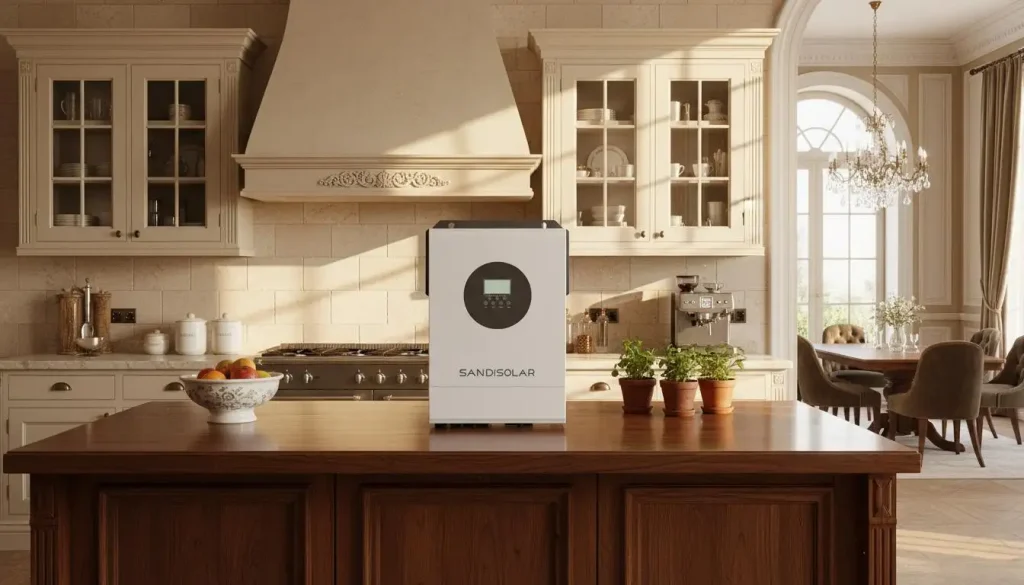
6.2kw 48v Off-Grid Solar Inverter is no longer only for "remote cabins." In 2026, it is becoming a smart daily-power tool for families and small businesses that want stable electricity, lower bills, and real energy control—especially where the grid is weak, expensive, or simply unavailable. At SANDISOLAR, we designed the SD-HYM-4862HWP to make off-grid power feel normal: quiet, steady, and easy to manage, even for beginners.
What "Smarter Daily Energy Use" Means in 2026
Many people think off-grid systems exist only for blackouts. In reality, the best systems work every day. "Smarter daily energy use" means your inverter helps you use solar power at the right time, reduce wasted PV energy, and avoid running a generator more than necessary.
A practical daily goal looks like this: use solar to carry daytime loads, charge a battery when there is extra PV, and keep stable AC output for evening use. When the weather changes, the system should adapt smoothly instead of forcing you to adjust settings all the time. This is why an inverter is not just a converter. It is the "energy traffic controller" of the whole system.
For home owners, the key is choosing a platform that supports today's needs and tomorrow's expansion. That is exactly where a 6.2kw 48v Off-Grid Solar Inverter can become the right middle size: strong enough for real household loads, but still practical to install and scale.
Meet the SD 6.2kW 48V Pure Sine Wave Off-Grid Solar Inverter
SANDISOLAR's SD-HYM-4862HWP is rated at 6.2kVA / 6.2kW, built around pure sine wave output for stable power quality. This matters because modern homes are full of devices that dislike "rough" electricity, such as variable-speed motors, control boards, and sensitive electronics.
Instead of chasing long spec sheets, we focus on features that improve daily life:
✔ Built-in 120A MPPT to capture more usable solar energy during changing sunlight
✔ PV input up to 500Vdc max to support flexible solar string design
✔ Compatible with LiFePO4 batteries for safe, long-life energy storage
✔ Built-in WiFi for easier monitoring and basic system visibility
✔ RS485 communication to support lithium battery communication
✔ Parallel support up to 12 units for single-phase or three-phase expansion
The goal is simple: make solar-first power reliable, easy to grow, and cost-effective over time.
Why 120A MPPT and 500V PV Input Matter in Real Life
• How MPPT Turns Sunlight Into Usable Savings?
MPPT (Maximum Power Point Tracking) is not a "nice to have." It is the difference between solar panels that look good on paper and solar panels that actually reduce your daily costs. With a 120A high-current MPPT, the inverter can process strong solar charging current when sunlight is available. This helps you store more energy for later and rely less on utility or generator power.
In daily use, MPPT matters most when conditions are not perfect—morning, afternoon, partial cloud, seasonal sun angles. A stronger MPPT stage can respond faster and keep the PV operating point closer to the best output level.
• Higher PV Input Lets Your System Breathe
A 500Vdc max PV input gives more options for how you design your solar strings. In many real projects, flexible PV design saves time and reduces wiring complexity. It can also support longer cable runs in remote sites when planned correctly, because string configuration can be optimized for the site and layout.
For users, this flexibility often translates to a cleaner installation path: fewer compromises, easier expansion, and more predictable performance.

Battery-Ready And Battery-Less: Two Practical Paths
Some users want a battery from day one. Others want to start with solar and add storage later. This is why we highlight "battery-ready thinking."
The SD-HYM-4862HWP supports LiFePO4 compatibility and includes lithium battery activation "by PV or utility." In plain language, this helps lithium systems start and operate properly under real conditions, instead of feeling fragile or difficult.
It also supports a battery-less operation mode. This option can be useful in specific designs where users want to maximize direct solar utilization during the day. It is not the best fit for every home, but for certain daytime-load scenarios, it can reduce complexity and improve PV utilization.
A simple beginner decision path:
✔ If you need night power and outage protection, add LiFePO4 storage
✔ If your main load is daytime and predictable, battery-less can be considered
✔ If you are unsure, start battery-ready so you can upgrade without redesign
This is how a 6.2kw 48v Off-Grid Solar Inverter supports a smarter step-by-step build, instead of forcing one "all-in" decision.
Parallel Expansion Up to 12 Units: Scale Without Rebuilding
A system that cannot grow becomes expensive later. Parallel networking of up to 12 units is not only for industrial projects. It is also a practical upgrade path for users whose needs increase over time: adding rooms, adding equipment, or switching more circuits to solar.
With parallel support, you can build:
✔ A stronger single-phase system for higher load capacity
✔ A three-phase system for sites that require three-phase power
✔ Redundancy options where uptime is valuable
The key benefit is flexibility. Instead of replacing your inverter when you outgrow it, you expand the platform. That protects your original investment and reduces long-term cost.
SANDISOLAR also designs details for real environments. A detachable dust cover supports harsh conditions where dust, sand, or workshop particles are part of everyday life. For users, this is not a cosmetic feature. It helps maintain stable performance and reduces maintenance pressure.
CTA: If you are planning an off-grid build or an upgrade in 2026, talk to SANDISOLAR about the SD-HYM-4862HWP. Share your load list and site type, and we can recommend a clean configuration path that fits both today's needs and future expansion.
Where This Inverter Fits Best, Plus FAQs for Beginners
SANDISOLAR off-grid inverter systems are built for places where grid access is unavailable, unreliable, or not worth the cost. Frequent scenarios include off-grid living/work, mobile power on the move, and proactive backup.
Typical application categories:
• Remote/field: mountain cabins, ranch outposts, islands, field units
• Mobile: RVs, campers, boats
• Backup: homes and critical spaces during unexpected outages
FAQ
Q1: What can a 6.2kW 48V off-grid solar inverter run at home?
Properly configured, it supports most daily essentials. Start with always-on loads (lighting, refrigerator, internet gear, fans). A pure sine wave lowers electrical noise and supports smooth, quiet motor runs.
Q2: Why 48V vs 24V at this level?
48V is more cable‑efficient and thermally favorable than 24V at high power, which is why it's standard for ~6 kW systems. Higher voltage means lower current for the same watts, which cuts heat and improves wiring efficiency—making 48V a practical choice for 6kW-class systems.
Q3: Do I Need A Battery From The Start?
Not always. If your key loads are daytime loads and solar is steady, battery-less operation can be an option. If you need stable night power and outage readiness, a LiFePO4 battery is the practical path.
Q4: Can I Expand Later Without Replacing The Inverter?
Yes. The SD-HYM-4862HWP supports parallel networking up to 12 units, enabling single-phase or three-phase scaling. This is one of the most cost-friendly ways to grow an off-grid system over time.
Q5: How Do I Monitor The System Easily?
This model includes built-in WiFi, which supports basic monitoring. It also supports lithium battery communication via RS485, helping the system coordinate with compatible batteries.
Q6: What Is One Common Beginner Mistake?
Sizing only by "watts" and ignoring usage patterns. Smarter daily energy use comes from matching PV input, inverter size, and battery capacity to when you consume energy—not only how much you consume.
CTA: Ready to design a practical, scalable off-grid system? Contact SANDISOLAR and ask for an SD-HYM-4862HWP configuration suggestion based on your location, loads, and whether you want battery-first or solar-first.
Share on Social:


Contact Us
In This Article
Related Posts
48V 6kW Off Grid Inverter: Why 48V Battery Systems Are Common for Higher-Power Solar Systems
August 31, 2026
Residential Solar System Installation: Technical Sizing, System Matching and Installation Guide
August 31, 2026
48 Volt Inverter for Solar Battery Storage: Key Specifications Buyers Should Compare
August 27, 2026