
Choosing A Household Energy Storage Battery: Cycles, BMS, And Value
By hqt
2026.02.24Related Posts
48V 6kW Off Grid Inverter: Why 48V Battery Systems Are Common for Higher-Power Solar Systems
August 31, 2026

Residential Solar System Installation: Technical Sizing, System Matching and Installation Guide
August 31, 2026

48 Volt Inverter for Solar Battery Storage: Key Specifications Buyers Should Compare
August 27, 2026
A Household Energy Storage Battery is no longer a niche choice. It is becoming a core part of modern home energy planning. Yet many buyers compare only capacity and price. The real decision starts elsewhere: cycle life, BMS protection, and long-term value. The most important detail is often the one not listed first.

Understand What "Cycles" Really Mean for Daily Use
A "cycle" is one full charge and discharge. In a home system, cycles matter because your battery may work every day—store solar power in the afternoon, then power your home at night. Over time, a low-cycle battery loses usable capacity faster, which raises the true cost of ownership.
SANDISOLAR LiFePO4 solutions are designed for frequent cycling and long-term use. For many households, the goal is not "the biggest battery." The goal is a battery that still performs well after years of normal routines. When you see 6,000 cycles under standard conditions, it signals that the battery chemistry and internal design are built for longevity, not short-term performance.
In plain terms, higher cycle life can give you:
✅More years of useful capacity before replacement becomes necessary
✅Better payback when you use solar self-consumption daily
✅Less worry about performance drop after heavy seasons (summer AC, winter heating)
Why a Strong BMS Is the Non-Negotiable Feature
A battery is not just "cells in a box." The Battery Management System (BMS) is the brain that protects the battery and helps it work safely with your inverter, solar charger, and home loads. For beginners, BMS quality is often the difference between a stable system and constant troubleshooting.
SANDISOLAR batteries use a built-in BMS to guard against common risks such as overcharge and short circuits. This matters because household usage is not perfectly predictable. Appliances start suddenly. Loads change. Charging conditions shift with weather.
A practical BMS helps you in real life by supporting:
✅Protection against overcharge and short circuit
✅More consistent performance during daily load changes
✅Cleaner system behavior when solar input rises and drops
What to look for when comparing BMS claims: choose brands that clearly state protection functions and pair them with a battery chemistry known for stability. That combination reduces risk and improves long-term reliability.
LiFePO4 Safety and Stability: Value Beyond Specs
When homeowners talk about battery safety, they usually mean one thing: "I want strong performance without extra fear or extra maintenance." This is where lithium iron phosphate (LiFePO4) chemistry shines. It is widely recognized for a strong safety profile, and it helps reduce fire and thermal risk compared with more reactive lithium chemistries.
From a manufacturer viewpoint, safety is not a marketing line. It is the result of chemistry choice, internal structure, and protection design working together. For households, that safety becomes daily comfort: you can place your system in a garage, utility room, or dedicated storage area with more confidence, while still getting stable energy output.
Just as important, LiFePO4 systems are typically suited for minimal maintenance. A battery that is stable and consistent saves time and reduces ownership stress.
Match Voltage and Capacity to Your Home System
The "best" Household Energy Storage Battery is the one that matches your system design. Many residential systems are built around common voltage levels, and choosing the right one helps reduce wiring complexity and improves compatibility.
Here are examples from the SANDISOLAR lineup to show how specifications map to real needs:
• Rack-Mounted Home Modules (Compact, Expandable)
The SD-Rack-Mounted Hvs-R60 is a rack-style energy storage module designed for clean installation and neat expansion. A typical module specification is 5.12 kWh, 51.2 V, 100 Ah—a format many homeowners and installers like because it fits structured ESS cabinets and keeps the system organized.
• Larger 51.2V Options (More Runtime For Bigger Loads)
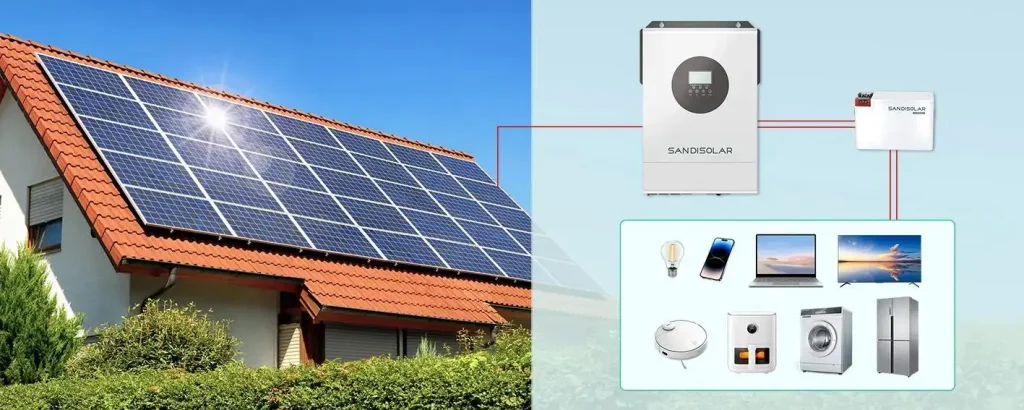
For homes with higher nightly usage, or for off-grid cabins, higher-capacity models can offer longer runtime. SANDISOLAR provides options such as 51.2 V 200 Ah, 51.2 V 300 Ah, and 51.2 V 320 Ah LiFePO4 batteries. In simple terms, higher Ah usually means more stored energy at the same voltage, which can support longer backup or deeper solar self-use.
A good matching process looks like this:
✅Confirm your inverter's supported battery voltage range
✅Estimate your nightly energy use and essential backup loads
✅Select a capacity that fits your budget now, but allows growth later
• Go Modular: Stackable Systems Reduce Upgrade Pressure
Many households hesitate because they fear choosing "too small" or "too large." A stackable, modular structure solves that. Instead of overbuying on day one, you start with a sensible capacity and expand as your lifestyle changes.
SANDISOLAR's stackable and rack-based designs support modular capacity expansion. This creates practical value:
✅Add capacity when your family's energy use increases
✅Expand after installing more solar panels
✅Scale backup time without replacing the whole system
If your goal is energy independence, modularity is not a luxury—it is a strategy. It protects your investment by keeping your first purchase useful even when your needs evolve.
Check Certifications, Efficiency, and the Real "Value" Equation
Value is not only the purchase price. Value is safety, performance, lifespan, and how smoothly the system runs with your solar and inverter.
SANDISOLAR products are built to meet international expectations for safety and quality, including CE, RoHS, ISO 9001, and UL, with relevant standards such as IEC 62109 supporting system integration needs. For homeowners, certifications matter because they reduce project risk and support smoother compliance in many markets.
For higher-voltage energy storage designs, SANDISOLAR also emphasizes system performance. For example, high-voltage ESS solutions can reach ≥97% efficiency and are designed for a ≥10-year lifespan under intended operating conditions. That kind of planning mindset is what turns a battery from "equipment" into a long-term home energy asset.
CTA (Next Step With SANDISOLAR)
If you are planning a solar-plus-storage system or upgrading an older setup, SANDISOLAR can help you choose a Household Energy Storage Battery based on your inverter type, target backup loads, and expansion plan. Send your critical load list and preferred backup duration, and we'll match and price the most suitable LiFePO4 battery and modular design.
Make the call easy by focusing on three essentials—cycle life, BMS protection, and modular design for long-term value.


Contact Us
In This Article
Related Posts
48V 6kW Off Grid Inverter: Why 48V Battery Systems Are Common for Higher-Power Solar Systems
August 31, 2026
Residential Solar System Installation: Technical Sizing, System Matching and Installation Guide
August 31, 2026
48 Volt Inverter for Solar Battery Storage: Key Specifications Buyers Should Compare
August 27, 2026