
Off-Grid Solar Inverter Basics: MPPT, PV Input & Safe Output Explained(2026)
By hqt
2026.02.20Related Posts
48V 6kW Off Grid Inverter: Why 48V Battery Systems Are Common for Higher-Power Solar Systems
August 31, 2026

Residential Solar System Installation: Technical Sizing, System Matching and Installation Guide
August 31, 2026

48 Volt Inverter for Solar Battery Storage: Key Specifications Buyers Should Compare
August 27, 2026
Off-Grid Solar Inverter systems are becoming the quiet backbone of reliable power in remote homes, businesses, and mobile projects that cannot depend on the utility grid. As SANDISOLAR, we design these systems to be simple to understand, safe to operate, and ready for real-world use in 2026 and beyond.
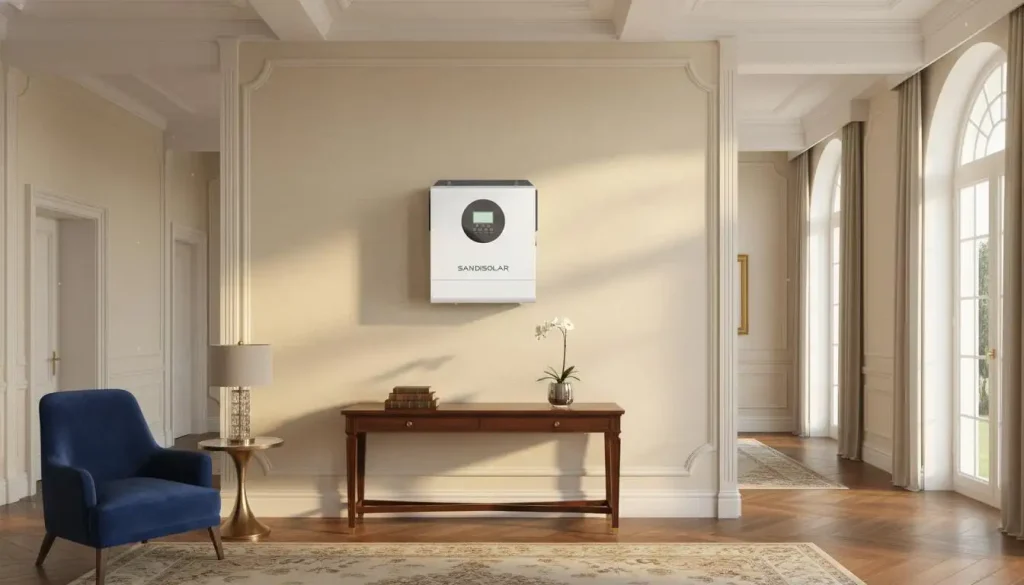
What Is an Off-Grid Solar Inverter?
An Off-Grid Solar Inverter is the “translator” between your solar panels, batteries, and AC loads. Solar panels produce DC power. Your appliances, tools, and office electronics need AC power. The inverter takes DC from solar panels (and often from batteries) and converts it into clean AC power at the correct voltage and frequency.
Unlike grid-tied inverters, an Off-Grid Solar Inverter does not rely on the public grid at all. It becomes the “local grid” for your home, farm, worksite, or vessel. This is why stability, protection, and efficiency are more than technical words—they decide whether your lights stay on and your equipment survives voltage fluctuations.
In 2026, customers also expect more than simple conversion. They want smart charging, monitoring, and the flexibility to connect solar, batteries, and generators in one integrated system. This is exactly where MPPT, PV input range, and safe output performance matter.
Why MPPT Matters for Real-World Solar Yield
MPPT stands for Maximum Power Point Tracking. In simple terms, it is the brain inside an Off-Grid Solar Inverter that constantly adjusts how the panels are loaded so they operate at their most efficient point.
Panels rarely work under perfect conditions. Clouds move, temperatures rise, and partial shading happens. Without MPPT, a part of your solar energy is wasted every day. With a good MPPT controller built into the inverter, the system automatically finds the best combination of voltage and current from the panels, even as conditions change.
For example, in SANDISOLAR systems, high-performance MPPT controllers are integrated directly into the inverter.
✔ They help capture more energy from the same PV array.
✔ They reduce payback time by improving daily kWh production.
✔ They simplify installation, because you do not need a separate charge controller.
For many projects—remote homes, cabins, or telecom sites—this can be the difference between a system that “just works on paper” and a system that still powers everything on a cloudy day.
Understanding PV Input: Voltage, Power and String Design
The PV input specification tells you how your solar panels can be connected to the Off-Grid Solar Inverter. It usually includes maximum PV voltage and maximum PV power. These numbers guide how many panels you can connect in series and how many strings in parallel.
SANDISOLAR off-grid models support high PV input conditions. For instance:
✔ Selected 48V models accept up to around 6,500 W of PV input power, enough to support higher daytime loads and faster battery charging.
✔ Our 24V Off-Grid Solar Inverter options accept up to around 5,000 W of PV input, giving small and mid-size systems enough headroom for expansion.
A wider PV voltage window gives installers more flexibility in string design. It also keeps system expansion straightforward, allowing you to add more panels later without having to redesign the system from the ground up. For owners, this means you can launch with a smaller PV array and expand over time as your energy demand increases or your budget supports growth.
Safe Output: Pure Sine Wave, Fast Switching and Protection
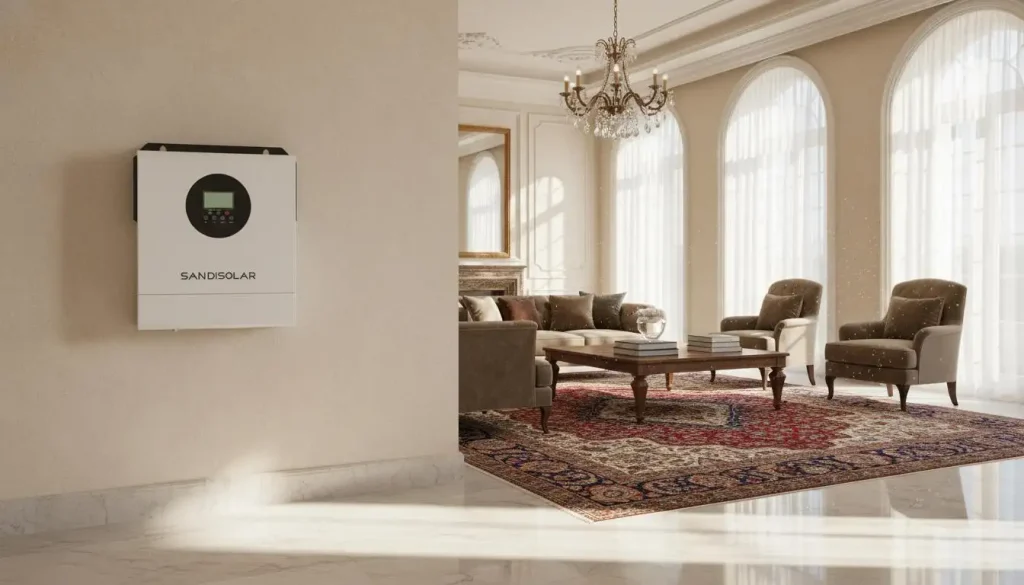
When we mention “safe output” in an Off-Grid Solar Inverter, we're addressing three core criteria: the cleanliness of the waveform, the steadiness of operation, and the robustness of protections.
- Pure Sine Wave Output
SANDISOLAR inverters provide a pure sine wave output that replicates the form and quality of utility power. This is essential for:
✔ Precision electronics—computers, network devices, and communications equipment.
✔ Modern home and industrial loads with variable-speed drives and microprocessor control.
✔ Curtailing excess heat, vibration, and acoustic noise in motors/transformers to prolong life.
- Stable Voltage And Frequency
Our Off-Grid Solar Inverter family is engineered to regulate voltage and frequency within safe thresholds, even during rapid load fluctuations. This helps stop flickering lights, nuisance trips, and start-up induced shutdowns.
- Fast Transfer And Comprehensive Protection
When load demand spikes or a generator begins supplying power, seamless transfer response helps preserve continuous, stable output. To safeguard your installation, SANDISOLAR Off-Grid Solar Inverters come standard with broad protections, including:
✔ Overload and short-circuit protection to help protect the inverter and connected loads from damage.
✔ Overcharge and over-discharge protection for lithium batteries across low- and high-voltage platforms.
✔ Active temperature management to support safe performance in tough environmental conditions.
In the field, this means your Off-Grid Solar Inverter acts as a robust, self-contained micro-grid—not a fragile electronic unit.
Inside SANDISOLAR Solutions: Power Classes and Use Cases
SANDISOLAR offers a comprehensive line of Off-Grid Solar Inverter products, from small systems for cabins to higher-capacity solutions for commercial sites, each designed with parallel capability and smart control features to match real-world needs. Instead of listing every number, it is more useful to see how the main power classes translate into real applications:
- 5.1 3–4.2 kW: Small Homes, Cabins And Mobile Systems
Our 24V models in the 3 kW to 4.2 kW range are ideal for:
✔ Remote cabins and small rural homes
✔ Mobile homes, RVs, and small marine systems
✔ Small offices or security stations
With up to around 5,000 W of PV input and built-in Wi-Fi on selected models, users can monitor performance, adjust parameters, and manage loads from a phone or laptop. The system can work with or without batteries, and can accept AC input from a generator when needed.
- 5.2 6.2–11 kW: Larger Homes And Ranches
Engineered for higher loads, our 48V Off-Grid Solar Inverters in the 6.2 kW and 11 kW range offer:
✔ Power for large homes operating multiple AC units
✔ Parallel expansion for scalable capacity—ideal for ranch operations
✔ Surge performance up to roughly twice the rated output for starting motors and driving heavy tools
These systems are often paired with high-capacity lithium battery banks and, where needed, diesel generators. Communication ports and monitoring functions allow integration into energy management systems, which is increasingly important for professional users.
As a manufacturer, we design each advantage—parallel support, wide PV input, Wi-Fi monitoring, generator compatibility—to give owners more control and less downtime, not just more specifications on a datasheet.
Reliability, Certifications and How to Move Forward in 2026
Harsh climates and infrequent maintenance windows make reliability a core requirement for off-grid sites. SANDISOLAR Off-Grid Solar Inverters meet this need and are manufactured within ISO 9001 quality systems. Many models are certified to CE, RoHS, UL, and IEC 62109, supporting smoother permitting and reducing long-term exposure for investors, EPCs, and owners.
For newcomers planning in 2026, a simple checklist is effective:
✔ Clarify your essential loads and daily consumption profile.
✔ Decide on the level of independence—occasional backup or full off-grid.
✔ Select the inverter size (e.g., 3 kW, 4.2 kW, 6.2 kW, 11 kW) to cover peak and surge loads.
If you want a quieter generator, a more predictable energy bill, and a system that you truly understand, choosing the right Off-Grid Solar Inverter is the first step.
Call to Action:
If you are planning a new off-grid project or upgrading an existing system, our engineering team at SANDISOLAR can help you size the correct inverter, PV array, and battery bank for your real load profile. Share your site details and target autonomy, and we will recommend a complete Off-Grid Solar Inverter solution that balances reliability, efficiency, and cost—ready for 2026 and the years ahead.


Contact Us
In This Article
Related Posts
48V 6kW Off Grid Inverter: Why 48V Battery Systems Are Common for Higher-Power Solar Systems
August 31, 2026
Residential Solar System Installation: Technical Sizing, System Matching and Installation Guide
August 31, 2026
48 Volt Inverter for Solar Battery Storage: Key Specifications Buyers Should Compare
August 27, 2026