
Off Grid Solar Power System With 200% PV Oversizing: When Does It Make Sense?
By hqt
2026.08.24Related Posts
48V 6kW Off Grid Inverter: Why 48V Battery Systems Are Common for Higher-Power Solar Systems
August 31, 2026

Residential Solar System Installation: Technical Sizing, System Matching and Installation Guide
August 31, 2026

48 Volt Inverter for Solar Battery Storage: Key Specifications Buyers Should Compare
August 27, 2026
PV oversizing is increasingly used in Off Grid Solar Power System design to improve solar availability outside peak irradiation hours. However, a larger PV array does not automatically mean higher usable power.
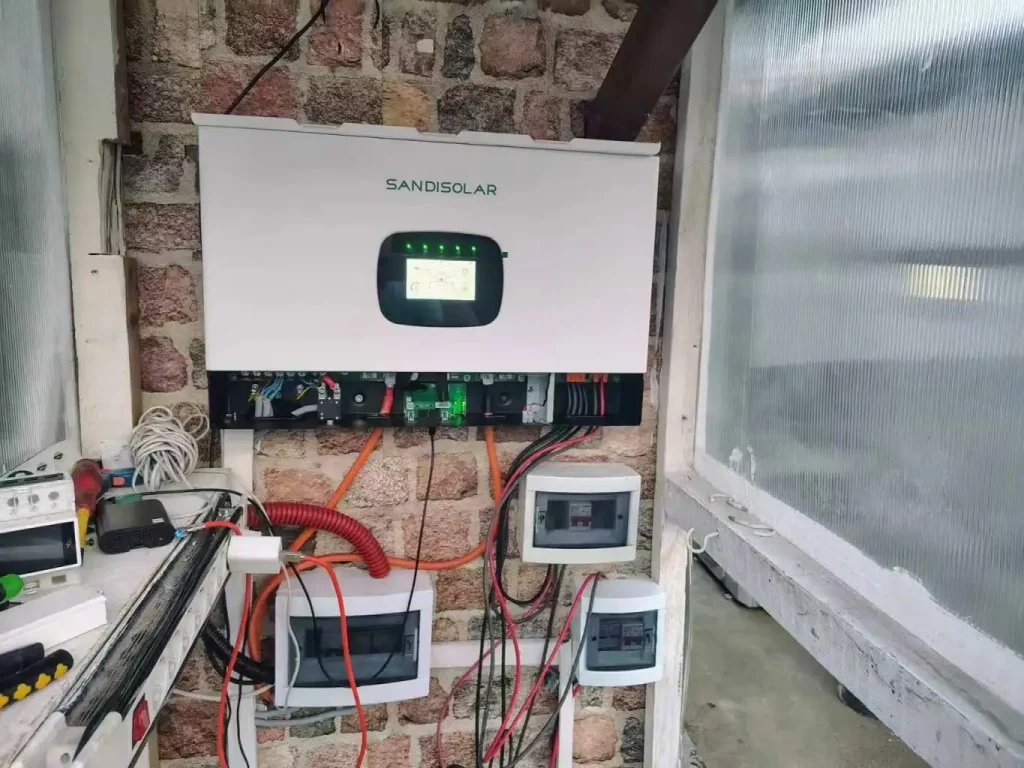
For an off-grid project, the real question is not simply whether the inverter supports a high DC/AC ratio. Engineers must determine whether the PV input stage, MPPT channels, battery bank, load profile, and backup strategy can actually absorb and use the additional solar energy.
This becomes especially important when discussing ratios approaching 200%.
What Does 200% PV Oversizing Actually Mean?
PV oversizing usually determines how much installed PV capacity is compared to the power of an inverter:
PV Oversizing Ratio = Installed PV Capacity / Reference Inverter Capacity
As an example, if there are 18kW modules wired to a 12kW inverter, it provides a nominal DC/AC ratio of:
18kW /12kW = 150%
This is relevant for Off Grid Solar Power System design.
The SD PRO 12kW Off-Grid Inverter from SANDISOLAR states 18,000W Maximum PV input power but also states PV oversizing up to 200%. This should not be taken to mean it is safe to connect a 24kW array directly to a 12kW inverter.
The configuration must still respect the published PV input limit on the inverter.
Key PV Input Limits
| Parameter | SANDISOLAR SD PRO Reference |
| Rated inverter power | 12kW |
| Maximum PV input power | 18,000W |
| Maximum PV input voltage | 500V |
| MPPT voltage range | 90–450V |
| Start-up voltage | 90V |
| Maximum MPPT current | 30A + 30A |
| Maximum short-circuit current | 44A + 44A |
For procurement, the stated oversizing percentage should therefore be confirmed against the exact inverter configuration and module string design.
Why Oversize PV in an Off Grid Solar Power System?
Solar modules rarely operate at STC nameplate output throughout the day.
Actual PV production is affected by:
•Module temperature
•Irradiance intensity
•Morning and afternoon sun angle
•Cloud cover
•Seasonal variation
•Module orientation
•Dust and contamination
•Cable and conversion losses
•Partial shading
An oversized array can keep the Off Grid Solar Power System closer to useful operating power for a longer period.
Instead of increasing inverter output above its rated limit, oversizing primarily increases daily available energy.
Typical Sizing Strategies
| PV/Inverter Ratio | Typical Application | Main Advantage | Main Limitation |
| 100–110% | Strong irradiation | Low DC investment | Lower weak-light production |
| 120–130% | Residential off-grid | Balanced energy yield | Moderate clipping |
| 140–150% | Farms, workshops, large storage | Longer charging window | Higher midday surplus |
| 150%+ | Project-specific applications | Strong low-irradiance performance | Requires detailed electrical validation |
The most aggressive ratio is not automatically the most economical.
MPPT Current Often Becomes the Real Limiting Factor
Many Off Grid Solar Power System designs focus on PV wattage while overlooking current.
Modern 550–700W modules can operate at relatively high current. Adding parallel strings may exceed the MPPT current limit even when total module wattage appears acceptable.
SANDISOLAR's dual MPPT architecture provides 30A + 30A maximum operating current, which can support high-power modules when strings are configured correctly.
Engineers must check four parameters simultaneously:
•Voc: maximum string open-circuit voltage
•Vmp: string operating voltage
•Isc: short-circuit current
•Imp: operating current
The following relationships are critical:
•Cold-weather string Voc < maximum inverter PV voltage
•String Vmp must remain within the MPPT operating range
•Parallel-string Imp ≤ MPPT input-current limit
•Corrected Isc ≤ permitted MPPT short-circuit current
This is why PV oversizing cannot be calculated from watts alone.
Battery Capacity Determines How Much Extra Solar Is Useful
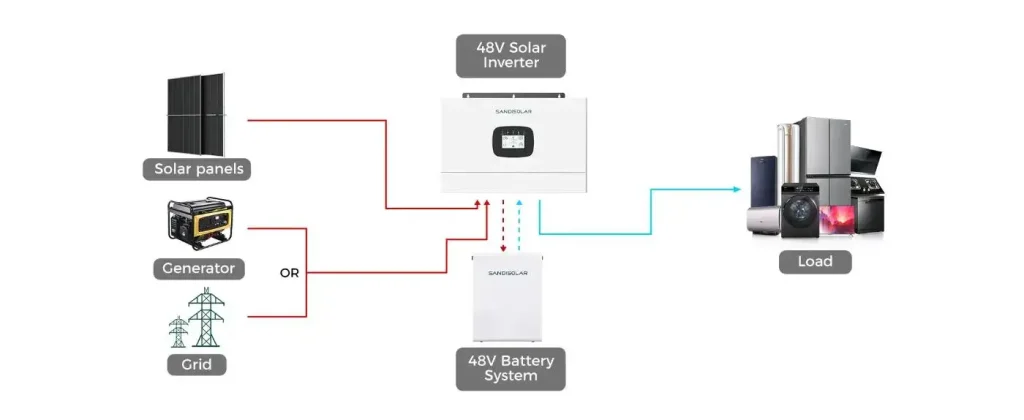
In an Off Grid Solar Power System, excess PV power cannot simply be exported to the utility grid.
Energy must be:
- Consumed by active loads,
- Stored in the battery,
- Used for controlled secondary loads, or
- Curtailed.
This makes battery design central to PV oversizing.
Compare Three Operating Conditions
Large battery + high overnight consumption
Oversizing is valuable because more morning solar power is available to restore battery SOC quickly.
High daytime load + moderate battery
Applications such as water pumps, HVAC, workshops and refrigeration can consume PV power directly.
Small battery + low daytime load
Heavy oversizing may provide limited benefit because the battery reaches its charging ceiling early and additional PV production must be reduced.
Battery assessment should include:
•Usable battery capacity in kWh
•Maximum charge current
•Maximum discharge current
•BMS current limits
•Depth of discharge
•Required autonomy
•Battery temperature limits
The SD PRO platform supports battery discharge current up to 280A, allowing an appropriately designed battery bank to support demanding off-grid loads.
PV Oversizing Does Not Solve Peak-Load Problems
A common design mistake is assuming that installing more panels will allow the inverter to start larger motors.
PV capacity and inverter surge capability are different engineering variables.
For loads such as:
•Air conditioners
•Water pumps
•Compressors
•Refrigerators
•Workshop motors
the Off Grid Solar Power System must be checked for both continuous power and starting surge.
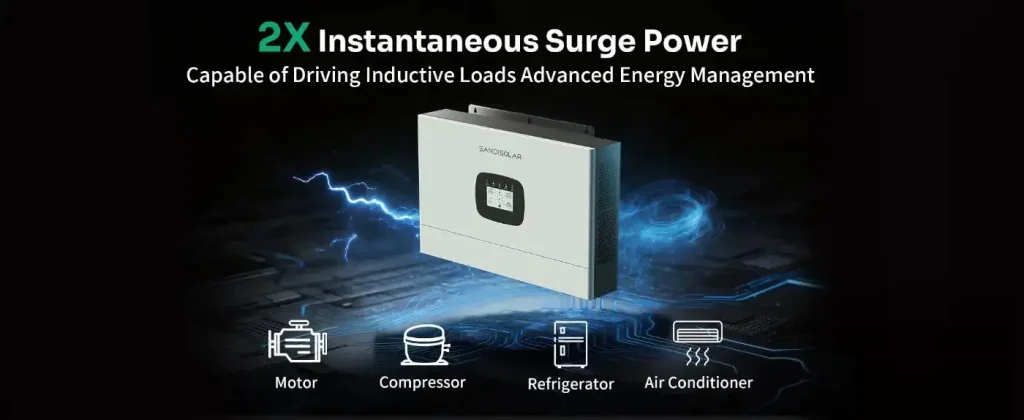
SANDISOLAR specifies up to 2× rated output for five seconds in off-grid mode, giving additional headroom for short-duration inductive loads.
However, battery discharge capability must also support that surge.
Generator Backup Changes the Optimal PV Ratio
PV oversizing is particularly useful where reducing generator operating hours is a priority.
SANDISOLAR integrates a GEN input port, allowing an Off Grid Solar Power System to combine:
PV → Battery → Load → Generator Backup
A larger solar array may reduce generator starts during weak irradiation periods, but the economic value depends on fuel cost, battery capacity and seasonal solar conditions.
Dual AC outputs can also separate critical and non-critical loads, preventing discretionary loads from unnecessarily discharging the battery.

Installation Checks for an Oversized PV Array
Before commissioning, verify:
•MPPT string allocation
•Maximum cold-weather Voc
•PV connector current rating
•DC cable ampacity
•DC voltage drop
•DC isolator rating
•Overcurrent protection
•Surge protection devices
•Grounding and bonding
•Inverter ventilation
•Battery communication and BMS settings
•Generator charging parameters
Periodic inspection should also check connectors, terminals, cable temperature, module contamination and cooling airflow.
When Does High PV Oversizing Make Technical Sense?
A highly oversized Off Grid Solar Power System is most suitable when:
•Local irradiation varies significantly
•Morning and afternoon generation is important
•Winter solar production is relatively low
•The battery has sufficient charging capacity
•Daytime consumption is substantial
•Generator runtime should be minimized
•MPPT electrical limits remain compliant
•Additional module cost is lower than the value of lost energy or fuel consumption
It is less attractive when the battery is already full for long periods, daytime loads are small, array space is limited or additional production would frequently be curtailed.
Specify the Complete Off Grid Solar Power System, Not Just the Oversizing Ratio
For SANDISOLAR projects, inverter selection begins with the complete energy profile rather than a headline DC/AC percentage.
Before finalizing an Off Grid Solar Power System, buyers should provide:
•PV module Voc, Vmp, Isc and Imp
•Proposed number of modules
•Minimum site temperature
•Daily energy consumption
•Maximum simultaneous load
•Motor and compressor loads
•Battery voltage and usable kWh
•Required backup duration
•Generator availability
SANDISOLAR can then match the PV array, MPPT configuration, storage capacity and load requirements against the inverter's actual electrical limits.
For an Off Grid Solar Power System using aggressive PV oversizing, a project-specific configuration is more valuable than simply selecting the highest published oversizing percentage. Providing SANDISOLAR with the module datasheet, load profile and battery requirements allows the system configuration to be evaluated before procurement and installation.
FAQs
Q1. What is PV Oversizing in an Off-Grid Solar Power System?
PV Oversizing refers to the addition of excess PV module capacity when compared to an inverter. While PV oversizing allows for continued energy generation in low-light conditions, there are limitations for the construction of the final system such as staying within the inverter's range in terms of PV voltage, current, MPPT tracking, and input power.
Q2. Does 200% PV oversizing ratio allow for the connection of twice the rated power of the inverter to the solar panels?
Not necessarily. The maximum allowable PV array is inverter specific. In such cases, the prospective buyer must consider the maximum PV input power, maximum DC input voltage, MPPT range, operating current, and short circuit current to set the final size of the PV array.
Q3. What PV inputs are of interest for the SANDISOLAR Off-Grid Solar Power System?
These include the Voc, Vmp, Isc and Imp of the solar modules; the maximum PV input voltage of the inverter; the MPPT (Maximum Power Point Tracking) voltage and current; local temperature; and short circuit current.
Q4. What is the purpose of the dual MPPT input for the SANDISOLAR 12kW off-grid inverter?
Separate MPPT inputs allow for separate management and control of string sections.Separate string management is useful in situations where the conditions on different sections are not the same and therefore vary. Under such conditions, it is favorable to use high-efficiency modules.
Q5. Can one use high power 600W-class modules in a SANDISOLAR Off Grid Solar Power System?
They can be installed, as long as they satisfy the inverter. No consideration is given to the wattage of the module. The operating current, short circuit current, string voltage, and the MPPT allocation also need to be checked.


Contact Us
In This Article
Related Posts
48V 6kW Off Grid Inverter: Why 48V Battery Systems Are Common for Higher-Power Solar Systems
August 31, 2026
Residential Solar System Installation: Technical Sizing, System Matching and Installation Guide
August 31, 2026
48 Volt Inverter for Solar Battery Storage: Key Specifications Buyers Should Compare
August 27, 2026