
Smart Energy Storage System With AI Energy Management: Technical Design, Load Control and System Matching
By hqt
2026.08.25Related Posts
48V 6kW Off Grid Inverter: Why 48V Battery Systems Are Common for Higher-Power Solar Systems
August 31, 2026

Residential Solar System Installation: Technical Sizing, System Matching and Installation Guide
August 31, 2026

48 Volt Inverter for Solar Battery Storage: Key Specifications Buyers Should Compare
August 27, 2026
A Smart Energy Storage System should do more than store surplus solar energy. In practical off-grid and backup applications, the system must continuously coordinate PV generation, battery state of charge (SOC), load demand, grid availability, and generator input.
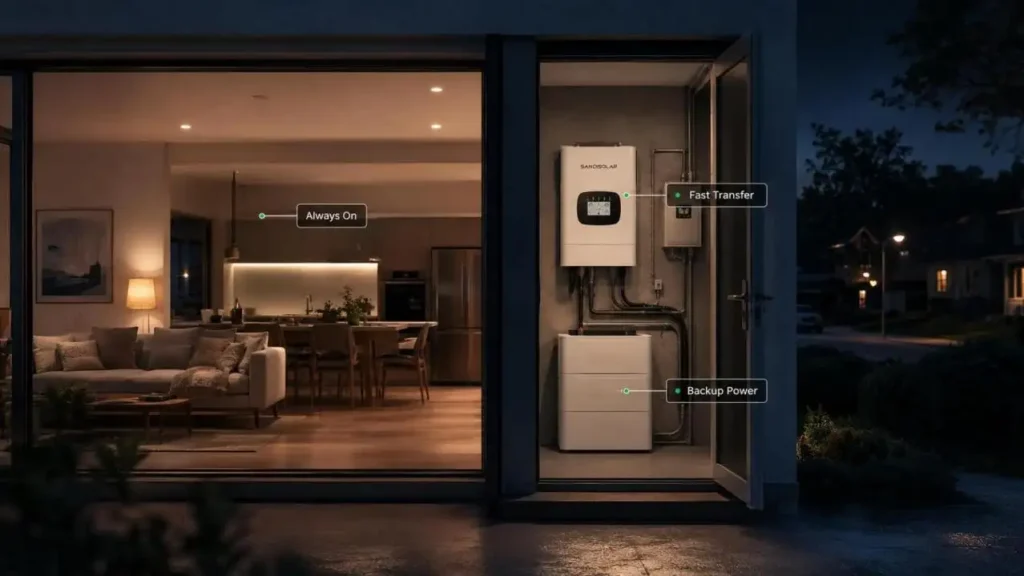
This is where AI-assisted energy management becomes relevant. Instead of treating the inverter, battery, PV array, and loads as isolated components, a Smart Energy Storage System uses operating data and configurable control logic to manage the complete energy flow.
For SANDISOLAR, this approach is reflected in functions such as wide-range MPPT input, dual AC inputs, dual AC outputs, fast transfer, remote monitoring, high battery charge/discharge current, and parallel expansion.
Why Storage Capacity Alone Does Not Guarantee Reliable Power
Many poorly configured systems have enough installed PV and battery capacity but still experience:
•Battery depletion before sunrise
•PV clipping or poor solar utilization
•Compressor startup failure
•Unnecessary generator operation
•Non-critical loads consuming backup capacity
•Equipment reboot during grid failure
The reason is that four separate parameters must be matched:
Energy capacity + continuous power + surge power + control strategy
A large battery solves an energy-duration problem, but it does not automatically solve peak-load or motor-starting problems.
How AI Energy Management Changes System Operation
The basic energy path of a Smart Energy Storage System can be represented as:
PV → Load → Battery → Grid / Generator
The control system determines how available sources are used according to operating conditions.
Energy Decisions That Matter
A practical energy management strategy may involve:
•Giving PV power priority when solar generation is available
•Charging batteries from excess PV production
•Maintaining a defined battery SOC reserve
•Switching to grid or generator input when battery energy reaches configured thresholds
•Separating essential and flexible loads
•Recording operating data and alarms for remote analysis
However, WiFi monitoring should not automatically be described as AI control. Monitoring displays operating information; intelligent energy management involves using that information to support or execute energy-management decisions.
Smart Energy Storage System Architectures Compared
System architecture should be selected according to grid conditions, load profile, and backup requirements.
| System Architecture | Best Application | Main Design Consideration |
| PV + Battery | Fully off-grid homes | Storage must cover low-solar periods |
| PV + Battery + Grid | Unstable-grid areas | Grid can supplement battery charging |
| PV + Battery + Generator | Remote farms, ranches, workstations | Generator integration and start/stop strategy |
| Parallel Inverter System | Higher or expanding loads | Communication, synchronization and battery design |
SANDISOLAR's off-grid inverter platform supports independent grid/generator inputs and parallel connection of up to nine units, providing a scalable foundation for applications where future load growth must be considered.
Parallel operation, however, should be treated as a system-engineering issue rather than simply multiplying inverter power. Installers must also confirm phase configuration, communication, battery-side current, protection devices, and permitted parallel topology.
PV Matching: Power, Voltage and Current Must Be Checked Together
For the referenced SANDISOLAR platform, key PV-side specifications include:
| PV Parameter | Specification | Engineering Meaning |
| Maximum PV Input Power | 9000W | Maximum supported PV array input |
| Maximum PV Voltage | 550V | Upper DC voltage limit |
| Start-Up Voltage | 120V | Minimum voltage required for startup |
| MPPT Range | 90–500V | Effective tracking voltage window |
| Max. Current per MPPT | 27A | PV operating current limit |
| Max. Short-Circuit Current | 32A | PV Isc design limit |
These values cannot be evaluated separately.
Why MPPT Voltage Range Matters
The PV string Vmp should remain within the 90–500V MPPT operating range under normal conditions.
At the same time, installers must verify that temperature-corrected string Voc stays below the 550V maximum PV input voltage, particularly in cold weather.
Why 27A PV Input Current Matters
Modern high-power modules often operate at higher current. A PV array can remain below the 9000W power limit while still exceeding MPPT input-current limits.
PV design should therefore check:
•Module Voc and Vmp
•Module Imp and Isc
•Number of modules in series
•Number of parallel strings
•Low-temperature Voc
•MPPT current limit
Importantly, 9000W PV input does not mean 9000W AC output. PV-side capacity and inverter AC output are different specifications.
Battery Sizing Must Consider Both kWh and Current
A Smart Energy Storage System battery should be selected around two different requirements:
•kWh determines backup duration.
•kW / current capability determines whether high loads can be supplied.
SANDISOLAR specifies up to 120A charging current and 137A discharging current on the referenced platform.
These values must remain compatible with:
•Battery BMS limits
•Cell chemistry
•Recommended C-rate
•Battery cables
•Busbars
•DC protection devices
Higher charge current is useful only when the battery is designed to accept it safely.
Running Air Conditioners and Compressors
Motor-driven appliances are common problem loads because starting demand can be substantially higher than running power.
The correct design sequence is:
Running Power → Starting Surge → Battery Discharge Capability → Inverter Overload Capability
SANDISOLAR specifies up to 2× instantaneous surge capability for inductive loads. For actual project sizing, buyers should still verify surge duration and operating conditions rather than assuming that 2× rated power can be maintained continuously.
Dual Outputs Improve Critical-Load Management
One of the most useful functions in a Smart Energy Storage System is separating loads by priority.
Critical Loads
•Refrigerator
•Lighting
•Communication equipment
•Security system
•Essential electronics
Flexible Loads
•Air conditioner
•Water heater
•Workshop equipment
•Other high-consumption appliances
With dual AC outputs, flexible loads can be managed independently when battery SOC becomes low. This can extend practical backup time without simply adding more battery capacity.
Fast Transfer and Backup Reliability
SANDISOLAR specifies 4ms switching for faster on-grid/off-grid transfer.
Fast switching is useful for:
•Computers
•Routers
•Control systems
•Communication devices
•Sensitive household electronics
However, transfer time alone cannot guarantee uninterrupted operation for every device. Equipment power-supply hold-up time and load characteristics must also be considered.
Installation and Monitoring Checklist
A properly commissioned Smart Energy Storage System should verify:
•PV string voltage and current
•Battery/BMS communication
•Charge and discharge current limits
•Critical/non-critical load circuits
•Grid and generator input settings
•SOC thresholds
•Cable and breaker sizing
•Grounding and protection
•Remote monitoring connection
•Alarm history and overload events
SANDISOLAR integrates a 4.3-inch 800 × 480 touch interface and built-in WiFi monitoring through the HaiPower App, allowing local and remote visibility into system operation.
A suitable Smart Energy Storage System should therefore be selected from the complete load profile rather than from inverter wattage alone. For off-grid homes, farms, remote sites, and backup-power projects, SANDISOLAR can use load data, PV configuration, battery requirements, and grid/generator conditions as the technical basis for matching a more appropriate energy-storage architecture.
FAQs
Q1. What is a Smart Energy Storage System?
A Smart Storage System is made of battery storage, inverter control, load management, solar inputs, and an optional grid or generator. Instead of treating the inverter and battery as two distinct elements, the system's objective is to integrate multiple variable energy sources.
Q2. How does AI energy management work in a SANDISOLAR Smart Energy Storage System?
AI energy management offers a variety of management functions that give users data pertaining to the system, help users understand the data, help users automate control based on the data, and help users determine the diagnosis of system issues. Users should confirm the exact functions of AI that are available with the selected configuration.
Q3. Can SANDISOLAR Smart Energy Storage Systems work with both the grid and a generator?
This is possible. The particular SANDISOLAR off-grid inverter platform can work with both a grid and a generator, so a Smart Energy Storage System can use alternative AC sources when battery energy or solar generation is insufficient.
Q4. Can critical and non-critical loads be managed separately?
Yes, this is possible. By using two DC outputs, one can manage flexible loads and critical loads. When battery SOC is low, a Smart Energy Storage System can operate and prioritize loading refrigeration, lighting, communication systems, and security equipment.
Q5. What PV array can be connected to the SANDISOLAR system?
The platform's upper limit is 9000W. It also supports a 550V PV, a 90V-500V MPPT, and a maximum current of 27A across the MPPT. The string design should consider the modules' Voc, Vmp, Imp, Isc, and operating temperature.


Contact Us
In This Article
Related Posts
48V 6kW Off Grid Inverter: Why 48V Battery Systems Are Common for Higher-Power Solar Systems
August 31, 2026
Residential Solar System Installation: Technical Sizing, System Matching and Installation Guide
August 31, 2026
48 Volt Inverter for Solar Battery Storage: Key Specifications Buyers Should Compare
August 27, 2026