
Portable Power Station Capacity Guide: Wh, Ah and Runtime Explained
By hqt
2026.08.20Related Posts
48V 6kW Off Grid Inverter: Why 48V Battery Systems Are Common for Higher-Power Solar Systems
August 31, 2026

Residential Solar System Installation: Technical Sizing, System Matching and Installation Guide
August 31, 2026

48 Volt Inverter for Solar Battery Storage: Key Specifications Buyers Should Compare
August 27, 2026
Selecting a Portable Power Station is not simply a matter of buying the largest Wh rating available. Capacity determines how much energy is stored, but it does not independently determine whether a refrigerator will start, how long a pump will operate, or how quickly the battery can be recharged.

For camping, RV systems, emergency backup and solar-powered applications, a Portable Power Station should be evaluated as a complete power system:
Battery Capacity + Inverter Output + Surge Capability + BMS Limits + Charging Input + Actual Load Profile
Understanding how these parameters interact is the key to choosing the correct capacity without oversizing or under-specifying the system.
Wh, Ah and Voltage: What Portable Power Station Capacity Really Means
Three values are commonly encountered in battery specifications:
• V (Voltage): Electrical potential of the battery system.
• Ah (Amp-hours): Amount of electrical charge stored.
• Wh (Watt-hours): Total nominal energy available.
The relationship is:
Wh = V × Ah
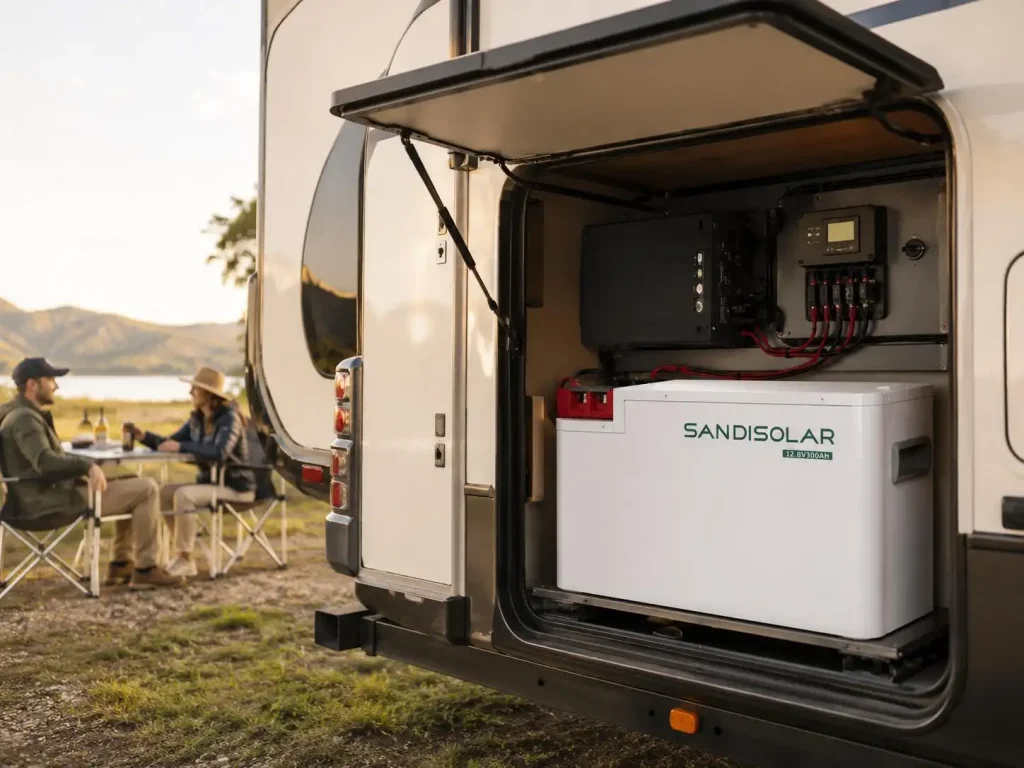
SANDISOLAR's 12.8V 300Ah LiFePO4 battery platform provides a practical example:
12.8V × 300Ah = 3840Wh
This is why Wh is generally more useful than Ah when comparing Portable Power Station capacity.
| Battery Configuration | Voltage | Capacity | Nominal Energy |
| Configuration A | 12.8V | 300Ah | 3840Wh |
| Configuration B | 25.6V | 150Ah | 3840Wh |
| Configuration C | 51.2V | 75Ah | 3840Wh |
All three configurations contain the same nominal energy, even though their Ah ratings are very different.
Why System Voltage Also Matters
Equal Wh does not mean identical electrical design.
For approximately the same power level:
Current ≈ Power ÷ Voltage
A lower-voltage battery therefore requires more current to deliver the same power. Higher current places greater requirements on:
• BMS current capability
• Busbars and cables
• Terminal design
• Contact resistance
• Fuse selection
• Thermal management
Portable Power Station engineering must therefore consider voltage, current and energy together.
How to Calculate Portable Power Station Runtime
The simplest calculation is:
Theoretical Runtime = Battery Wh ÷ Load W
For a 3840Wh battery supplying a constant 500W load:
3840Wh ÷ 500W = 7.68 hours
However, 7.68 hours is a theoretical value—not guaranteed AC runtime.
Why Actual Runtime Is Lower
A real Portable Power Station has several energy-consuming stages:
Battery → BMS → DC Bus → Inverter → AC Output → Appliance
Actual runtime is affected by:
• Battery usable state-of-charge window
• Inverter conversion losses
• Inverter standby consumption
• BMS cutoff thresholds
• Battery temperature
• Cable and connection losses
• Appliance load variation
A more useful engineering estimate is:
Runtime ≈ Usable Battery Energy × System Efficiency ÷ Average Load
This distinction is especially important for refrigerators, compressors and pumps. Their nameplate power may represent running or maximum demand rather than continuous average consumption.
Why W Is Not Wh: Capacity And Output Must Be Sized Separately
A common mistake with Portable Power Stations is saying 2000 Wh and 2000 W are the same.
They measure completely different things:
•Wh = stored energy
•W = instantaneous power
•Surge W = short-duration starting capability
Consider two systems:
| Portable Power Station | Capacity | Continuous Output | Selection Advantage |
| System A | 2000Wh | 1000W | Longer runtime at moderate loads |
| System B | 1000Wh | 2000W | Supports higher-power loads |
| System C | 3000Wh+ | 2000W+ | Extended backup, but heavier and slower to recharge |
A high-capacity Portable Power Station can still fail to start a compressor if its inverter cannot provide sufficient surge power.
For motors, refrigerators and pumps, buyers should verify:
•Rated running watts
•Startup or surge watts
•Simultaneous load
•Inverter continuous rating
•Inverter surge duration
•Battery-side current capability
How Much Portable Power Station Capacity Do You Need?
Capacity should be based on the actual operating profile.
Step 1: Determine Daily Energy Demand
For each appliance:
Daily Energy (Wh) = Average Power (W) Time (h)
Consider the following example:
| Loaded | Average Power (W) | Time (h) | Daily Energy (Wh) |
| Router | 15W | 10 h | 150Wh |
| Lighting | 40W | 5 h | 200Wh |
| Laptop | 65W | 4 h | 260Wh |
| Refrigerator | 80W ave | 10 h | 800Wh |
| Total | ------ | ------ | 1410Wh |
- Real refrigerator consumption is affected by compressor duty cycle, temperature, and operating conditions.
A reasonable capacity margin should be accounted for system losses and the changing demand of load.
Step 2: Check Peak Simultaneous Power
Energy demand determines required Wh.
Simultaneous operating load determines required continuous W.
Startup loads determine required surge W.
These three calculations should remain separate during Portable Power Station selection.
1000Wh vs. 2000Wh vs. 3000Wh+: Where Each Capacity Range Fits
Customize battery selection to duty cycle instead of choosing the largest capacity battery.
Around 500–1000Wh
Typically used for:
• Laptops and communication devices
• Lighting
• Mobile electronics
• Short camping times
• Are lightweight and easier to transport
Around 1000–2000Wh
This range is better for:
• Portable refrigeration
• Electronics
• Lighting
• Emergency household loads
There is often enough of a balance between run time and portability.
2000–3000Wh+
More appropriate where the Portable Power Station must support:
• Extended RV operation
• Longer power outages
• Multiple appliances
• Off-grid working equipment
• Larger daily energy demand
The trade-off is greater weight, longer recharge requirements and reduced mobility.
Battery, Inverter and Charging Input Must Work as One System
Portable Power Station sizing should not stop after the Wh calculation.
| System Element | Key Specification | What It Controls |
| Battery | Wh | Runtime |
| Battery | Chemistry / cycles | Service life |
| BMS | Current limit | Battery-side power capability |
| Inverter | Continuous W | Running load |
| Inverter | Surge W | Motor/compressor startup |
| AC Charger | Input W | Grid recharge time |
| MPPT | Solar input range | PV compatibility |
| Thermal system | Temperature range | Operating stability |
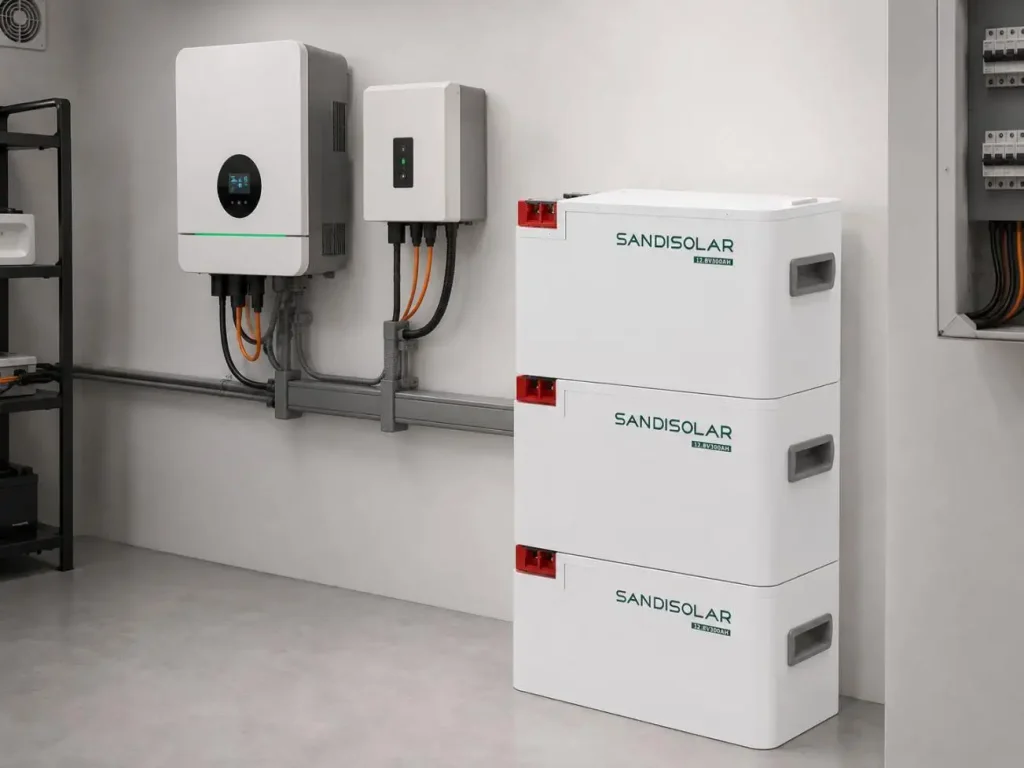
SANDISOLAR's referenced 12.8V 300Ah LiFePO4 battery provides 3840Wh nominal energy and integrates a 200A BMS. The platform is specified for 3000 cycles at 80% depth of discharge, with charging from 0°C to 50°C and discharging from -20°C to 60°C.
These battery-level parameters provide useful engineering inputs when SANDISOLAR evaluates energy-storage configurations, but they should not be confused with the AC output rating of a complete Portable Power Station.
Installation and Operating Conditions Affect Real Capacity
Even a correctly sized Portable Power Station may deliver less runtime if installation conditions are poor.
Consider the following:
• Temperature: Excessive or extreme temperatures both ways can impact battery capacity.
• Standby losses: When the inverter loses power, so does the entire system.
• Cable sizing: Big DC currents need big wires.
• Ventilation: Design the cooling for the battery and the inverter.
• Solar matching: Voltage and current from the PV need to be within a range of MPPT.
• Recharge strategy: To charge large batteries, you need a lot of power.
The time to recharge is as important as the capacity that can be stored. This is important for systems that will undergo a lot of charging cycles.
Final Words
For distributors, energy-storage integrators and project buyers, SANDISOLAR can use defined loads, required backup hours and charging conditions as the starting point for evaluating suitable LiFePO₄ battery capacity and system configuration. This makes capacity selection more technically meaningful than choosing a Portable Power Station based on Wh alone.
FAQs
Q1. How does SANDISOLAR advise selecting a suitable Portable Power Station capacity?
When selecting a Portable Power Station, SANDISOLAR says to start with a load profile. Wh consumption, the highest continuous running wattage, surge current, and the length of backup time must all be considered when selecting battery capacity.
Q2. What LiFePO4 battery capacity does SANDISOLAR offer for high-power applications?
SANDISOLAR offers one battery platform with a 12.8V 300Ah LiFePO4 configuration. This battery provides a battery energy reference for higher power, backup, solar storage, and related applications with 3840Wh.
Q3. Why does SANDISOLAR suggest considering Wh instead of Ah on their own?
Ah demonstrates total stored energy with battery voltage. The case of SANDISOLAR's battery pack becomes more clear when looking at the configuration:
12.8V × 300Ah = 3840Wh.
Therefore, when comparing batteries, Wh more accurately refers to total energy.
Q4. If a SANDISOLAR battery is 3840Wh, does that mean a Portable Power Station has a 3840Wh maximum output of AC Energy?
Not entirely, 3840Wh is the energy capacity of the battery. The final output of the system will change based on the battery's cell state, efficiency of components, losses, and power consumption.
Q5. What battery chemistry is used in the 300Ah battery platform?
The battery packs in question utilize LiFePO4. This battery chemistry is used more for battery storage applications because of its efficiency at holding charge, cycle life, and the safety of charging and discharging.


Contact Us
In This Article
Related Posts
48V 6kW Off Grid Inverter: Why 48V Battery Systems Are Common for Higher-Power Solar Systems
August 31, 2026
Residential Solar System Installation: Technical Sizing, System Matching and Installation Guide
August 31, 2026
48 Volt Inverter for Solar Battery Storage: Key Specifications Buyers Should Compare
August 27, 2026