
12kW Off Grid Inverter With Dual MPPT: Why It Matters for Large Solar Arrays
By hqt
2026.08.19Related Posts
48V 6kW Off Grid Inverter: Why 48V Battery Systems Are Common for Higher-Power Solar Systems
August 31, 2026

Residential Solar System Installation: Technical Sizing, System Matching and Installation Guide
August 31, 2026

48 Volt Inverter for Solar Battery Storage: Key Specifications Buyers Should Compare
August 27, 2026
A large PV array creates more than a power-sizing problem. As solar capacity increases, installers must manage string voltage, MPPT current, different roof orientations, partial shading, battery charging limits and high-load demand.

This is where a 12kW Off Grid Inverter with dual MPPT becomes particularly relevant.
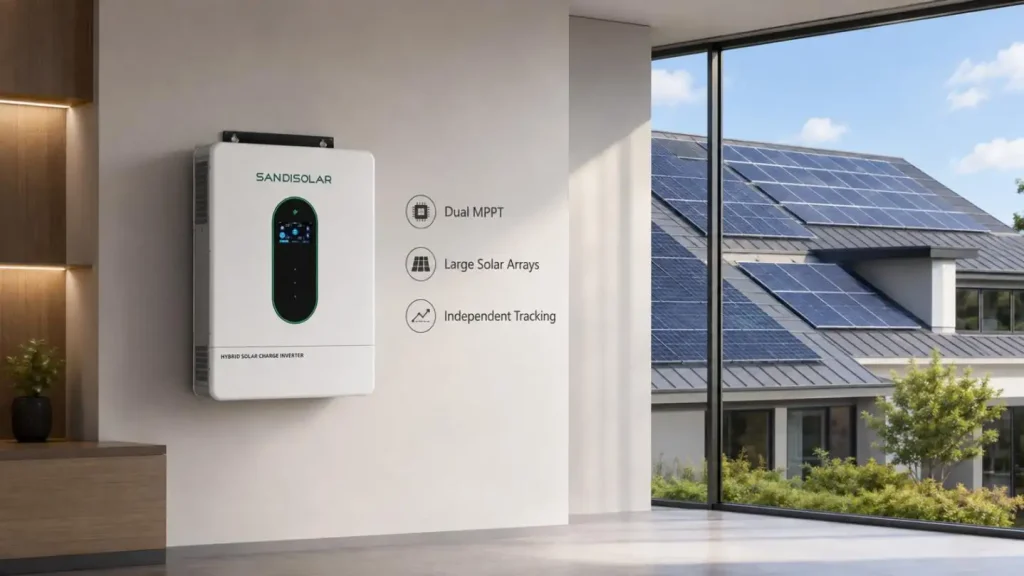
For high-capacity residential and light-commercial systems, SANDISOLAR's 12kW split-phase platform combines 12,000W continuous output with two independent MPPT channels, 120V/240V split-phase output, generator compatibility and a 48V-class battery architecture. The important question, however, is not simply whether dual MPPT is available—it is how the two trackers improve PV array design.
Why Large PV Arrays Need More Flexible MPPT Control
Solar strings do not always operate under identical conditions.
Consider a roof with:
•An east-facing array receiving stronger morning irradiance
•A west-facing array peaking later in the day
•Partial shading affecting only one roof section
•Different module groups operating at different temperatures
Connecting these electrically different arrays to the same tracker can create mismatch because one MPPT must identify a common operating point.
A dual-MPPT 12kW Off Grid Inverter allows the two PV groups to be tracked independently.
Single MPPT vs. Dual MPPT
| PV Configuration | Single MPPT | Dual MPPT |
| One roof orientation | Usually sufficient | Suitable |
| East-west roof | Less flexible | Recommended |
| Uneven shading | Higher mismatch risk | Arrays can be separated |
| Different string groups | More restrictions | Independent optimization |
| Large multi-array system | Limited design flexibility | Better array management |
Importantly, two PV connectors do not automatically mean two MPPT trackers. Buyers should verify the number of independently controlled MPPT channels in the inverter specification.
How Much Solar Can a 12kW Off Grid Inverter Accept?
Rated AC output and installed PV capacity are not the same parameter.
A 12kW Off Grid Inverter can be used for PV oversizing because most PV modules don’t remain at their nameplate output for the whole day. SANDISOLAR supports PV oversizing up to 150%, so designers can allow for increased periods of available solar generation during lower-irradiance periods.
PV oversizing can be acceptable as long as all design limits remain within specification.
Check four parameters before adding modules:
•Maximum PV input power
•Maximum PV open-circuit voltage (Voc)
•MPPT operating voltage range
•Maximum current per MPPT
More PV wattage does not override voltage or current limits.
String Voltage: Voc and Vmp Must Be Checked Separately
For modules connected in series:
String Voc ≈ Module Voc × Number of Modules in Series
The resulting voltage must remain below the 12kW Off Grid Inverter's maximum DC input voltage, including the increase in module Voc that occurs under low-temperature conditions.
But maximum Voc is only one limit.
During normal generation:
String Vmp ≈ Module Vmp × Number of Modules in Series
String Vmp should remain inside the inverter's MPPT operating window so the tracker has sufficient control margin across changing irradiance and temperature.
SANDISOLAR specifies a PV operating range of approximately 90–485VDC with a maximum open-circuit voltage of 500VDC for this platform.
This means designers should not treat 500VDC as the target operating voltage. It is an upper safety boundary.
Parallel Strings Increase Current, Not Voltage
Series and parallel design affect the inverter differently.
| Array Change | Voltage Effect | Current Effect | Parameter to Verify |
| Add modules in series | Increases | Minimal change | Maximum Voc / MPPT range |
| Add strings in parallel | Similar | Increases | MPPT input current |
| Increase PV wattage | Depends on layout | Depends on layout | All DC limits |
| Separate roof orientations | Different operating points | Depends | MPPT allocation |
SANDISOLAR's 12kW Off Grid Inverter uses dual MPPT inputs specified at 27A + 27A. Therefore, installers should calculate the operating current of all parallel strings assigned to each MPPT rather than checking only total panel wattage.
For example, an east-facing string and west-facing string are generally better assigned to separate trackers instead of being combined electrically.

Large PV Arrays Also Require a Properly Sized Battery Bank
Increasing solar input does not automatically increase usable charging power.
The battery side can become the limiting factor.
A 12kW system operating from a nominal 51.2V battery requires very high DC current. Ignoring losses:
12,000W ÷ 51.2V ≈ 234A
Actual battery current can be higher because inverter conversion is not 100% efficient and battery voltage changes during discharge.
Therefore, battery selection should verify:
•BMS continuous discharge current
•Maximum charge current
•Battery module parallel capability
•DC cable cross-section
•Fuse and breaker ratings
•Terminal and busbar current capacity
SANDISOLAR's 12kW Off Grid Inverter supports lithium and lead-acid batteries and provides high-current battery charging for large storage systems. The usable charge rate must still remain within the battery manufacturer's limits.
Can a 12kW Off Grid Inverter Start HVAC?
A 12kW continuous rating does not mean every 12kW combination of loads will operate correctly.
Inductive equipment can demand several times its normal current during startup.
Typical loads requiring surge evaluation include:
•HVAC compressors
•Air compressors
•Workshop motors
•Refrigeration equipment
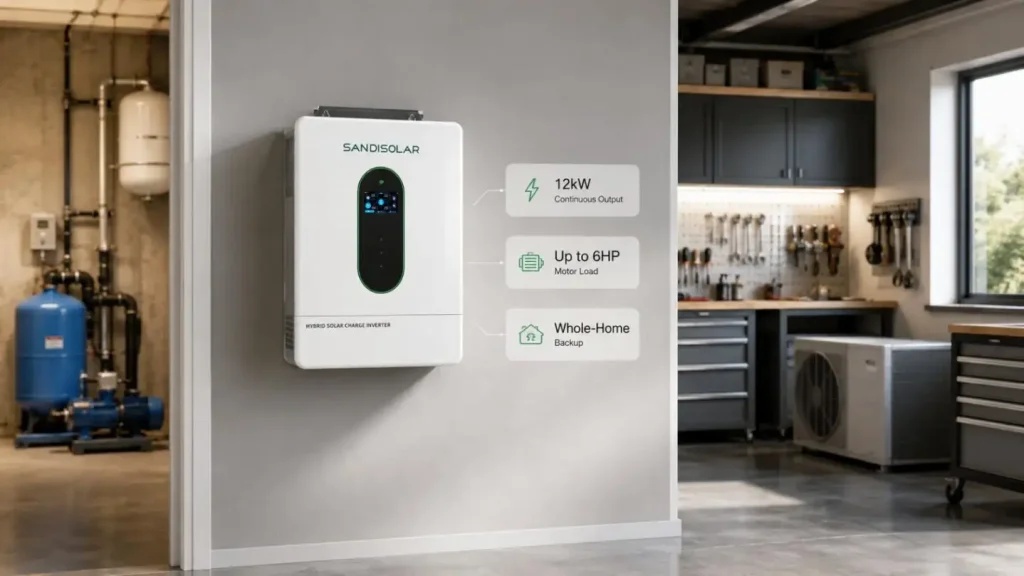
SANDISOLAR offers 12,000W continuous output, additional EPS peak capacity and motor-load capability up to 6HP.
For engineering purposes, installers should still check:
Running Loads + Simultaneous Loads + Motor Starting Surge
Motor type, starting method and existing household demand can all change the required inverter peak capacity.
Dual MPPT Does Not Replace Good Installation Design
Even a high-specification 12kW Off Grid Inverter can lose performance when strings are poorly configured.
PV-Side Checks
•Separate significantly different roof orientations
•Verify temperature-corrected string Voc
•Keep operating voltage within the MPPT range
•Check current per MPPT
•Use correctly rated DC connectors and isolators
Battery-Side Checks
•Confirm BMS current capability
•Size cables for high DC current
•Verify breaker and fuse ratings
•Check terminal torque and heating
Operation and Maintenance
Monitor:
•MPPT voltage and current
•Unexpected production differences between trackers
•DC connector temperature
•Battery communication alarms
•Inverter event logs
•Firmware status
Large differences between two otherwise similar PV arrays can indicate shading, string faults, connector problems or module mismatch.
What Should Buyers Verify Before Purchasing?
A 12kW Off Grid Inverter should be selected as part of a system rather than as an isolated 12kW device.
Before procurement, request and verify:
| Item | Why It Matters |
| MPPT voltage/current limits | Determines PV string design |
| Battery voltage/current limits | Determines storage compatibility |
| Surge capability | Determines motor-load suitability |
| 120/240V split-phase output | Important for North American loads |
| Generator compatibility | Supports low-solar backup operation |
| Parallel capability | Allows future capacity expansion |
| Communication interfaces | Supports BMS and monitoring |
| Certification documents | Supports project compliance review |
SANDISOLAR's 12kW platform integrates dual MPPT, 120V/240V split-phase output, generator input, CT zero-export control, CAN/RS485/Wi-Fi communication and parallel operation for larger energy systems.
Choosing the Right 12kW Off Grid Inverter Configuration
Dual MPPT matters most when a large solar array has different orientations, uneven irradiance or multiple PV groups that should not share the same operating point.
But successful system design requires more than dual MPPT. PV voltage, MPPT current, battery discharge capability, charging current and load surge must all be engineered together.
For residential backup, farms, workshops and light-commercial solar-storage projects, SANDISOLAR can support system configuration around the actual PV array, battery bank, generator and load profile—helping installers and buyers select a 12kW Off Grid Inverter configuration based on electrical requirements rather than rated power alone.
FAQs
Q1. Does the SANDISOLAR 12kW Off Grid Inverter use Dual MPPT?
Yes. The 12kW split-phase inverter from SANDISOLAR has two separate MPPT channels and can therefore control two separate PV arrays dealing with different environmental conditions.
Q2. Why is MPPT useful in a large solar array?
MPPT becomes relevant when PV modules are installed on separate roofs, different parts of a building, or a single structure, and are exposed to varying levels of light. MPPT can also be used to separate PV modules into different electrical groups.
Q3. Does the SANDISOLAR 12kW Off Grid Inverter allow for PV oversizing?
This inverter can be used for oversizing PV up to 150% as long as the PV array remains under the defined PV voltage and MPPT operating range, input current, and power limits.
Q4. At what battery voltage does the SANDISOLAR 12kW Off Grid Inverter operate?
The Inverter is designed to work around a 48V battery, however it is compatible with a 51.2V nominal lithium battery as long as the voltage and BMS requirements are met.
Q5. Does SANDISOLAR support lithium batteries?
Yes. The 12kW Off Grid Inverter supports both lithium and lead acid batteries. For lithium systems, the BMS current limit and communication should be checked before installing the inverter.


Contact Us
In This Article
Related Posts
48V 6kW Off Grid Inverter: Why 48V Battery Systems Are Common for Higher-Power Solar Systems
August 31, 2026
Residential Solar System Installation: Technical Sizing, System Matching and Installation Guide
August 31, 2026
48 Volt Inverter for Solar Battery Storage: Key Specifications Buyers Should Compare
August 27, 2026