Selecting a 12kW Split Phase Hybrid Inverter for 120V and 240V Home Loads
By hqt
2026.09.25


While a 12kW hybrid inverter might be sufficient total output for a large residential system, total wattage is not the only factor to determine a North American home's fit for this inverter.
The inverter should deliver the proper split-phase output of 120/240V, load balance between L1 and L2, start motor driven equipment and manage solar, battery, utility and generator power.
Thus, this inverter should be chosen not just based on a 12kW headline rating, but around the distribution system and back-up plan of the house.
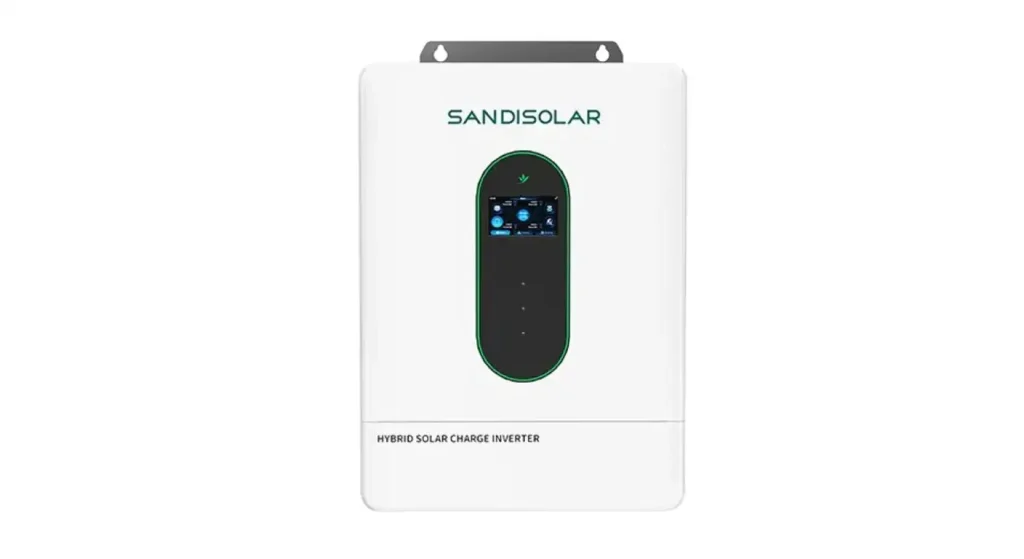
What is 12Kw Split Phase Hybrid Inverter?
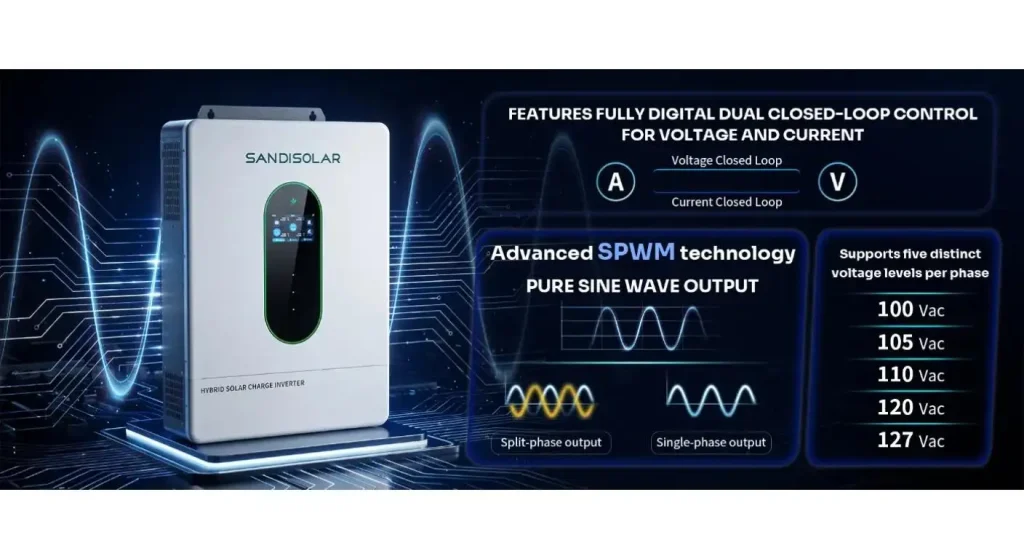
Split-phase inverter provides two 120V lines 180 degrees out of phase. The volts to the loads between line and neutral is 120V, and the volts to the loads between L1 and L2 is 240V.
This is similar to how panels are arranged in homes in North America. Generally, lighting, electrical outlets and appliances are activated at 120 volts and central air conditioners, well pumps, dryers and other major equipment is at 240 volts.
A hybrid inverter also can coordinate multiple power sources. Can supply energy to household loads, charge a battery, power from the grid/generator to household loads and provide power to the backup circuit during outages.
The Sandisolar 12kW split phase hybrid inverter is suitable for solar plus storage 120/240V residential and light-commercial installations.
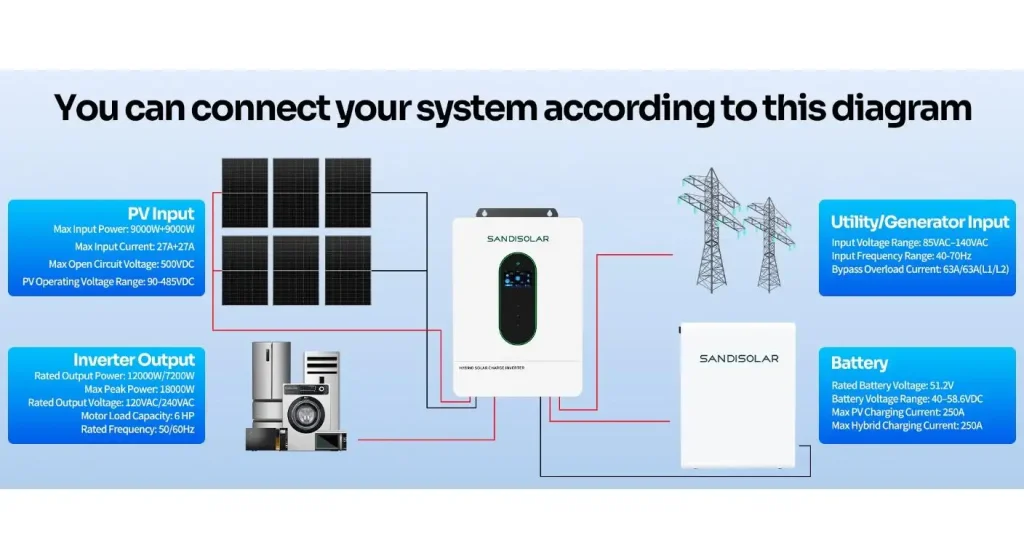
Test 120V and 240V Loads Independent of Each Other
Start at the electrical panel and work to the solar array. Write down the running power and the starting power for each appliance and determine if it is a 120V or 240V appliance.
Equipment like central air conditioning, well pumps and workshop motors should be included in the 240V load calculation. Refrigerators, lighting, kitchen circuits, electronics/general outlets should be included in the 120V calculation.
All loads are not necessarily required to run during an outage. Keeping necessary circuits separate from optional equipment will minimize the battery's capacity and eliminate the possibility of several large power consuming appliances starting up simultaneously.
The total demand on the final schedule should not be equal to the sum of all circuit-breaker ratings but rather represent the simultaneous demand.
Distribute Loads between L1 and L2
The total output (12kW) does not mean that all of that power can be put on one 120 volt line without limitation. If there is significant gap between L1 and L2, this can result in an imbalanced system, and could decrease the available capacity.
Installers should load both sides of the 120V branch circuits. Normal operating demand may be reasonably balanced by arranging for refrigeration, lighting and outlet circuits.
If a 240V appliance is connected to both lines it would normally take the split-phase output. But its initial demand needs to be taken into consideration for the inverter and battery calculation.
| Circuit Type | Typical Equipment | Main Planning Point |
| 120V L1-N | Lighting, outlets and electronics | Balance with L2 loads |
| 120V L2-N | Refrigerator and kitchen circuits | Check simultaneous use |
| 240V L1-L2 | Air conditioner and well pump | Confirm starting current |
| Essential circuits | Refrigerator, router and lighting | Prioritize during outages |
| Discretionary circuits | Dryer, heater and EV charger | Shed when capacity is limited |
Verify start-up power capacity of the motors.
Motors and compressors can draw many times their normal running amperage upon starting up. It's for central air conditioners, well pumps, pool pumps, refrigerator compressors and workshop equipment.
Normally functioning system might shutdown due to a high motor start-up. The surge, duration and motor rating of this inverter is therefore of equal importance as continuous output.
The SD-48120WP-US will accommodate up to 6HP motor loads, and has 125% EPS peak capacity. These ratings should always be compared to the actual locked-rotor or starting current of the equipment to be used.
If multiple motor loads are involved, then soft starters or sequenced load control can be beneficial.
Match to 12kW Output – Battery Bank
A 12kW inverter may require a significant amount of current from a 48V class battery system while operating at full power. DC current can be more than 250A after conversion loss is taken into account.
Two factors of the battery bank are needed: Current and Backup Time. Verify BMS Continuous Discharge rating, Peak Current Duration, communication protocol and recommended cable protection.
A battery can deliver enough energy, but with too little current. On the other hand, a high current battery bank can provide the power for the inverter, but a short backup time.
Sandisolar offers a variety of capacities and voltages in LiFePO4 battery series for the coordinated inverter systems.
Specify PV Array for Dual MPPT Operation
The 12kW inverter provides 27A + 27A at 2 channels of MPPT with the ability to oversize PV array up to 150%. Oversizing can have the effect of increasing useful solar production during mornings and afternoons/low irradiance conditions.
PV strings should be split up as per the direction of the roof, PV module properties and shading. Different orientations of arrays should be connected separately to different MPPT channels, except in unique situations.
Determine open circuit voltage in the cold weather prior to deciding string length. At the lowest operating temperature in the site, the total string voltage cannot exceed the inverter PV input limit.
This does not imply that all PV over-sizing wattages can be utilized at once. Available solar power can be curtailed if it exceeds the capacity of the inverter to convert it to output.
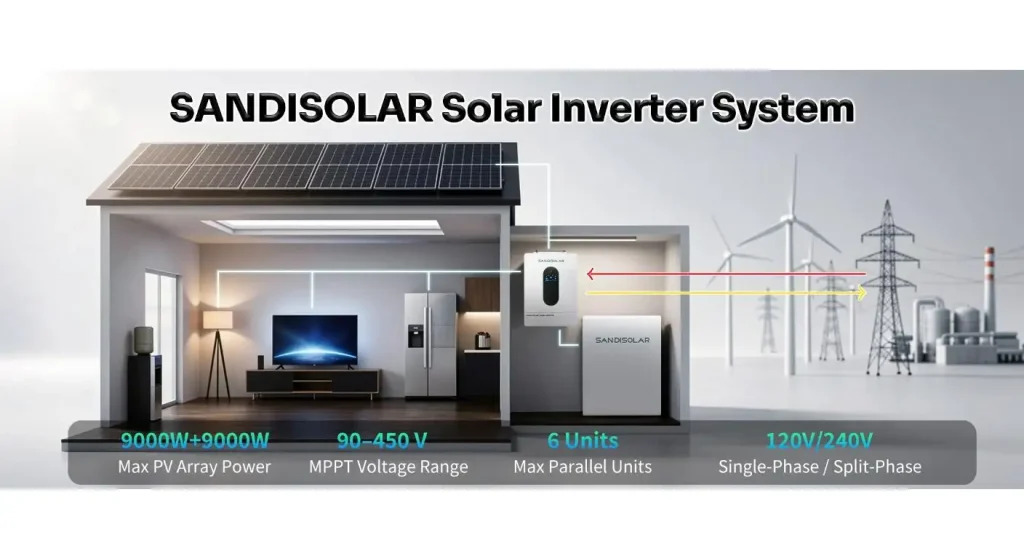
Coordinate Utility, Battery and Generator Inputs.
For hybrid operation, the priorities of energy need to be explicitly stated. This can be set to use solar first, to hold the battery for when there are outages, to use the grid when the solar power is not available or to switch on a generator when the battery level is low.
Compatibility of generators must be assessed based on voltage, frequency, current, and stability of the generators' wave form. Only matching the nameplate output to the inverter rating should not be the only criteria used to select the generator.
The inverter also is battery-free. If the system doesn't include battery storage, however, it can't operate at night or as a stored energy back-up as can a solar-plus-battery system.
Solar, storage and household loads work together as seen in Sandisolar's residential energy storage solution.
Zero Export Control Plan correctly.
The zero export system with CT takes power flow measurement at the grid connection point and modifies the inverter output power to minimize unintended power export.
The current transformer installation position and direction must be correct. If the inverter is not placed correctly then it may identify import as export or only a part of the building's load.
Zero-export control is not an alternative to approval for local interconnection. Installer to confirm for the project location what the relevant utility requirements are, what modes of operation may be used and what the inspection procedures are.
Strategically use the 10ms Backup Transfer
Typical inverter to bypass (ON/OFF) trans time 10ms. Ideal for powering numerous electronic and home loads during a power outage.
It is important to test critical equipment in real transfer situations. There may be some specific equipment that may need more stringent power-quality or continuity requirements.
Clearly identify backup circuits. If the whole house is attempted to be moved during the time that several big loads are running, there is a risk for overload even if the inverter is installed properly.
If you don't want or need to upgrade the version included in Parallel, you can create a plan parallel expansion beforehand.
For projects with more output, up to 6 compatible units can be operated in parallel. Expansion has an impact on battery capacity, PV input, AC distribution, communication wiring and protection devices.
When planned for future expansion, the parallel operation should be designed from the start. It is difficult to make changes to space, cable routing and switchgear after initial system is commissioned.
To compare the configuration in a wider view, the installer can view the range of Sandisolar's off-grid inverters and request the corresponding technical documents from the download center.
Complete Split-Phase System commissioning.
The commissioning should start with verifying L1-N, L2-N and L1-L2 voltages. Check out phase balance, neutral connection, grounding, CT direction and protective-device ratings.
Check the 120V and 240V loads individually prior to using them together. Measure the stability of AC output, battery current and voltage during starting of the largest motor load.
Lastly, perform a simulated power outage/power in. Verify transfer to backups, generator feeding, charging, zero export response, monitoring data, protection shut down.
| Inspection Area | Acceptance Focus | Verification Method |
| Split-phase voltage | Correct L1-N, L2-N and L1-L2 output | Multimeter test |
| Phase loading | Reasonable balance between L1 and L2 | Current measurement |
| Motor starting | No overload during startup | Controlled start test |
| Battery system | Stable voltage and BMS communication | Inverter monitoring |
| Zero export | No unintended grid export | Meter and CT test |
| Backup transfer | Essential loads remain operating | Simulated grid outage |
Conclusion
While 12kW split phase hybrid inverter is ideal for high-demand North American residential systems, they can only be used when 120V and 240V loads are properly designed.
The performance of the system depends on load balance, motor starting demand, battery current, PV string design and generator compatibility and CT placement. The capacity is given by the inverter rating, and reliability is given by the system coordination.
FAQs
Q1. A hybrid inverter's split phase refers to what?
It comes with 2 lines of 120V and 240V between the two lines. This will allow support of common North American residential appliances and distribution panels.
Q2. Is it possible to run a whole house on a 12kW inverter?
It can carry several loads in the house, but will depend on the simultaneous demand and starting power of the motors. Essential-load-management may still be required.
Q3. Does it have the power to power a central air conditioner?
The inverter has the ability to handle the heavy motor load but the running and starting current of the air conditioner should be verified. A soft starter can help to lower the starting load.
Q4. So, if a PV system is oversized by 50% does this mean that 18 kW of continuous AC output is available?
No. This is possible, but does not increase the AC output of the inverter beyond its rated conversion capacity.
Q5. Is it possible to operate the inverter without using a battery?
Yes, the product can be used without battery. If stored energy or outage backup for a prolonged period is desired, then a battery is still necessary.