
From Weekend Van to Full-Time Bus: Scalable 12V LifePO4 Batteries for RV with Parallel Support
Nach Hauptquartier
2026.05.19Verwandte Beiträge
Solarenergie-Lieferant: Solarspeicher-Ladesystem + Nahtloses Smart EMS-Schalten
Mai 21, 2026

Notstromversorgung für das Zuhause: 3,840Wh von reiner stiller Bereitschaft
Mai 21, 2026

6kw Off-Grid-Wechselrichter: Verständnis der 6kW-Klasse und warum sie für viele reale Anwendungen geeignet ist
Mai 20, 2026
Not every RV owner starts with the same power needs. A weekend van traveler might run only a compressor fridge and LED lights. A full-time bus conversion often powers a residential air conditioner, induction cooktop, water heater, and multiple home-office setups. The challenge has always been finding a battery system that grows with the user.
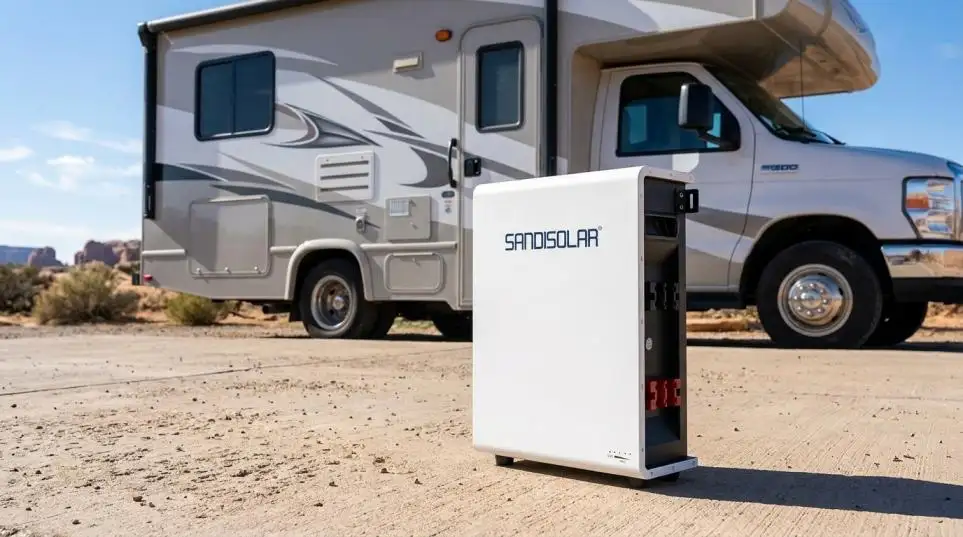
SANDISOLAR solves this by designing 12V LifePO4 Batteries for RV applications that support parallel connection. This means starting small and expanding without replacing existing units, making the transition from weekend van to full-time bus both practical and cost-effective.
Why Scalability Matters in 2026 RV Living
The RV lifestyle has diversified. Many buyers purchase a van or small trailer to test part-time travel, then upgrade to a larger bus or fifth wheel for full-time living. Traditional battery systems force a complete replacement when energy needs double or triple. That approach wastes money and creates electronic waste. SANDISOLAR takes a different path.
• Parallel support: SANDISOLAR 12V LifePO4 Batteries for RV can be connected in parallel to increase total capacity while keeping the same 12V system voltage.
• No replacement penalty: A user starting with one SD-12.8V100AH can later add a second or third unit. The original battery remains in service.
• Mixed capacity compatibility: Different capacities, such as 100Ah and 200Ah, can be paralleled as long as they are from the same SANDISOLAR LiFePO4 family and at similar state of charge during initial connection.
This modular approach matches how people actually buy RVs. Start small. Add later. SANDISOLAR supports that journey.
Technical Basics: How Parallel Connections Work
Parallel connection means linking multiple battery positive terminals together and negative terminals together. Voltage stays at 12.8V nominal, while amp-hour capacities add up. Two 100Ah batteries in parallel deliver 200Ah total. Four 200Ah batteries deliver 800Ah. The system behaves as one large battery bank.
• Simple wiring: Use equal-length copper cables of the same diameter to connect each battery to ensure that no battery is receiving/charging the most current.
• Single point of connection: Complementary corners of the parallel bank charge the main RV loads and charge the bank (positive to battery one, negative to battery two).
• BMS coordination: The embedded Battery Management System in each of SANDISOLAR’s 12V LifePO4 Batteries for RV manages parallel bank concern at the collection level and individual cell management at the individual cell level.
For basic parallel operation, no added master controller wires appears keeping the system simple and robust.
Step-by-Step: Growing from 100Ah to 600Ah
A realistic upgrade path shows how SANDISOLAR supports changing needs without waste.
• Phase one – Weekend van:
A SANDISOLAR SD-12.8V100AH provides 100Ah of usable capacity (100% Entladungstiefe). This runs a 12V compressor fridge, LED-Beleuchtung, phone charging, and a water pump for a full weekend without solar recharge.
• Phase two – Extended travel:
Add a second SD-12.8V100AH in parallel. Total capacity becomes 200Ah. Now the van supports a diesel heater, a small inverter for laptop charging, and three days of cloudy weather.
• Phase three – Full-time bus:
Replace the two 100Ah units with four SD-12.8V200AH units, or add two 200Ah units alongside two 100Ah units. Total capacity reaches 600Ah or more. This powers a 3000W inverter, rooftop air conditioner for six to eight hours, induction cooking, and a residential refrigerator. The original 100Ah units are not discarded. They move to a secondary role or remain in the expanded bank.
SANDISOLAR 12V LifePO4 Batteries for RV never become obsolete. They just become part of a larger team.
Physical Layout and Space Efficiency
As the battery bank grows, physical space becomes a constraint. SANDISOLAR addresses this with stackable and compact case designs.
• Stackable structure: The SD series cases are designed to stack vertically. Three 200Ah units occupy the same floor footprint as one unit. This is critical for bus conversions where floor space is at a premium.
• Side-by-side mounting: When vertical stacking is not possible, units mount side by side in standard 19-inch equipment racks or custom trays.
• Flexible orientation: SANDISOLAR LiFePO4 cells have no liquid electrolyte. Units can be mounted on their side or end, subject to terminal access, fitting into odd-shaped compartments.
A full-time bus conversion can house 600Ah of SANDISOLAR 12V LifePO4 Batteries for RV in a space previously occupied by 200Ah of lead-acid batteries. That is three times the energy in the same volume.
Maintaining Balance in a Parallel Bank
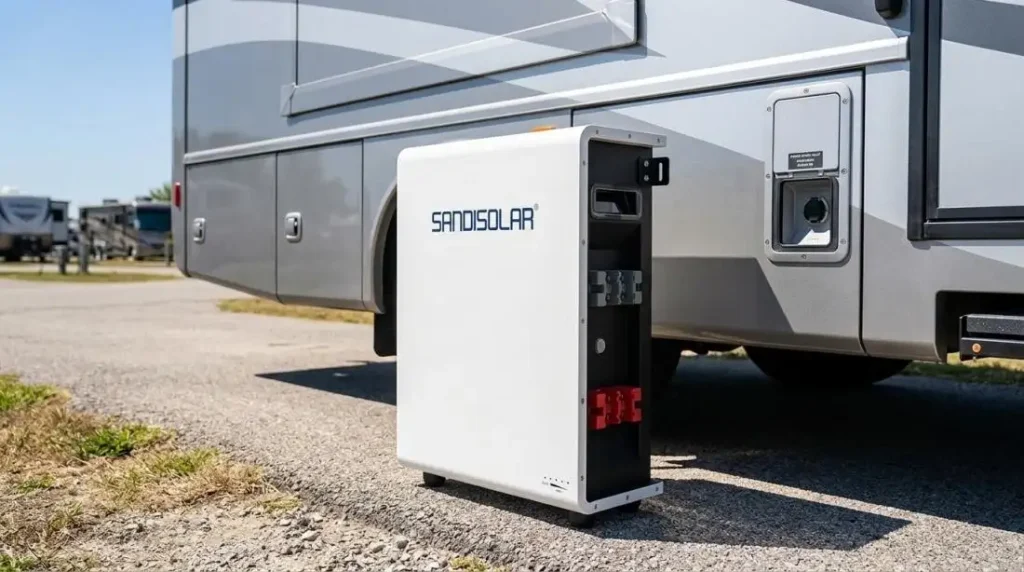
Any parallel battery bank requires attention to balance. Uneven current sharing reduces total capacity and shortens lifespan. SANDISOLAR simplifies this through internal design.
• Matched internal resistance: Manufacturing consistency means each battery presents a similar resistance, encouraging equal current sharing.
• Passive balancing: The BMS in each SANDISOLAR battery performs passive balancing among its own four cells. This does not balance between batteries, but similar state of charge at connection time largely solves the issue.
• Best practice: Charge each new battery individually to 100% before adding it to an existing parallel bank. This controls voltages and limits high initial currents.
These steps will let a parallel bank run for years without active balancers or external management hardware.
Safety and Protection When Banned
Putting more cells in parallel increases the total possible fault current. Bei SANDISOLAR, safety features expand with the size of the bank.
• Individual BMS Protection: Each 12V LiFePO4 batteries for RVs has over current, Kurzschluss, and over temperature protection. If one unit has a fault, that unit disconnects itself and the rest continue to work at a reduced level.
• External Fusing: A class-T fuse or high-capacity ANL fuse is installed at each battery positive terminal. It contains a fault to one battery.
• Common Bus Bar: Fuse each cell and connect the positive and negative cables to a copper bus bar. Do not connect them in series from battery to battery. This improves current sharing and simplifies troubleshooting.
These measures keep a 600Ah bank as safe as a 100Ah bank.
Cost Efficiency of Scaling vs. Replacing
The financial case for scalable 12V LifePO4 Batteries for RV is clear. Buying one large 600Ah battery upfront costs more initially than buying one 100Ah battery today and adding capacity over three years.
• Cash flow friendly: Weekend travelers only take their necessities at the start to keep cash for the van purchase.
• No stranded asset: The first battery will not need to be recycled as it will contribute to the completed battery bank and will function as it is designed.
• Price trends benefit: If lithium battery prices decrease, those later units bought will cost less than buying the entire bank at the start.
SANDISOLAR allows for this type of plan as it will not require greater performance than its current batteries.
Real-World Example: Sprinter Van to School Bus Conversion
A client would use a Sprinter van for skiing in the winter. The SANDISOLAR batteries run the heaters, Kühlschrank, and lights to warm the van for the following three days. After a year, they buy a short school bus for full-time living.
They add three 200Ah units in parallel with the existing 100Ah unit. Total capacity becomes 700Ah. The bus runs a mini-split air conditioner, induction cooktop, and two laptops. The original 100Ah battery stays in service, proving that SANDISOLAR 12V LifePO4 Batteries for RV truly scale from weekend van to full-time bus without waste.
Visit SANDISOLAR to request a quote for your current setup, with room to grow later.
Häufig gestellte Fragen
Q: Can I connect a SANDISOLAR 100Ah battery in parallel with a 200Ah battery?
Ein: Ja. As 12.8V LiFePO4 cells, they are at a similar state of charge with each other to start. They can work in parallel. The total capacity is then 300Ah.
Q: How many SANDISOLAR batteries can I run in parallel?
Ein: SANDISOLAR suggests no more than 4 Einheiten. 4 units achieves even current and less wiring issues. If you need more than 4 Einheiten, you should reach out to SANDISOLAR technical support.
Q: Do I need an external BMS when running batteries in parallel?
Ein: Nein. Each SANDISOLAR battery has a built-in BMS. The built-in BMS are integrated with the bank cells. An external BMS is not needed.
Q: Will adding a second battery later damage the older one?
Ein: Nein, as long as they are both in good health. It is encouraged to charge the older battery and the newer one to full capacity. The new addition to the bank will not damage the older battery.
Q: Can I mix SANDISOLAR with other brands of LiFePO4 batteries?
Ein: Nein. They have logic difference in their BMS, their internal resistances are different, and their charge/discharge curves are different. The best combination is all SANDISOLAR batteries.


Kontaktieren Sie uns
In diesem Artikel
Verwandte Beiträge
Solarenergie-Lieferant: Solarspeicher-Ladesystem + Nahtloses Smart EMS-Schalten
Mai 21, 2026
Notstromversorgung für das Zuhause: 3,840Wh von reiner stiller Bereitschaft
Mai 21, 2026
6kw Off-Grid-Wechselrichter: Verständnis der 6kW-Klasse und warum sie für viele reale Anwendungen geeignet ist
Mai 20, 2026