
48 Volt Inverter for Solar Battery Storage: Key Specifications Buyers Should Compare
By hqt
2026.08.27Related Posts
48V 6kW Off Grid Inverter: Why 48V Battery Systems Are Common for Higher-Power Solar Systems
August 31, 2026

Residential Solar System Installation: Technical Sizing, System Matching and Installation Guide
August 31, 2026

48 Volt Inverter for Solar Battery Storage: Key Specifications Buyers Should Compare
August 27, 2026
Selecting a 48 Volt Inverter for solar battery storage is not simply a matter of matching inverter kW to appliance wattage. In a correctly engineered system, the inverter must operate within the electrical limits of the battery, BMS, PV array, AC loads, cabling, and protection equipment.
For system integrators and distributors, the more useful question is therefore:
Can this 48 Volt Inverter operate safely across the complete battery, PV, and load envelope of the project?
At SANDISOLAR, this system-level matching approach is particularly relevant to off-grid inverter applications, where battery discharge current, MPPT design, surge loads, and backup duration directly affect system performance.
1. Start With the Battery—"48V" Is Only a Nominal Rating
A 48 Volt Inverter does not operate at exactly 48.0V. Battery voltage changes continuously with chemistry, state of charge, load, and charging conditions.
A common LiFePO₄ configuration uses sixteen 3.2V cells in series, producing a nominal battery voltage of approximately 51.2V. Compatibility therefore depends on the inverter's operating window rather than the nominal label.
Battery Parameters Buyers Should Compare
| Battery Parameter | Why It Matters |
| Nominal voltage | Identifies the basic battery platform |
| Operating voltage range | Must remain inside inverter DC limits |
| Maximum charge voltage | Must match inverter charging settings |
| Low-voltage cutoff | Prevents excessive battery discharge |
| Continuous discharge current | Must support full inverter load |
| Peak discharge current | Important during surge loading |
| CAN/RS485 protocol | Determines closed-loop BMS communication |
A 48V-class lithium battery may be electrically suitable for a 48 Volt Inverter while still being incompatible at the communication level.
CAN or RS485 hardware alone does not guarantee BMS compatibility. The protocol implemented in the inverter firmware must match the battery BMS.
SANDISOLAR's off-grid inverter range includes 48V configurations with lithium-battery communication options, allowing battery parameters and communication requirements to be considered during system configuration rather than after installation.
2. Rated Power and Battery Current Must Be Checked Together
An inverter rated at 5 kW, 8 kW, or 11 kW tells only part of the story.
Approximate battery current can be estimated from:
DC Current ≈ AC Load ÷ Battery Voltage ÷ Inverter Efficiency
For example, a 10 kW AC load on a 48V-class battery system can require well above 200A on the DC side after conversion losses are considered.
This directly affects:
•Battery BMS current rating
•Battery parallel quantity
•DC cable cross-section
•Fuse and breaker capacity
•Busbar sizing
•Connector temperature rise
•Voltage drop
This is why a high-power 48 Volt Inverter cannot simply be connected to any 48V battery bank.
3. Continuous Power Is Not Surge Power
Motor-driven loads can expose another sizing problem.
Compressors, refrigerators, air conditioners, and workshop motors can demand considerably more power during startup than during steady operation.
Buyers should compare three specifications together:
•Rated continuous power
•Maximum surge power
•Permitted surge duration
A high peak-power number is not sufficient if that level can only be sustained for a very short period.
Typical Load Behavior
| Load | Starting Characteristic | Key Inverter Requirement |
| Lighting | Low surge | Continuous efficiency |
| Electronics | Low/moderate | Stable pure sine wave |
| Refrigerator | Short high surge | Peak capacity |
| Compressor | High surge | Overload capability |
| Resistive heater | Near rated power | Continuous output |
4. Why Choose 48V Instead of 24V?
At the same power level, doubling DC voltage approximately halves current before losses are considered.
| Design Factor | 24V Architecture | 48V Architecture |
| DC current | Higher | Lower |
| Cable demand | Larger | More manageable |
| Voltage drop sensitivity | Higher | Lower |
| High-power expansion | Less practical | Better suited |
| Typical use | Smaller systems | Medium/high-power storage |
A 48 Volt Inverter is therefore commonly more practical as system power increases. However, 48V should not be treated as automatically superior; system voltage must still reflect actual load size, battery architecture, and installation cost.
5. Match the PV Array to the MPPT—Not Just the PV Wattage
One of the most common specification mistakes is comparing only maximum PV power.
A properly matched 48 Volt Inverter also requires the following limits to be checked:
PV Input Checklist
•Maximum PV open-circuit voltage (Voc)
•MPPT operating voltage range
•Maximum MPPT input current
•Maximum PV short-circuit current
•Number of MPPT trackers
•Maximum supported PV power
PV string Vmp should remain within the MPPT operating window under normal conditions.
At the same time:
Cold-weather string Voc must remain below the inverter's maximum PV input voltage.
Because module Voc rises at low temperature, using only standard-test-condition voltage can produce an unsafe string design.
SANDISOLAR integrates MPPT solar charging across its off-grid inverter portfolio, with selected configurations providing multiple MPPT inputs. This becomes useful for arrays with different orientations or electrical operating conditions.
6. Single MPPT vs. Multiple MPPT Inputs
Multiple MPPTs are not simply a higher-end feature. They solve specific array-design problems.
Single MPPT is appropriate when:
•Modules share similar orientation
•String lengths are similar
•Shading conditions are consistent
Multiple MPPTs become useful when:
•Roof sections face different directions
•Strings use different layouts
•Partial shading differs between arrays
•Independent PV sub-arrays are required
The correct 48 Volt Inverter should therefore be selected after the PV string architecture is defined.
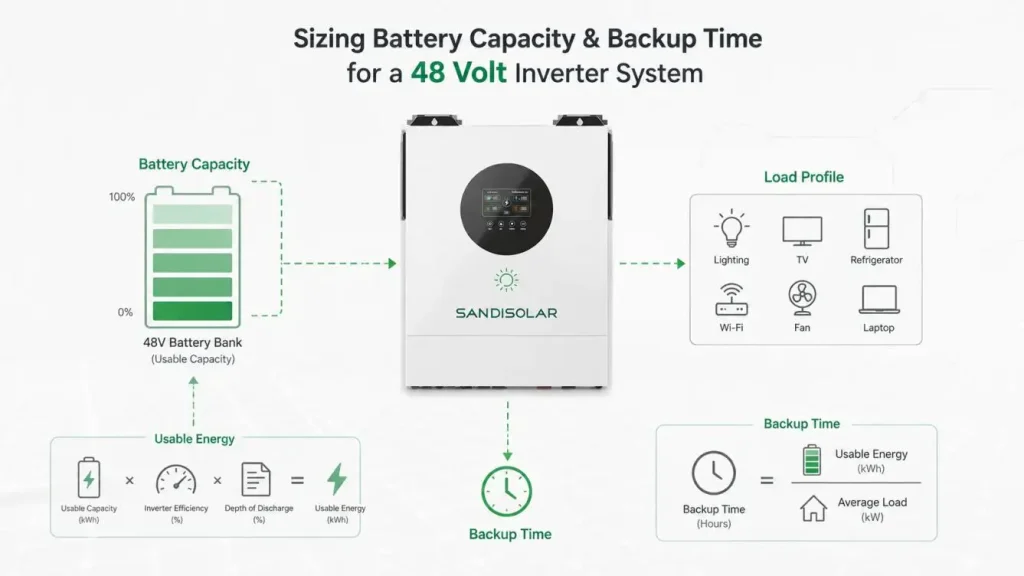
7. Size Battery Capacity From Energy Demand, Not Inverter Power
A 10 kW inverter does not automatically require a specific kWh battery.
Battery energy should start from:
Required Battery Energy ≈ Average Load × Backup Time
Then allow for:
•Battery usable DoD
•Inverter conversion losses
•Battery aging margin
•Minimum reserve SOC
•Maximum discharge current
For example, a system with relatively low average load but occasional high motor loads may require a powerful 48 Volt Inverter while still using a moderate battery capacity—provided the battery can supply the required peak current.
8. Off-Grid, Hybrid, and Parallel Architecture Should Not Be Confused
Different inverter architectures solve different problems.
| Architecture | Best Evaluated For |
| Off-grid | Independent power and battery-backed loads |
| Hybrid | Battery + PV + supported grid interaction |
| Single inverter | Simpler fixed-capacity systems |
| Parallel inverter | Capacity expansion or multi-unit architecture |
SANDISOLAR's off-grid range includes pure sine wave inverter platforms with MPPT solar charging, AC charging/input functions, battery communication, and selected parallel-capable 48V configurations.
Parallel capability should still be verified at model level, including communication wiring, maximum unit quantity, output synchronization, and whether single-phase or three-phase configurations are supported.
9. Installation Can Become the Actual System Bottleneck
Even a correctly selected 48 Volt Inverter can perform poorly when DC-side installation is inadequate.
Before commissioning, check:
•DC cable ampacity and voltage drop
•Battery-to-inverter cable length
•Fuse/breaker interrupting capacity
•Terminal tightening torque
•Grounding
•Ventilation clearance
•Ambient temperature
•Dust and moisture exposure
•Battery disconnect location
High-current connections deserve particular attention because excessive resistance at terminals creates both voltage drop and localized heating.
10. Verify Claims Before Procurement
Technical buyers should request supporting documentation rather than relying on headline specifications.
| Supplier Claim | Evidence to Request |
| High efficiency | Datasheet and test conditions |
| LiFePO₄ compatible | Supported BMS protocol list |
| High surge capacity | Overload curve/duration |
| Parallel operation | Installation manual |
| IP protection | Applicable test documentation |
| Market compliance | Model-specific certificates |
| PV capacity | MPPT voltage/current limits |
Safety requirements such as the IEC 62109 series may be relevant to photovoltaic power conversion equipment. CE, RoHS, UL, or other certifications should always be verified against the exact 48 Volt Inverter model and destination market rather than assumed from a product-family statement.
Closing Words
SANDISOLAR's off-grid inverter platform can be evaluated together with PV modules, batteries, and energy-storage requirements rather than as an isolated inverter component. For distributors, installers, and project buyers, supplying the load profile, battery specification, PV string data, required backup duration, and target market allows SANDISOLAR to support a more technically appropriate 48 Volt Inverter configuration before quotation and system deployment.
FAQs
Q1. Does SANDISOLAR offer 48 Volt Inverter solutions for solar battery storage?
Yes, SANDISOLAR offers off-grid inverter solutions for residential and small commercial solar storage projects for battery systems configured to operate in the Class 48V range.
Q2. Can a SANDISOLAR 48 Volt Inverter work with 51.2V LiFePO₄ batteries?
A battery operating in the 51.2V range would typically be used in a Class 48V system. The inverter’s battery voltage range, charging and discharging limits, charging protocol and battery management system (BMS) would have to be checked to confirm compatibility.
Q3. Does a SANDISOLAR 48 Volt Inverter support lithium battery communication?
On certain inverter platforms offered by SANDISOLAR, communication with lithium batteries is supported using either CAN or RS485.
Q4. What information should I provide before selecting a SANDISOLAR 48 Volt Inverter?
Specifications for the load to be connected to the inverter, battery specifications, backup time, PV data, voltage, frequency, markets, and string configuration.
Q5. How to choose the power rating of a SANDISOLAR 48 Volt Inverter?
The power rating of the inverter should not be chosen based solely on the total wattage of the appliances. The peak and surge current requirements of motors and compressors, the duration of the surge, the battery discharge capability, and potential future loads be considered.


Contact Us
In This Article
Related Posts
48V 6kW Off Grid Inverter: Why 48V Battery Systems Are Common for Higher-Power Solar Systems
August 31, 2026
Residential Solar System Installation: Technical Sizing, System Matching and Installation Guide
August 31, 2026
48 Volt Inverter for Solar Battery Storage: Key Specifications Buyers Should Compare
August 27, 2026