How to Choose the Best Battery for Your Home Solar System
By hqt
2026.09.29Related Posts

C&I PV System Design: How to Plan Commercial Rooftop and Ground-Mounted Solar
October 30, 2026

What Is C&I Solar? A Guide to Commercial and Industrial Solar Systems and Examples
October 29, 2026

How to Become a SANDISOLAR Solar Distributor in Poland and Develop Your Storage Business
October 28, 2026
It's not always the case that the largest advertised capacity home battery is the best. It should have a sufficient amount of usable energy, be able to provide the backup requirements of a house, and have the correct communication with the inverter.
When homeowners consider battery chemistry, usable kWh, cycle life, BMS protection and after-sales support, they should take a comprehensive look at the overall situation. Using a battery that is matched to the required equipment is much more useful than using a larger battery that will not operate with the equipment.
Begin with Your Home's Actual Energy Needs.
Use electricity bills or electricity monitoring information to make an estimate of daily electricity usage. Next, unplug high-load items like electric heaters or big air conditioners from outlets that also power essential equipment like light fixtures, refrigeration, Internet devices and certain outlets.
The units of measurement are kilowatt-hours for the battery and kilowatts for the appliances. Capacity is the time that loads can run and inverter output is the number of appliances that can be run at the same time.
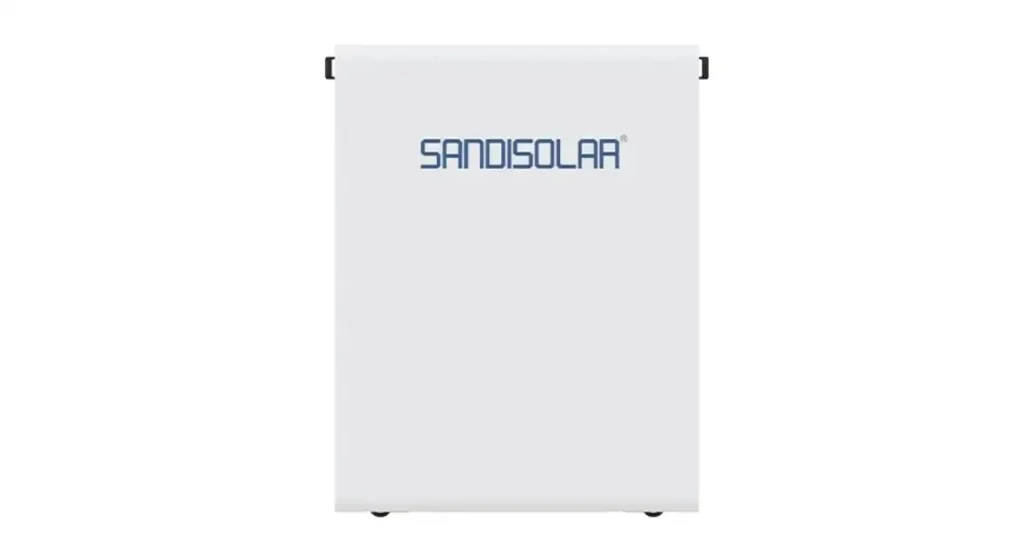
Households with high overnight storage needs will find the SANDISOLAR SD-51.2V 320Ah LiFePO4 battery to be a great choice, offering a nominal energy of 16.384kWh.
Not only Nominal Capacity but Usable Capacity too.
All of the energy that is scheduled for normal use is not nominal capacity. The battery, with an 80% depth of discharge, would provide about 13.1kWh of charge from a 16.384kWh battery, before losses from inverter and wiring.
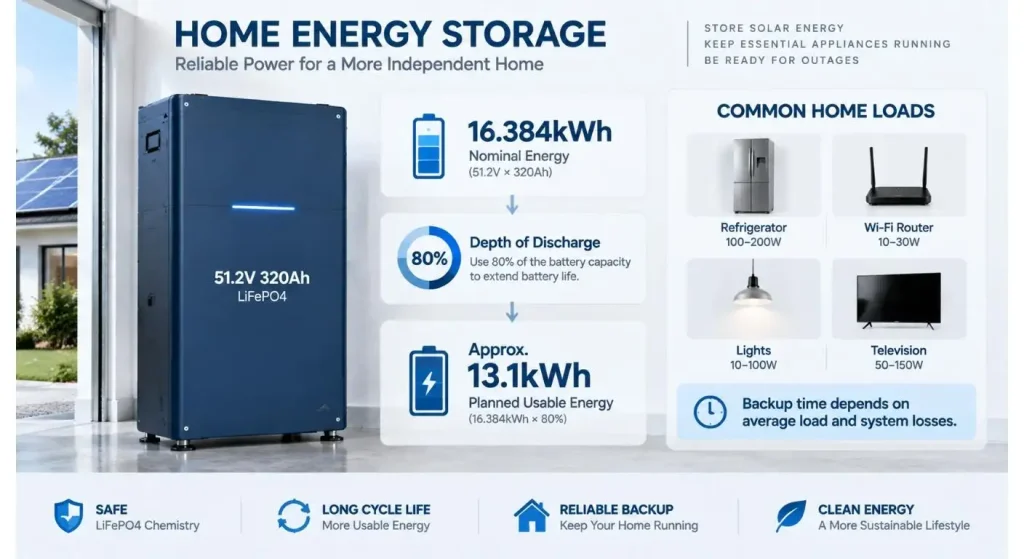
The usable-energy figure should be compared to the loads which have been selected as backups. The theoretical battery life is approximately 13 hours if all the essential devices require an average of 1kW, but this will vary depending on the temperature, changes in conversion loss and load.
| Average Essential Load | Approx. Runtime from 13.1kWh* | Typical Load Combination |
| 0.5kW | 26.2 hours | Lights, router, refrigerator |
| 1.0kW | 13.1 hours | Essentials plus fans and electronics |
| 1.5kW | 8.7 hours | Multiple household circuits |
| 2.0kW | 6.5 hours | Heavier backup demand |
How LiFePO4 is Ideal for Home Energy Storage.
A combination of thermal stability, long cycle life and relatively low maintenance, LiFePO4 chemistry is available. These attributes are ideal for solar systems which are being charged during the day and discharged on a regular basis at night.
According to SANDISOLAR, the battery will last up to 6,000 cycles under their operating conditions. It has an intelligent BMS to defend over-charge, over discharge and overheating. Comparing other capacities will also find that the entire SANDISOLAR LiFePO4 battery line is available.
Use the voltage of the battery that is matched to the voltage of the inverter.
The voltage range of the battery and inverter have to be compatible. The battery shown is a nominal 51.2V battery with a working voltage range of 44.8V to 57.6V and is suited for storage applications with a suitable design of 48V class.
Just voltage compatibility isn't enough. Prior to installation, verify the charging voltage, maximum charging and discharging current, cable size and protection equipment and firmware support with the equipment supplier.
Always read the newspapers first to know what to buy (or not to buy).
Information of state-of-charge, voltage, temperature and protection should be exchanged between the BMS and the inverter. The SD-51.2V 320Ah battery is CAN, RS232 and RS485 compatible and will require the installer to determine the proper communication protocol, cable pinout and inverter setup.
With a proper communication the inverter will respect battery limits automatically. If not, the manual settings may have to be conservative; depending on the design of the system.
Determine the Purpose of the Battery
There are three different tasks that a home battery can do:
- Have solar energy for night time.
- Change peoples' consumption habits to lessen demand during expensive peak hours.
- Keep selected circuits on at times of power failures.
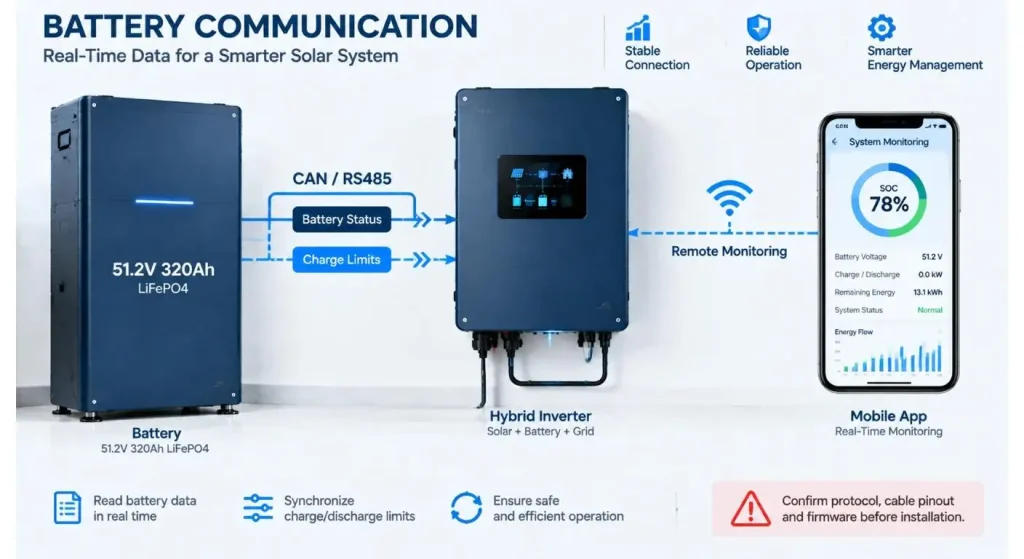
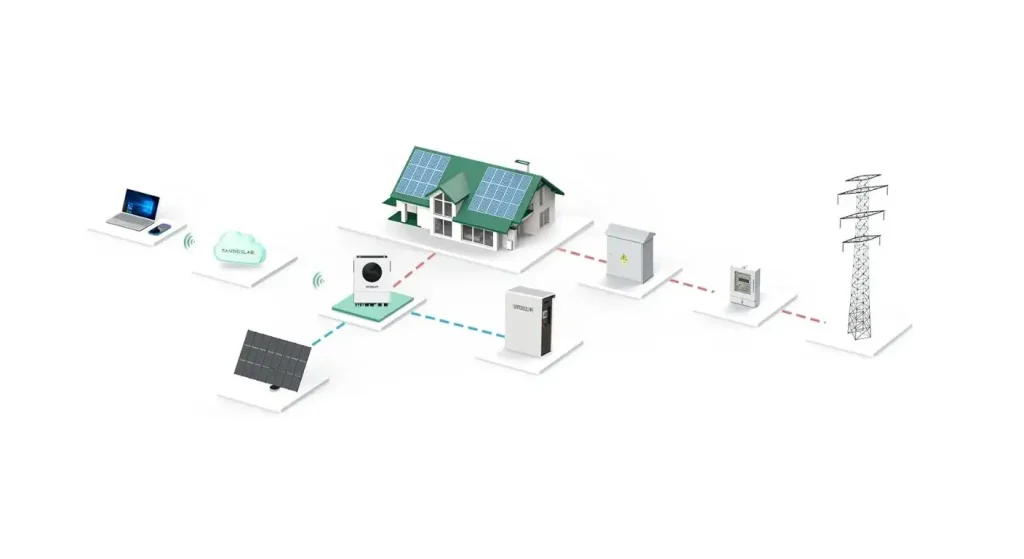
The capacity and control settings will vary for these goals. A homeowner who wants to generate power during the evening to power their home may not require as much reserve capacity as a homeowner who wants to be able to operate during an extended outage. The diagram below shows how the residential energy storage solution can be used to integrate solar generation, storage and domestic load.
| Compatibility Item | What to Confirm |
| Battery voltage | Inverter supports the 44.8–57.6V working range |
| Communication | CAN, RS485 or approved manual operation |
| Charge settings | Voltage and current follow battery limits |
| DC protection | Correct breaker, fuse and isolation rating |
| Data cable | Correct protocol and pin configuration |
Take Climate and Installation Conditions into account.
Place battery in a well-ventilated area within the manufacturer's recommended temperature limits. Keep away from direct sunlight and water, and do not block ventilation and keep away from combustible materials.
The floor/mounting surface must be able to hold the product securely. Installer MUST be qualified and installation MUST have the correct rated DC protection, Grounding and Accessible Isolation equipment.
Appraise monitoring and long term ownership
This should be apparent in a good home battery. The product featured in the photo is equipped with Wi-Fi and remote-monitoring features to enable users to keep track of its operation status and abnormal situations.
Warranty terms, documented operating limits and technical assistance and access to product information are also important factors for long-term value. If you are planning to commission, download the necessary manual(s) or technical documents at the SANDISOLAR download center.
Why choose SD-51.2V 320Ah Battery?
A powerful option for homes that need substantial overnight power storage or backup for a few critical circuits, this 16.384kWh LiFePO4 battery can be used. It has a 51.2V architecture, with an intelligent BMS and communication interfaces and remote monitoring for use in a professionally designed solar system.
For situations where electricity consumption is low at night, the capacity may be too large. The choice of capacity should be based on actual energy demand, required backup time, and proven inverter compatibility, not just the capacity itself.
Conclusion
Finding the most suitable home battery for a solar energy system is the battery that will be able to safely and efficiently achieve a defined energy goal. Determine usable energy and test critical loads and voltage, communication and charging needs prior to ordering.
For homes with a planned 13.1kWh of usable battery storage at 80% depth of discharge, the SANDISOLAR 51.2V 320Ah LiFePO4 battery is a viable high-capacity battery.
FAQ
Q1. 16.384kWh – is this a sufficient amount of energy for a house?
It can provide enough power for necessary loads for houses overnight in many houses. For real-life runtimes, refer to the consumption of the appliances, system losses and maximum depth of discharge.
Q2. Is it feasible to have this battery powering a whole house?
The battery has a certain capacity to store energy and the simultaneous appliance capacity is based primarily on the output of the inverter. Cooking, heating or cooling equipment with large loads may be needed for load management.
Q3. Are there any solar inverters with which it can work?
Not automatically. Check the compatibility of voltage, current limit, communication protocol, firmware before installing.
Q4. How much life can you expect from a LiFePO4 home battery?
The battery shown is rated for up to 6 000 cycles under certain conditions. Actual service life is affected by the temperature, discharge depth and charging practices.
Q5. Will the battery be functional during a loss of electrical power at the electrical grid?
Yes, if used in conjunction with an inverter that can output to the grid or provide back-up power. Back-up circuits and protection devices must be properly set up.


Contact Us
In This Article
Related Posts
C&I PV System Design: How to Plan Commercial Rooftop and Ground-Mounted Solar
October 30, 2026
What Is C&I Solar? A Guide to Commercial and Industrial Solar Systems and Examples
October 29, 2026
How to Become a SANDISOLAR Solar Distributor in Poland and Develop Your Storage Business
October 28, 2026