
Can a Hybrid Inverter Cut Bills? A 2026 Net Metering Guide
By hqt
2026.01.15Related Posts
48V 6kW Off Grid Inverter: Why 48V Battery Systems Are Common for Higher-Power Solar Systems
August 31, 2026

Residential Solar System Installation: Technical Sizing, System Matching and Installation Guide
August 31, 2026

48 Volt Inverter for Solar Battery Storage: Key Specifications Buyers Should Compare
August 27, 2026
Across residential and light-commercial sites, the question for 2026 is simple: will a Hybrid Inverter meaningfully reduce monthly electricity costs while staying compliant with evolving net metering rules? The answer is yes - if the system is sized correctly, dispatch is tuned to your tariff, and export behavior aligns with local policy. From a manufacturer's standpoint, the path to savings is practical: maximize self-consumption, time-shift into peak windows, and keep grid interaction safe and predictable.
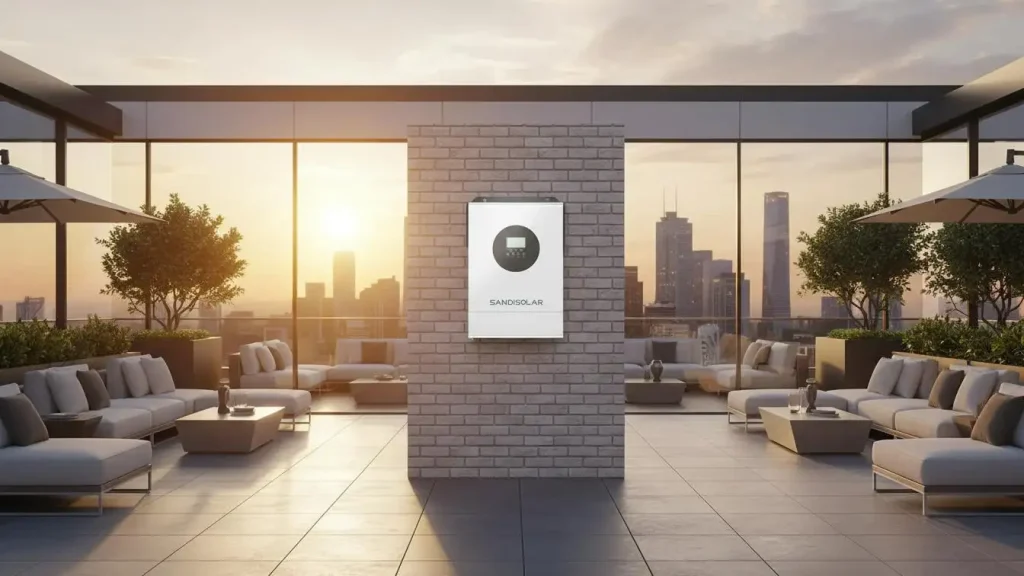
What a Solar Inverter Actually Does
A solar inverter converts direct current from PV modules into clean, synchronized AC power for everyday loads. Modern designs monitor voltage and irradiance to run maximum power point tracking (MPPT), squeezing out extra energy under fast-changing weather. Robust units deliver a pure sine wave with low harmonic distortion and protect the site with fast surge response, anti-islanding, and fault detection. If batteries are present, the inverter manages charge and discharge profiles, cooperates with a battery management system (BMS), and can prioritize essential circuits so critical equipment remains powered when the grid misbehaves.
- What "Hybrid" Adds
A Hybrid Solar Inverter integrates the PV conversion, battery interface, and intelligent control into one platform so you don't need separate chargers, transfer switches, and export limiters. In practice, "hybrid" enables three things:
•Storage integration for time-of-use arbitrage and backup
•Flexible source selection across PV, battery, utility, or generator
•Export control to meet zero-export mandates or cap backfeed at defined limits
The Hybrid Inverter becomes the coordinator: it reads PV output, battery state of charge, and tariff schedules, then decides whether to self-consume, store, export, or hold reserve capacity for resilience.
Where Savings Come From in 2026
Net metering policies vary, but the core mechanics are consistent. You save by consuming your solar generation on site at the retail rate you would otherwise pay, and you earn credits for energy exported to the grid when allowed. Where credits are close to retail, daytime export remains valuable. Where credits are lower or capped, it pays to push self-consumption higher and shift a slice of midday surplus into evening peaks.
Consider a straightforward scenario:
•A 6.2 kW array with around 5 peak sun hours produces roughly 31 kWh on a good day.
•Suppose you directly self-consume 20 kWh during solar hours at a retail tariff of $0.22/kWh for a $4.40 daily reduction.
•Without storage, the remaining 11 kWh would be exported; at an $0.08/kWh credit, that's $0.88.
If you add a battery and store 10 kWh of the midday surplus, you export just 1 kWh ($0.08) and discharge those 10 kWh during a $0.30/kWh evening peak.
• The battery avoids $3.00 of peak purchases but forfeits $0.80 of export credits, netting an extra $2.20 over simple export.
• Total daily benefit becomes $4.40 (self-consumption) + $0.08 (export) + $2.20 (storage) = $6.68.
• Across 300 productive days, that's about $2,004 before any demand charge mitigation or outage avoidance is counted.
Actual results depend on your load shape, weather, and local rules, but the levers stay the same: align consumption with solar hours, and use storage to bridge into peak periods.
- Industry Pain Points We Solve
Facilities encounter three recurring issues:
•Tariff complexity: time-of-use timing, demand charges, and tiered structures make payback calculations unclear.
•Export limitations: zero-export mandates or low feed-in rates reduce the value of daytime generation.
•Grid instability: sags, swells, frequency variations, and outages interrupt operations.
A properly set Hybrid Inverter addresses these with export limiting, fast transfer for backup, and tariff-driven intelligent dispatch. Even in markets with strict net metering, battery-less daytime assistance with storage added later can achieve savings without complicated upgrades.
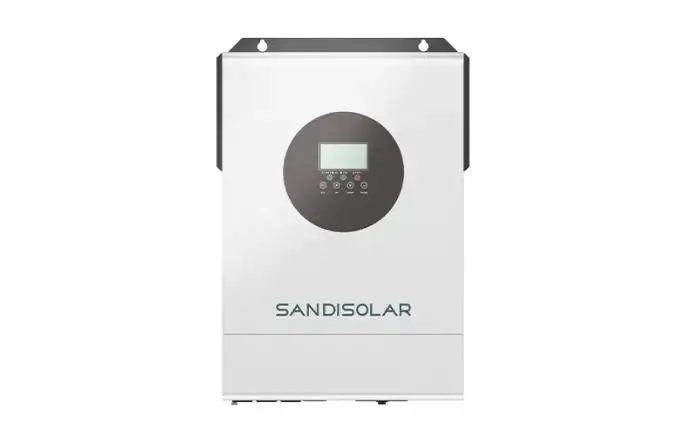
SANDISOLAR Converts Design into Payback
The Hybrid Inverter targets bill reduction, uptime, and safe interconnection with:
•6.2 kW pure sine wave output to lower losses and extend equipment life.
•120 A MPPT to capture high-irradiance peaks, minimizing clipping and boosting yield consistency.
•500 V DC PV input to simplify arrays, reduce BOS materials, and expand the efficiency sweet spot.
Outcomes you can measure - savings you can bank.
•Battery-less operation lets sites begin saving immediately by feeding daytime loads directly from PV; storage can be added later on the same platform.
•LiFePO4 compatibility via RS485 ensures precise BMS communication for accurate state-of-charge reporting and optimized cycle life.
•Lithium battery activation from PV or utility power supports safe commissioning and recovery at remote or outage-prone locations.
•Built-in Wi-Fi provides real-time insight into generation, consumption, and idle loads, making it easy to shift flexible demand into solar windows.
•Service-friendly dust protection helps maintain cooling pathways and stable efficiency in harsh environments.
•Parallel scalability up to 12 units enables single-phase or three-phase builds for homes, small commercial sites, ranches, and island microgrids, with redundancy and high motor start capability.

Dispatch Modes That Match Your Site
One size rarely fits all. SANDISOLAR's Hybrid Inverter supports configurations that track real-world constraints.
•Battery-less PV assist: For capital-sensitive projects, daytime loads are supplied directly from PV. Essential loads can be prioritized to uphold zero-export limits while maximizing on-site utilization.
•Self-consumption with LiFePO4 storage: When evening tariffs are steep, storage shifts energy into those expensive windows. RS485 BMS control keeps charging precise and cycle life extended, with discharge aligned to tariff windows.
•Parallel, single- or three-phase: Connecting units in parallel on a common bus raises power capacity, improves resilience, and can help shave demand charges by smoothing brief surges from motors and compressors.
- Compliance and Safety Across Markets
Interconnection and safety frameworks vary by region and utility. In 2026, utilities will reference standards such as IEEE 1547-2018 and UL 1741 SB in the United States, EN 50549 or G98/G99 in Europe and the UK, and AS/NZS 4777.2 in Australia.
A compliant Hybrid Inverter will implement anti-islanding, export limiting, voltage/frequency ride-through as required, and appropriate arc-fault and residual current protection where applicable. Approvals often require documentation of settings, one-line diagrams, and sometimes witness testing. SANDISOLAR supports configuration profiles for major markets and provides guidance to streamline applications so sites get permission to operate without surprises.
A Roadmap to Lower Bills
Start with the numbers, then let the controls do the work:
•Audit your tariff: Gather 12 months of bills, tag peak windows, note demand charges, and record average rates by period.
•Size PV for daytime use first. A 6.2 kW system delivering ~31 kWh/day covers routine daytime demand before you chase exports.
•Add LiFePO4 if rates say so. When peak tariffs outpace off-peak or credits are low, 8 - 12 kWh of storage can carry the evening and cut costs. Even 8 - 12 kWh can be a meaningful lever.
•Configure modes: Enable zero-export if required, prioritize essential loads, and schedule discharge for peak periods. Keep a small reserve if backup is important.
•Plan for growth: Leave room to parallel units for expansion or three-phase needs. This protects the initial investment and supports future electrification.
Can a Hybrid Inverter Cut Your Bill?
Yes - when you use it to bend consumption toward solar hours and convert low-value exports into high-value peak avoidance. In forgiving net metering markets, credits help. In restrictive ones, self-consumption and smart storage carry the savings. A Hybrid Inverter amplifies both, while keeping grid interaction compliant and safe.
Call to Action
If you're navigating net metering changes, zero-export rules, or volatile time-of-use pricing, SANDISOLAR can map a configuration to your tariff and your site. Ask our team for a bill analysis, a proposal that matches your load profile, and a compliance review for your utility. Start with battery-less PV assist, add storage when the economics say "go," and scale to three-phase on the same proven Hybrid Inverter platform. Reliable savings, flexible operation, and safe integration - delivered in a system that's built for 2026 and beyond.


Contact Us
In This Article
Related Posts
48V 6kW Off Grid Inverter: Why 48V Battery Systems Are Common for Higher-Power Solar Systems
August 31, 2026
Residential Solar System Installation: Technical Sizing, System Matching and Installation Guide
August 31, 2026
48 Volt Inverter for Solar Battery Storage: Key Specifications Buyers Should Compare
August 27, 2026